
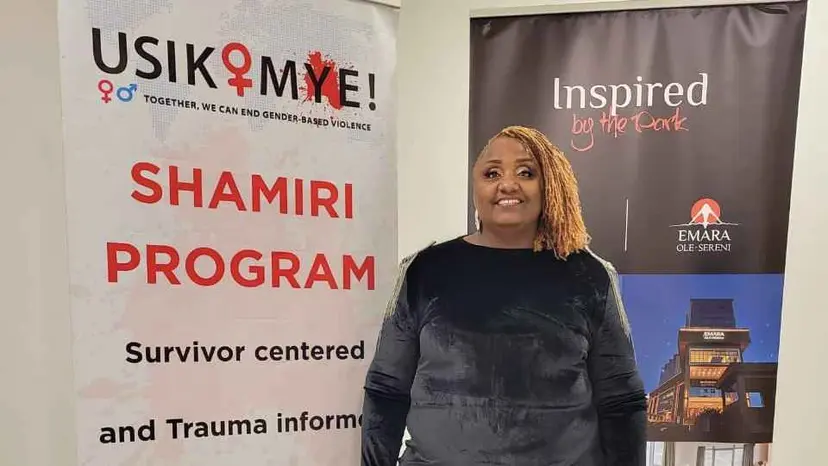
Njeri wa Migwi is a Kenyan human rights defender and intersectional feminist. She is the founder and CEO of the Usikimye Organisation.
The organisation combats sexual and gender-based violence (SGBV). Migwi has recently been the subject of significant attention across social media over unconfirmed reports circulating online that have placed the activist, known for her tireless work, firmly in the spotlight.
A Life Forged in Pain
Migwi’s path to activism is deeply personal. She was born and raised in Kariobangi, Nairobi. Her parents divorced when she was young, and she grew up with her father.
She married at a very tender age. She was still a minor. Migwi endured physical abuse for 15 years in that marriage. According to her past relations, she was kicked, punched, shoved, and struck with objects.
ALSO READ: Understanding Gender-Based Violence: Causes, Forms, and Global Support Centres for Survivors
This abuse caused her partial hearing loss. She left a luxurious five-bedroom house and her own BMW SUV. She chose to walk away and start life afresh with nothing.

“My pain has fuelled her activism, and she is determined to never let another woman go through what she experienced on her watch,” she stated in a past interview.
She began by working from a single rented room in Nairobi. She hawked tomatoes and worked as an interior designer. Activism quickly became more urgent than interior design.
Launching Usikimye
In 2019, she founded Usikimye, which means "Don’t Be Silent". The goal was to provide a rescue and care centre for SGBV survivors.
Her first rescue case involved a woman who had reported her husband but had nowhere safe to stay.
Initially, Migwi hosted three women survivors in her own home. This experience showed her the need for a dedicated haven. The well-guarded shelter was later established in March of last year, coinciding with a spike in GBV cases due to the COVID-19 pandemic.
The main shelter hosts women and their children for 90 days.

Rescues, Training, and Statistics
Usikimye provides comprehensive support. Survivors receive therapy sessions, including yoga and dance. They are also equipped with skills.
This training includes financial literacy, basic economics, and learning to make pottery. Usikimye runs three safe houses today. Two are for women and children, and one is for men.
The organisation has made a significant impact since 2020. They have rescued 9,821 women and girls. They have also rescued 80 men and boys from abusive situations.
Furthermore, Usikimye’s 24/7 hotline receives over 150 daily calls. The organisation estimates that one in three Kenyan women will suffer GBV in their lifetime.
“We’re building more than services—we’re building a movement for justice, healing, and dignity. Usikimye exists because no one should suffer in silence,” she said.
Leading the Fight Against Femicide
Migwi is also known for advocating for systemic change. In January 2024, she helped organise nationwide anti-femicide demonstrations.

Usikimye runs the Femicide Accountability and Community Empowerment (FACE) programme. This programme demands that femicide be legally recognised as a distinct crime in Kenya.
The situation is described as dire. At least 170 women were killed in 2024 alone.
Acclaim for Advocacy
Migwi’s efforts have earned her several major accolades. She was named CEO of the Year at the East Africa Women of Excellence Awards in 2024.
She also received the Human Rights Champion Award at the Diar Awards in 2023. She was also named Person of the Year by The Star Newspaper in 2020.