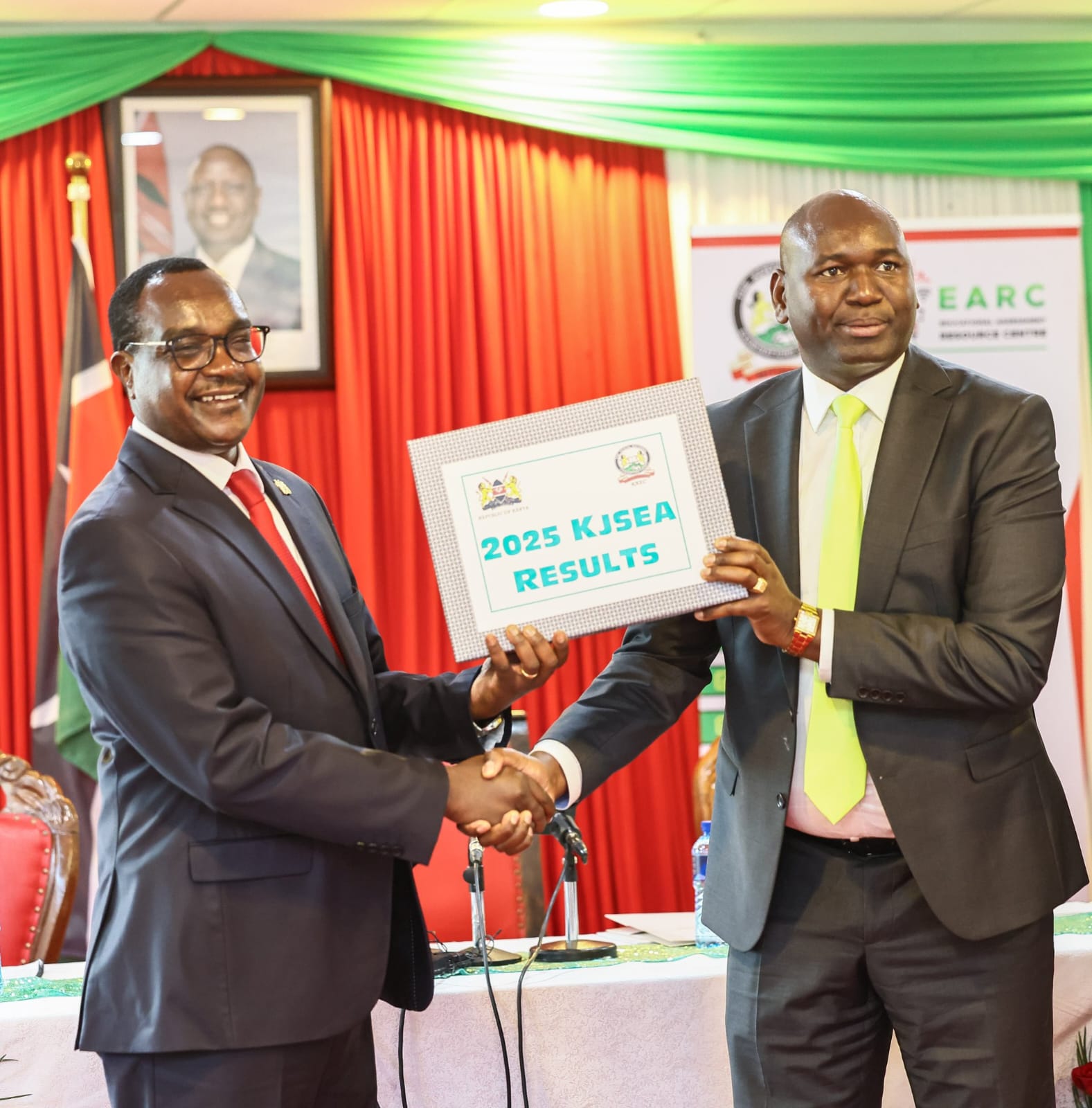
 Education Cabinet Secretary Julius Ogamba receives 2025 KJSEA results from Basic Education Principal Secretary Julius Bitok at KNEC's Mitihani House, December 11, 2025. /X
The release of the inaugural Kenya Junior School Education Assessment results on Thursday left most parents confused as many are still struggling to make sense of the new grading system used by the Kenya National Examination Council to rank their children's performamce.
"Sasa huyu wangu amewekewa E mbili na point saba, inaamaanisha amenguka vibaya sana ama nini? But nashangaa amendikiwa 'well done'. Well done vitu gani na amepata E, tena mbili?" one parent quipped.
The hilarious comment sparked debate on social media with many parents echoeing her sentiments saying they really do not understand what those grades mean.
While releasing the results at KNEC headquarters on Thursday, Education Cabinet Secretary Julius Ogamba akcnowledged the complexity of the new grading system, saying it uses a two-tiered metric.
He said the grading system uses performance levels of Exceeding Expectation, Meeting Expectation, Approaching Expectation and Below Expectation.
Below each level, there is an eight-point scale used to gauge how learners fared in each of the 12 assessed learning areas.
"Reporting of KJSEA has thus been done from point 1 to point 8, where point 8 is the best at Exceeding Expectation 1 and point 1 is the least at Below Expectation 2," Ogamba explained.
"The creation of these bands serves to distinguish exemplary performance from good performance," the CS emphasised.
It is important to note that the final KJSEA results were based on three different evaluation levels.
The first 20 per cent was from the Kenya Primary School Education Assessment (KPSEA) done in Grade 6 in 2022.
The second 20 per cent was from school-based assessment done in Grade 7 and 8 in 2023 and 2024 respectively.
The final 60 per cent is what candidates attained in KJSEA in Grade 9, conducted between October 27 and November 3, 2025.
So, how is it determined that a child has either exceeded expectation or performed below expectation.
The answer to this is arrived at by adding all the marks they scored at all three assessment levels listed above.
The ranking of the outcome is then measured against a percentage metric from 1 per cent to 100 per cent.
EXCEEDING EXPECTATIONS (8EE1 TO 7EE2)
A child is considered to have exceeded expectation if they score between 90 per cent and 100 per cent either overall or per individual subject, known under CBE as Learning Area.
Such a child will get a result that reads 8EE1 - meaning they exceeded expectations (EE) by getting all the 8 points. This is remarked as Exceptional.
The 8 before the EE1 denotes the points attained.
The second tier is for scores between 75 and 89 per cent.
If a child exceeded expectations by scoring an overall mark of between 75 and 89 per cent, they are ranked 7EE2, remarked as Very Good.
MEETING EXPECTATION (6ME1 TO 5ME2)
Scores between 58 per cent to 74 per cent earn a learner 6 points, graded as 6ME1 and remarked as Fair.
Scores between 41 per cent to 57 per cent carry 5 points, graded as 5ME2 and remarked as Fair.
APPROACHING EXPECTATION (4AE1 TO 3AE2)
Scores of between 31 per cent to 40 per cent carry 4 points, graded as 4AE1, and remarked as You need Improvement.
Anything between 21 per cent to 39 per cent carry 3 points, graded as 3AE2, and remarked: Below Average.
BELOW EXPECTATION (2BE1 TO 1BE2)
A child is considered to have performed Below Expectation if they scored between 11 per cent and 20 per cent.
This result is graded as 2BE1, and remarked: Way below average.
If a learner scored between 1 per cent and 10 per cent, they are graded 1BE2 and remarked: Minimal.
In the 2025 KJSEA, learners were assessed across 12 learning areas but ranked in only nine based on whether one wrote Kenya Sign Language, Hindu or Islamic studies.
These are English (or Kenya Sign Language), Kiswahili, Mathematics, Integrated Science, Agriculture, Social Studies, Christina Religious Education (or Hindu, Islamic Studies), Creative Arts and Sports and Pretechnical Studies.
Overall, 75 per cent of all the 1,130,459 learners who were assessed performed at Approaching Expectation and above across all subjects.
However, Ogamba said only seven subjects recorded a higher proportion of learners performing at Meeting Expectation and Exceeding Expectation.
These were Hindu Religious Education (84.62 per cent); Integrated Science (61.77 per cent); Social Studies (58.56 per cent); Creative Arts and Sports (58.04 per cent); Kiswahili (57.98 per cent); Christian Religious Education (53.96 per cent) and Agriculture at 52.26 per cent.
Creative Arts and Sports registered the strongest performance with 96.84 per cent of candidates attaining Approaching Expectation and above.
Agriculture was the second-best performing learning area where 96.2 per cent of candidates registered similar performance, followed by Kiswahili at 93.11 per cent and Social Studies at 92.92 per cent.
"An Approaching Expectation grade is sufficient for learners to progress to Senior School pathways that require basic competencies in the subject areas," Ogamba said.
The placement exercise will start next week and is expected to be completed by December 20, 2025.
Schools have been categorised as C1, C2, C3 and C4, with C1 being the former national schools, C2 the former extra-county schools, C3 county schools and C4 subcounty schools.
Grade 10 learners will start reporting from January 12, 2026 across all the 9,540 Senior Schools available in the country.
The learners will be placed in either of the three pathways of Arts & Sports Science, Social Sciences or Science, Technology, Engineering, and Mathematics (STEM) based on their preferrence or KJSEA performance.
Commenting on the results, KNEC chief executive officer David Njengere said: "This is a landmark moment as the pioneer Grade 9 CBE cohort transitions to Senior School. For the first time, the Kenyan education system will be reporting on learners’ achievement using a rich array of data accumulated over a period of time, from both formative and summative assessments."