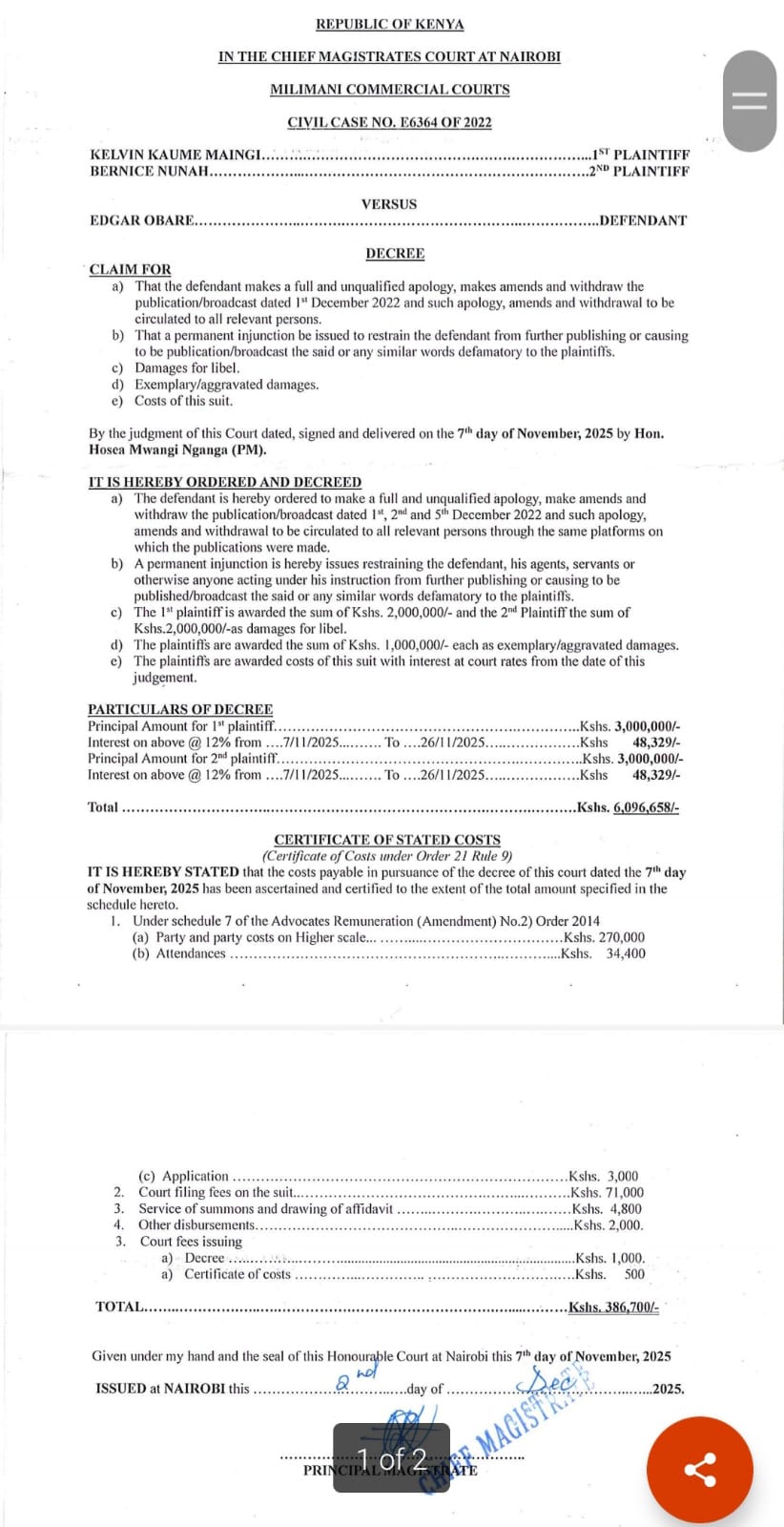
A Nairobi court has delivered a significant ruling in a high-profile defamation case, ordering blogger Edgar Obare to pay Sh6 million in damages and publicly apologise to model Bernice Nunah and co-plaintiff Kelvin Kaume Maingi over a defamatory post published in 2022.
The judgment, delivered on November 7, 2025, by Hon. Hosea Mwangi Nganga in Civil Case No. E6364 of 2022 highlights the growing legal risks associated with sharing defamatory content online.
According to the ruling, the plaintiffs were awarded Ksh4 million in general damages—split equally at Ksh2 million each—and an additional Ksh2 million in exemplary and aggravated damages, also shared equally at Ksh1 million each.
Beyond the financial compensation, Obare has been directed to issue a full and unconditional apology, correct and withdraw the defamatory publication dated December 22, 2022, and comply with a permanent injunction prohibiting him from making further defamatory statements about Nunah.
Nunah is a prominent personality in Kenya’s fashion and media industry, celebrated as a leading runway and commercial model. Her public profile rose even further when she became the second runner-up in the Miss World Kenya pageant for the 2019–2021 cycle.
She continues to build her personal brand as an entrepreneur and content creator, specialising in luxury lifestyle, travel, and fashion.
Obare, known for his digital reporting on Instagram, the BNN website, and Telegram, has previously faced numerous lawsuits over his publications. However, this ruling marks one of the rare cases that have resulted in a decisive victory against him. As of the time of publication, reports indicated that the blogger had appealed to his followers for financial support as he prepared to file what is presumed to be an appeal against the decision.
The outcome of the case sends a strong message to bloggers and online publishers about the serious legal consequences that accompany the dissemination of false or harmful allegations.

What the Law Says About Defamation in Kenya
Kenyan law treats defamation primarily as a civil matter, not a criminal one. While the Constitution strongly protects freedom of expression, this right does not extend to statements that unjustifiably damage another person’s reputation.
Following a 2017 High Court ruling that struck down the Penal Code provision criminalising defamation, civil remedies now form the backbone of defamation proceedings.
Under the Defamation Act, defamation can take the form of libel (written or published statements) or slander (spoken statements). A claimant must show that the statement was published to a third party, that it referred to them, and that it harmed their reputation. For libel, the claimant does not need to prove financial loss—the reputational damage alone is enough.

Courts also recognise key defences such as:
Truth – an absolute defence if the statement can be proven factual
Fair comment – protecting honest opinions made in good faith on matters of public interest
Qualified privilege – applying when a person has a legal, moral, or social duty to share information
However, online defamation is additionally governed by the Computer Misuse and Cybercrimes Act (CMCA) of 2018. Section 23 of the Act criminalises the intentional posting of false information likely to damage someone’s reputation. The penalties are severe: a fine of up to Ksh5 million, up to 10 years in prison, or both. As a result, the law effectively reinstates the possibility of imprisonment for reputational harm committed online.
Overall, Kenya’s legal framework makes it clear that digital creators and publishers must exercise caution when posting allegations, as the cost of getting it wrong—financially and legally—can be significant.