
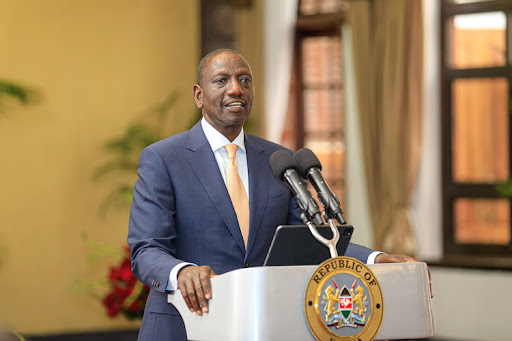
 President William Ruto/FILE
Impending vacancies at the Supreme Court have shone the spotlight on key agencies that face leadership transitions ahead of the 2027 general elections.
The leadership changes, which could also play out at institutions in the security sector, are argued could create both political opportunities and challenges for President William Ruto.
The impending transition at the Supreme Court represents perhaps the most consequential scenario, considering its crucial role in the country’s presidential election.
With Judge Ibrahim Mohammed and Deputy Chief Justice Philomena Mwilu approaching the end of their terms, the court's leadership will soon be in new hands.
Judge Ibrahim is proceeding on leave pending retirement on January 1, 2026, after attaining the constitutional age limit of 70. He was born in 1956.
His exit would also occasion a vacancy at the Judicial Service Commission, where he is currently a member representing the Supreme Court.
Justice Njoki Ndung’u has already taken over Judge Mohamed’s role of chairperson of the Judiciary Committee on Elections, a critical body for handling poll disputes.
Mwilu is turning 70 in April 2027, just months to the general election where President Ruto is keen on defending his seat for a second term.
She was appointed by President Uhuru Kenyatta in October 2016.
The process of enlisting their successors is like to trigger a fierce succession battle, with the President as a key player.
“There is the possibility of influencing the appointments. This is considering the fact that members of the Judicial Service Commission who vet nominees to the apex court are appointed by the head of the executive despite the nominations by the different sectors,” activist Suba Churchill observed.
The Judiciary is not a passive player in the electoral process, and has played a decisive role, most notably in the 2013, 2017 and 2022 presidential elections.
In 2017, in a historic move and the country’s first, it nullified President Uhuru Kenyatta’s election.
The court upheld Ruto’s election in 2022, denying the late Raila Odinga’s Azimio la Umoja side what they had deemed as their clearest chance to form government.
The memory of its judicial assertiveness and power likely remains fresh for an administration that may face contested elections in 2027.
Already, Chief Justice Martha Koome has publicly launched the 2027 elections operations plan, calling for legal reforms from Parliament.
Beyond the Judiciary, transitions within Kenya's security infrastructure present additional avenues for potential political consolidation.
Several key security positions are occupied by officials who could be replaced at the President's discretion.
The Inspector General of Police and DCI boss positions held by Douglas Kanja and Mohamed Amin, respectively, have raised particular interest.
This is given their potential influence over election security operations and the investigation of political figures.
Kanja was handed a four-year contract in September 2024, hence would be in office during the election period.
However, the President could ask him to resign, and he would get paid the attendant benefits.
A proposed law which seeks to provide that the Inspector General of Police retires at 60 could force his early exit.
The bill, albeit on ice in Parliament, proposes a retirement age of 60, which would affect the current IG, who is 62.
Amin has a contract expiring in October 2026, after which he can only serve at the pleasure of the President.
“Whether one has a contract or not, the President can ask them to leave anytime. He can as well retain them as he wishes,” security expert George Musamali said.
The National Cohesion and Integration Commission is simultaneously undergoing its own leadership transition.
The terms of chairperson Samuel Kobia and the cohesion agency's seven commissioners expired in November 2025.
The Interior Ministry has already gazetted the vacancies and constituted a selection panel to oversee the recruitment of new leadership.
The NCIC plays a crucial role in mitigating election-related violence and hate speech, and has been the guard against post-election conflict.
The commission was established following the 2007-2008 post-election violence that claimed over 1,300 lives.
Its effectiveness in curbing inflammatory rhetoric directly impacts election stability.
President Ruto faces significant political pressure, with widespread youth-led protests over economic challenges and corruption.
The administration may view control over key institutions as essential for maintaining stability and securing its political future.
The reconstitution of the Independent Electoral and Boundaries Commission also marked another crucial transition.
In July 2025, the President approved and swore in new electoral officials led by chairperson Erastus Ethekon, ending the inordinate wait.
The new commissioners will serve six-year terms, meaning they will oversee the 2027 general elections.
Their appointment process raised questions about potential political influence by the President and his ODM allies.
The Kenya Defence Forces, which is also a centre of focus, may not see many changes in the transition as all force commanders are on a proper contract.
With the transitions in play, the administration has an opportunity to reshape the institutional landscape in ways that could extend political influence.
Political scientists hold that institutional capture, where independent state institutions gradually come under executive control through strategic appointments, could play out.
The United Opposition has on many occasions lamented the use of state agencies to contain dissent and shut down critics.
DCP leader Rigathi Gachagua, during his US trip in August, claimed that the President had captured Parliament and compromised opposition voices.
These converging transitions present President Ruto with an unprecedented opportunity to reshape Kenya's institutional landscape.
By installing loyalists in the judiciary, IEBC, and security agencies, his administration could theoretically secure significant advantages ahead of the 2027 polls.
INSTANT ANALYSIS
The ultimate legacy of these appointments will be measured not by short-term political gains, but by whether the independence of these crucial bodies is preserved or eroded, thereby determining the integrity of the nation's future elections and the strength of its democratic foundations. However, the very potential for institutional capture poses a huge test for the country’s democracy.






