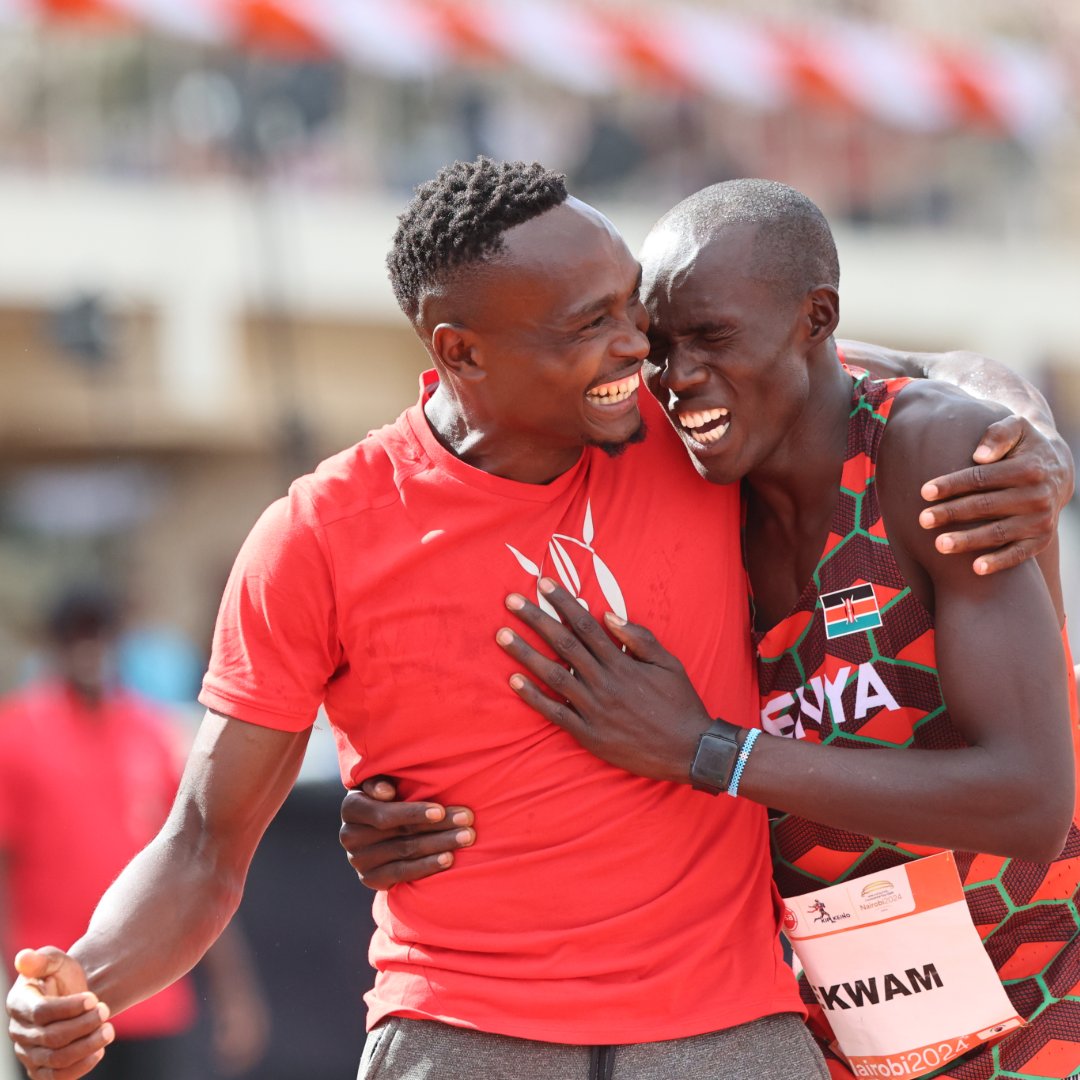
 KDF sprinters Boniface Mweresa and Zablon Ekwam/FILE
A big tide is sweeping through the country, a tide of youthful, energetic blood baying to put Kenya’s name among the continent’s sprinting top guns.
It is a tide no longer whispering at the edges of African sprinting, but roaring forward with the urgency of a new era and at the heart of this movement stands a man who saw the future long before the nation dared to believe.
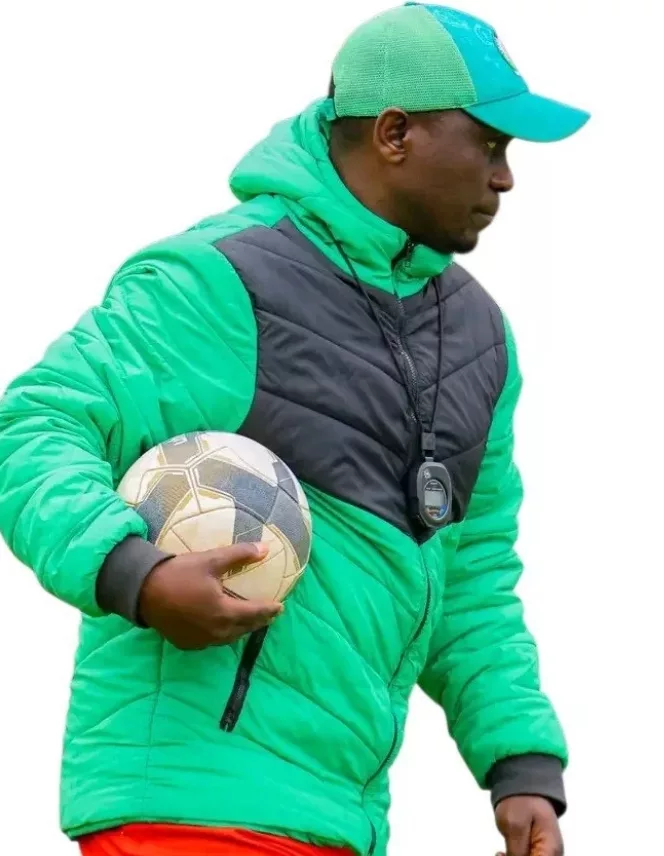
Kenya Defence Forces (KDF) sprints coach Vincent Mumo reckons the country is slowly becoming an African heavyweight, with the nation’s first major test expected to be the 2026 season.
Mumo believes Kenya is standing on the brink of a sprinting renaissance, one he has waited for, fought for and helped build from the ground up.
Mumo is arguably one of the country’s forefathers in matters of sprints, having opened up the floodgates for the newer generation of top sprinting talents.
His story is not just of medals won, but of pathways carved, barriers broken and a relentless belief that Kenya could sprint just as fiercely as it runs distance.
Born on August 3, 1982, Mumo was part of the Kenyan squad that clinched gold in the 4x400m men’s relay at the 2011 African Games in Maputo.
Alongside Anderson Mureta, Jonathan Kibet and Mark Mutai, the quartet stopped the clock in 3:03.10 to claim gold ahead of Nigeria (3:05.26) and Botswana (3:05.92).
Before the continental conquest, Mumo had helped his team, which consisted of Vincent Koskei, Mutegi and Mutai, to win silver at the 2010 Commonwealth Games in Delhi, India, clocking 3:03.84.
The quartet trailed Australia (3:03.30) and finished ahead of England (3:03.97), a result that proved Kenya could challenge sprinting superpowers even in their most guarded territories.
Having been among the older sprinters in Kenya, Mumo reckons the country is now entering a glory era.
“Sprints in Kenya are going on great, you can clearly see that the nation is heading the right way,” Mumo remarked.
He highlighted the glaring differences between his time and the current sprinting environment.
“In our time, sprinters were not much taken care of. Much focus was on distance races, leaving us sprinters on our own,” he observed.
“At the moment, you can even see the federation is doing a lot in matters of sprints, which is helping the event grow.”
One of the revolution's driving forces, Mumo believes, is none other than Africa's fastest man over 100m, Ferdinand Omanyala.
“Omanyala has inspired so many sprinters in the country. He is part of the reason more athletes are taking up the 100m," he said. “What he has been able to achieve has motivated a lot of young sprinters who are now slowly stepping up to the scene and that is very motivational.”
Omanyala made headlines in 2021 during the Kip Keino Classic World Continental Tour after posting a 9.77 for second place, the fastest time by an African, and just behind American Trayvon Bromell (9.76).
Omanyala’s defining moment on the 100m scene, however, came at the 2022 Birmingham Commonwealth Games when he clocked in 10.01 to claim gold.
He beat South Africa’s Akani Simbine (10.13) and Sri Lanka’s Yupun Abeykoon (10.14).
Mumo’s optimism stems from a strong display by Kenyan sprinters during the 2025 season, a season that announced Kenya’s sprinting intentions with thunderous clarity.
For the first time in history, Kenya fielded one of its largest contingents of sprinters to a global showdown at the World Championships in Tokyo in September.
It was not just history in the making, but a clear indication that the country was not only growing in sprints but a clear warning to continental sprint rivals.
In Tokyo, Kenya fielded 21 sprinters in both individual and relay events.
Omanyala (100m) headlined the individual event runners alongside Mercy Oketch (400m), Wiseman Were (400m hurdles) and the trio of Kelvin Kipkorir, Brian Tinega and George Mutinda in the men’s 400m.
In the team events, Kenya made history by qualifying the men’s 4x100m relay team for a global championship.
The 4x400m mixed and the men’s 4x400m relay events were also represented in Tokyo.
“This year has shown us that indeed we are ready to be counted among Africa’s best sprinting nations. We had more than three athletes running 44 seconds (over 400m) this year, something that has been hard to achieve in the past couple of years," Mumo observed.
“Our performance in Tokyo has also shown us that if nurtured, our athletes and teams can square off with the likes of Botswana and South Africa.”
Botswana and South Africa have long been considered the continent’s powerhouses, owing to the global medals their athletes have stacked over the years.
In Botswana, Letsile Tebogo shot to stardom at the 2024 Paris Olympic Games when he claimed silver in the 200m.
At the Tokyo World Championships, Botswana yet again dominated with Collen Kebinatshipi claiming the world 400m title, with the nation also running riot in the men’s 4x400m relay, clinching gold.
Meanwhile, South Africa has had some top-class sprinters on the global scene, including Wayde van Niekerk, 2016 Olympic 400m champion and World Indoor 60m bronze medallist.
In Tokyo, the men’s 4x400m squad clinched bronze. Mumo pointed to the two nations’ intensive preparations.
“After the World Relay Championships in Guangzhou, China, Botswana and South African athletes went into intensive camps to prepare for the Tokyo championship,” he said.
“They switched training bases and went to Europe. For us, after the World Relays, the team dispersed, and it was only after the trials for the world championships that the team went into camp.”
“Our athletes should have gone into camp early on to ensure they were prepared in advance for Tokyo.”
For a brighter 2026 season, Mumo says preparations should begin as early as now.
“We should start our preparations for 2026 now. If we want to have positive results next year, we should start sharpening our athletes early.”
The 2026 calendar is packed with global races, starting with the World Relays set for May 2-3 in Gaborone, Botswana.
Then the Commonwealth Games, set for July 23-August 2 in Glasgow, Scotland.
For the relays, Mumo says the teams should get into camp early to develop chemistry.
“We have the Betika championships, which we can leverage to help our relay teams get sharper for next year. The country seems to have forgotten that the Relay is an event that can win Kenya global medals just like at the 1972 Olympics," he said.
At the 1972 Olympic Games in Munich, the quartet of Julius Sang, Charles Asati, Munyoro Nyamau and Robert Ouko won Kenya’s first-ever gold medal in the men’s 4x400m event at the Summer Games.
“If we are to go to the championships and dominate, we need to start early preparations, including sending them to camp early. We are not the USA or Jamaica, who have good sprint development systems and athletes don’t necessarily have to train together," he reckoned.
In addition, Mumo wants the athletes to put maximum effort into their individual training in the hunt for tickets to the Club Games.
“Athletes should ensure they maximise their time well next season. They should chase the Commonwealth qualification times when the season kicks off,” he advised.
Mumo is already preparing KDF athletes for the 2026 season.
“We have already started preparing our athletes for next season with a focus on the national championships. We have top athletes, like Meshack Babu, Steve Odhiambo and Samuel Chege. I believe they will be the athletes to watch next season," he teased.
Babu and Odhiambo represented Kenya in the 4x100m men’s relay at the Tokyo World Championships.
Babu is also the 2024 national 100m champion.
Also under Mumo's wings is the 2019 African 400m hurdles champion Vanice Kerubo.
The veteran coach observed that the emergence of sprint clubs like Utawala Sprints Club has helped elevate the status of short races.
“Clubs like Utawala are good because they are helping build sprints in Kenya; they are the reason the events have grown. We allow our athletes, like Babu, to train with such clubs so that they may sharpen themselves," he said.
Mumo’s interest in sprinting started while still in school.
“My journey in sprints began way back. I used to do the 400m hurdles while in Form Three and I remember representing Kenya at the 1999 U-17 championships in Poland," said Mumo.
In Poland, Mumo secured a bronze medal in 51.50 behind South African Marthinus Kritzinger (49.86) and Cuba’s Sergio Hierrezuelo (49.95).
However, after completing his Kenya Certificate of Secondary Education (KCSE), Mumo almost ventured into distance running.
“If I had not joined the KDF, I think at the moment I would be a marathoner because after my KCSE, I started doing distance running, the half marathon, cross country and road races. I think I would have gone all the way up to the marathon,” he said.
It was after joining the KDF that he put a sharper focus on sprinting and went on to represent Kenya in continental and global events.
In 2003, Mumo represented Kenya at the World Championships in Paris but failed to go past the 400m heats.
The following year, he was at the Olympic Games in Greece, once again failing to advance past the 400m heats.
In 2008, he competed at the Beijing Olympics, yet again failing to go past the heats.
The hallmark of his career was the African Games silver medal in 2011 and the 2010 silver medal at the Commonwealth Games.
“In 2010, we won silver at the Commonwealth Games, which inspired us, and we believed that if we could win a medal at such a tournament, then we could win gold at the African Games, which we did," he said.
Mumo believes the key to the performance was due to the team’s chemistry and maturity.
“Our team was mature and we had sober minds. We trained together, unlike now, where athletes have different coaches and training programmes,” he observed.
After hanging up his spikes, Mumo recalls how he was instrumental in shaping the careers of the late Nicholas Bett and Boniface Mucheru on the 400m hurdles stage.
“In 2014, before I retired, a manager from Europe approached me and told me that Kenya has got top talent in sprints. He asked me to connect him with Bett and Mucheru, which I did," he revealed.
“I was already getting old on the track, so I decided to help the manager because he had a project to uplift the level of Kenyan sprints.”
“I remember in 2015, before Bett won the world title, (in Beijing), he had done some races in Europe which had sharpened him. Mucheru finished fifth in Beijing, but the following year, he won silver in Rio.”
Bett won the 2015 world 400m hurdles title in Beijing, clocking 47.79, while Mucheru was an Olympic silver medallist from Rio 2016, clocking 47.78.
Mumo is confident Kenya will field a bigger contingent of sprinters at the 2028 Los Angeles Olympic Games.
“As we prepare our athletes, our main focus should be on the 2028 Olympic Games. We have already shown potential and we should keep up that same fire on the global scene," he said. “In LA 2028, we will have a very big contingent of sprinters because our athletes are fired up.”