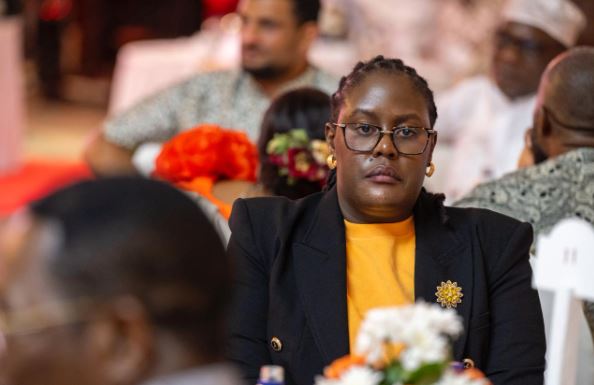
EALA MP Winnie Odinga has stormed into the heart of Kenya’s national political conversation, capturing attention with fiery speeches and bold accusations.
Winnie’s recent remarks in Mombasa have both unsettled and energized the Orange Democratic Movement (ODM).
Her remarks during the ODM@20 celebrations on Friday have provoked intense debate and drawn sharp reactions across the political divide.
Winnie, the youngest daughter of the late former Prime Minister Raila Odinga, stood before supporters and party leaders and unleashed a critique of what she sees as creeping betrayal within the ODM ranks.
The event, laden with emotion due to Raila’s recent passing, became the stage on which the 35-year-old demanded accountability and fidelity to her father’s political ideals.
She claimed that a section of ODM leaders were holding secret meetings “in boardrooms and bedrooms” to negotiate the party’s future and possibly “sell ODM” at a time when it remains divided over whether to continue its cooperation with President William Ruto’s administration or adopt a bolder, independent stance ahead of the 2027 general elections.
“ODM is not a party that was secretly birthed,” she declared defiantly.
“Some of us are walking with us during the day, but at night are hatching plans to sell our party. That will not be possible. The party was not born in a boardroom. It was not made in a bedroom, and its future will not be discussed as pillow talk. It was born out of protest, made in resistance, and the people of ODM have bled time and again and shed tears for this country.”
Her words—delivered with the trademark Raila resolve long associated with her father—sent shockwaves through the gathering.
Some saw in her speech the unmistakable signs of a young leader stepping into the vacuum left by Raila.
Others viewed it as overreach from someone who is not a party official and has yet to earn political grounding.
Indeed, suggestions have already emerged that Winnie is positioning herself to inherit Raila’s political empire, whether or not she acknowledges it.
ODM Party Leader Dr. Oburu Oginga, Raila’s elder brother, sought to cool rising temperatures following Winnie’s call for the convening of a National Delegates Conference (NDC) to redefine ODM’s relationship with the government.
Oburu diplomatically dismissed her proposal in public but noted that he would hold a private discussion with her to address the issues she raised.
This measured response reflected the delicate balancing act ODM leaders now face: showing respect to Raila’s daughter while maintaining control of a party struggling to navigate a post-Raila reality.
Winnie’s speech was met with both praise and intense criticism.
Kileleshwa MCA Robert Alai publicly chastised senior leaders for “allowing Winnie to lecture them,” calling the young MP inexperienced and unqualified to direct party affairs.
“Winnie Odinga doesn’t have the political experience to give anyone direction in ODM. She isn’t even a party official,” Alai remarked, questioning how seasoned politicians could sit back as she issued what he termed political admonitions.
However, those critical of Winnie were immediately countered by her defenders—chief among them Saboti MP Caleb Amisi, who issued a strongly worded statement condemning what he termed “Ruto-sponsored ODM nincompoops” attacking Raila’s daughter.
Amisi described Winnie as a true heir of Raila’s political spirit; someone who had endured teargas, political hostility, and personal sacrifice alongside her father.
“Winnie Odinga has been the pillar of her father; Baba died in her hands. I have seen her endure teargas and shield the father from political mandarins,” he said.
According to Amisi, those attacking her had never believed in Raila’s ideals and were now revealing their intentions to weaken the party.
“These ODM sell-outs only show how Baba was surrounded with parasites and not disciples,” he said, insisting that Raila’s political vision would endure through individuals like Winnie.
Beyond the personal attacks and counterattacks, the ODM@20 event laid bare a deeper ideological struggle within the party.
Siaya Governor James Orengo—one of ODM’s most respected stalwarts—used the platform to criticise the party’s ongoing collaboration with the Kenya Kwanza administration.
He described the cooperation as “cowardly” and warned against any attempts to weaken ODM by aligning too closely with President Ruto.
“We want an accountable government,” Orengo said. “Ruto needs ODM; it’s not ODM that needs Ruto. There are people in the party behaving as if ODM is the one that needs Ruto. It’s Ruto that needs ODM because he has been unable to deliver.”
He welcomed Oburu’s assurance that ODM would not be “swallowed,” emphasising that the party must preserve its identity and legacy.
The storm that Winnie triggered in Mombasa is a testament to the influence she already wields—and the political gap she appears poised to fill following her father’s death.
Her boldness, youthful energy, and emotional connection to Raila’s legacy have combined to make her a magnetic but polarising figure.
To her supporters, she represents continuity, courage, and a refusal to compromise the ideals that defined the ODM movement.
To her critics, she is inexperienced, fiery to a fault, and untested for the heavy mantle they believe she is prematurely trying to carry.
Winnie’s voice, convictions, and style—sharp, unapologetic, and emotionally charged—have forced ODM and the nation to confront difficult questions about leadership, loyalty, and the future direction of one of Kenya’s most influential political parties.