Today is commemorated on all continents with prayers for those who have departed this earthly abode.
As much as it is a taboo in many cultures, saying so is frowned upon, yet it is a fate that awaits us all. The lucky few will have their graves visited by family and friends, dedicate a prayer, who will then light candles and lay beautiful flowers, which too will burn out and wither away.
This day’s origins and purpose have been lost in many countries, and in the US, for example, it has been transformed into an irreverent fun day called Halloween, filled with pranks and bizarre costumes.
But equally, very few observe this special day in Kenya. In fact, public cemeteries are forlorn and in a decrepit state. The main cemetery in Nairobi, in Langata, paints a sorry picture. Not that long ago, it was mainly the domain of warthogs from across the Nairobi National Park, which did no harm, as they happily pranced around. No more of them ever since a dual carriage road was constructed in between.
Personally, I have many friends who have their last repose over here. I was aghast to discover that some of their graves had mysteriously “disappeared” and other new ones with different names had supplanted them.
Those that were still there had their crosses toppled over, statues burst to smithereens, and the marble covers severely cracked and crumbled. My mind went into overdrive as I imagined hooded vandals having a field day, or rather night, doing these dastardly deeds.
Maybe they held a grudge against crosses and what they represented? However, I decided to stay my horses before jumping into the myriad theories that flooded my mind.
Instead, I decided to calm down and make a judicious investigation of what I was witnessing. I concocted a plan to stalk out the premises for several nail-biting 24-hour vigils. What I saw was with my very own eyes was totally unexpected and confounding. Nothing had prepared me for what transpired.
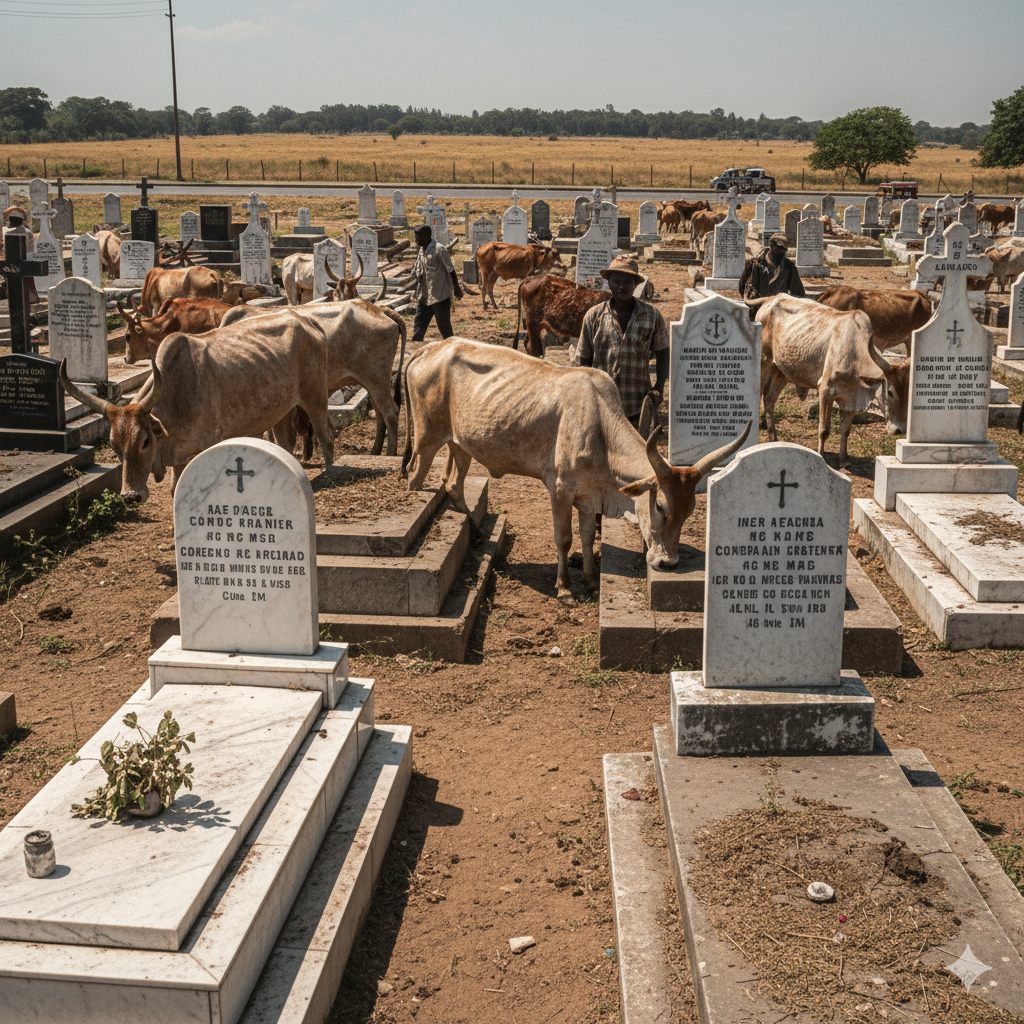
Several young men descended with innumerable cattle. They herded them all over the cemetery. These cows and bulls scratched their tick infested behinds on crosses and statues, making them tumble down.
The older graves caved in under their hooves. Utter havoc, and all within the limited time I was there. I surreptitiously took photographs of the ensuing mayhem until my lens focused on one of the men glaring menacingly straight at me. Then and there, I surmised that I should beat a hasty retreat, not wanting to find a premature final resting place among the debris.
How did they get into the cemetery? Easy, as the chain-link fence had long ago been stolen, leaving the whole place unguarded. What’s worse, the authorities of the compound shirked not only this but all their other responsibilities. For one, they let go of any semblance of organisation.
Obviously, no one here had any idea of how such a reverent piece of land should be managed, as the very concept was alien to them. In their defence, I can add that in Europe, only in the XVIII Century did the codified layout become accepted, as attested by Phillipe Aries in his book “Homme Devant La Morte” (“Man and Death”).
Here, in Langata, they allowed for graves to be inserted between older ones, and the whole place is in a complete disarray. There were no discernible alleys, with some recent graves dug into what were previously storm drains.
Most of the destroyed graves belonged to two communities: European and Goan. It had become a norm for most local communities to bury their dead not in cities like Nairobi, but back in their rural areas, from which the majority of current town dwellers originated.
Even this was mostly a historically new custom, borrowed from distant lands. To begin with, most tribes in Kenya did not bury their dead but left them on the savanna to be devoured by scavengers like hyenas and vultures.
This was very much like the Sky Burials in Asia’s mountains, where huge, winged birds tore pieces of flesh from bodies deposited in open towers, before flying off with them.
One community, in the then Kenya Colony, living in forested areas, relied on leopards to dispose of carcasses. Sometimes heart-rending screams tore the stillness of nights as some of those discarded had been mortally ill but still alive and were being mauled bit by bit, limb by limb. This is attested by many biographies and autobiographies about the period, one such being “Lost Lion of Empire” by Edward Paice.
The case is that not all people have any ancestral ground in the countryside. So where are Goans and Europeans to be buried in Kenya? With the prevalent desecration of the hallowed remains of their dear ones currently both communities currently often opt for cremation.
In some instances, bones are excavated, relocated and reburied in distant continents. Yet African Kenyans, who, for example, are buried in Europe or America, have their graves protected by law.
Death is the ultimate equaliser. Isn’t it high time the same respect was accorded to all, regardless of who they are, but reside and die in Kenya?