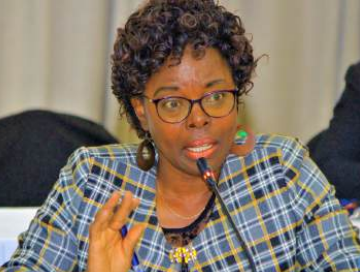
Governors are demanding the full devolution of the education function, following their ongoing standoff with Controller of Budget Margaret Nyakang’o over the management of bursary funds.
The push came a day after county chiefs held a meeting with Nyakang’o in an attempt to regain control of the bursaries.
However, the CoB maintained that her February circular—which effectively barred counties from administering bursary funds for secondary schools and universities—remains in force.
“The requirements are still the same as per my circular of January 2025. Counties must submit a valid intergovernmental agreement,” Nyakang’o told the Star.
She clarified that even with a valid agreement, bursaries for secondary and university students should only be funded by the national government.
“The funds for secondary and university bursaries should come from the national government. Bursaries for TVET and ECDE should come from the county budget,” she said.
Appearing before the Senate Education Committee on Thursday, Nairobi Governor Johnson Sakaja confirmed the meeting with Nyakang’o had provided new guidelines on the matter.
“Our bursaries and scholarships are now going to resume because we are following the CoB’s guidelines,” Sakaja said.
While resolving to summon Nyakang’o to explain the guidelines further, the committee maintained the issuance of bursaries for secondary and university students is a national government function.
“You want to pay the bill for the national government,” said nominated Senator Catherine Mumma.
“When you take over the functions of the other level, some responsibilities will suffer. The correct position is that governors can assist students only through conditional grants until the function is formally transferred.”
However, Sakaja insisted that counties should take full charge of the education function, arguing that devolved governments understand the needs of their constituents better.
“We are better placed as counties to run the education function. We understand the needs of our people. What we need is a full transfer of the function—what we have now is a mongrel,” he said.
In her circular, Nyakang’o had cited the Constitution’s Fourth Schedule, which assigns functions such as universities, tertiary institutions, primary schools, secondary schools and special needs education to the national government.
“Conversely, Part 2 of the Fourth Schedule assigns pre-primary education, village polytechnics, home craft centres and childcare facilities to county governments,” she said.
But Sakaja defended counties for continuing to offer bursaries despite the constitutional restrictions, saying it was a political and moral imperative.
“The counties have no option but to ensure that bright and needy students go to school. This role cannot be left entirely to the national government,” he told the committee chaired by nominated Senator Betty Montet.
“In Nairobi county, we have spent Sh1.8 billion on school bursaries in the last two years compared to Sh3 billion used by previous administrations over 10 years. We must ensure that needy and bright students get an education,” he said.
Senator Mumma questioned why counties were determined to continue giving bursaries despite the constitutional limits, arguing that they should only do so if allocated conditional grants by the national government.
Sakaja responded that counties were not encroaching on national functions but complementing them.
“Most counties don’t see bursaries as interference. We are already building classrooms and employing ECDE teachers—these are essential aspects of education too,” he said.
He added that discontinuing bursaries would be politically untenable for county leaders.
“In Nairobi, we have given bursaries to 134,000 deserving students. Imagine what would happen if we said we won’t support them because it’s a national government role. No governor will dare do that—it would be political suicidal,” Sakaja stated.
Nairobi Senator Edwin Sifuna, however, took Sakaja to task over the shortage of Early Childhood Development Education (ECDE) centres in some city wards, saying the deficit was affecting learning.
“Some wards such as Ruai, Korogocho and Kayole Central have only one ECDE centre. This is a serious gap that must be addressed,” Sifuna said.