Kenya’s 2027 general election is already shaping up to be unlike any other in the nation’s modern political history — largely because it will be the first in more than two decades without Raila Odinga on the ballot.
For over 30 years, Raila was the heartbeat of opposition politics, a unifying symbol for millions and the rallying point around which alliances formed or fractured.
His death leaves a vacuum not just in leadership, but in the emotional and ideological identity of the opposition.
Without him, the political battlefield could become more fragmented and unpredictable.
The traditional Orange Democratic Movement (ODM) base in Nyanza and parts of Western Kenya will now need to find a new political anchor.
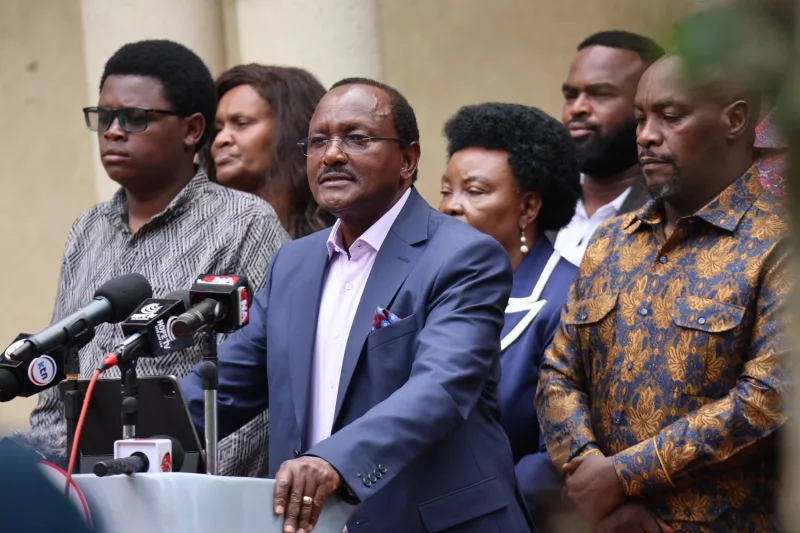
Figures such as Kalonzo Musyoka, Wycliffe Oparanya, Hassan Joho, and Martha Karua may attempt to inherit his mantle, but none yet command his national reach or charisma.
New faces and regional alliances are likely to emerge, reflecting Kenya’s shifting demographics and generational appetite for a new kind of politics. Still, even in death, Raila’s influence will linger.
His endorsements, networks, and reputation as a reformist will continue to shape who rises within the opposition.
The 2027 election, therefore, may not be about Raila the candidate — but about his legacy and who carries it forward.
Few figures have loomed as large over Kenya’s politics as Raila. For more than three decades, he was at the center of nearly every major political transition, earning a reputation as the country’s ultimate kingmaker — the man whose word could make or break political careers.
His most defining moment came in December 2002, when he stood before a jubilant crowd at Uhuru Park and declared “Kibaki Tosha!” — an endorsement that would change Kenya’s political course.
At the time, the opposition was fragmented, with several contenders vying to unseat the ruling KANU party after nearly 40 years in power.
Raila’s backing of Mwai Kibaki as the National Rainbow Coalition (NARC) flagbearer unified the opposition and catapulted Kibaki to a historic victory, ending KANU’s reign.
The phrase “Kibaki Tosha” would forever symbolise Raila’s ability to move crowds and alter destinies.
Since then, Raila’s political decisions have continuously shifted Kenya’s balance of power.
In 2007, he came within a whisker of the presidency under ODM, but the disputed outcome led to post-election violence and a power-sharing deal that saw him become Prime Minister in the Grand Coalition Government.
His influence extended well beyond the executive. Many of his allies ascended to powerful positions across government and county administrations.
In 2013, Raila championed devolution, turning ODM into a powerhouse at the county level. His endorsements helped propel leaders like Hassan Joho (Mombasa), Wycliffe Oparanya (Kakamega), and Cornel Rasanga (Siaya) to power.
Beyond personalities, Raila’s legacy was built on ideas — from the “Second Liberation” movement that fought for multiparty democracy, to his push for constitutional reform and later the Building Bridges Initiative (BBI).
His unexpected 2018 handshake with then-President Uhuru Kenyatta again redefined Kenya’s political landscape, easing tensions and isolating William Ruto, who would later defeat him in 2022.
Even in that election loss, Raila’s power was evident. Many of his preferred candidates across Nyanza, Coast, and Western Kenya triumphed, underscoring his unmatched grassroots influence.
Raila’s death has left the ODM party in turmoil. Once unified by his towering presence, the party now faces internal divisions and uncertainty over succession.
Alego Usonga MP Sam Atandi sparked debate within ODM after stating that the party should not rush to field a presidential candidate for the 2027 elections.
“There is currently no leader within ODM capable of defeating President William Ruto. Even if we decide to field one, who among us can defeat Ruto? As things stand, there is no one in ODM with that capacity,” Atandi said in Siaya.
Atandi, a close ally of the late Raila, insisted that the party must remain realistic in the face of new political realities, acknowledging that “there is no one Raila Odinga had anointed or proposed to be ODM’s presidential candidate in 2027.”
Following Raila’s death, ODM’s National Executive Council (NEC) convened an emergency meeting and appointed Siaya Senator Oburu Oginga — Raila’s elder brother — as interim party leader.
Oburu’s appointment, announced shortly after Raila was laid to rest on October 19, 2025, at Kang’o Ka Jaramogi beside his father, the late Jaramogi Oginga Odinga, symbolises continuity within the Odinga family.
ODM Chairperson and Homa Bay Governor Gladys Wanga, National Assembly Minority Leader Junet Mohamed, and Treasury Cabinet Secretary John Mbadi have all maintained that Raila wished for the party to remain within Ruto’s broad-based government.
Wanga recalled that Raila’s last public instruction, during the burial of Dr Phoebe Asiyo, was to work closely with President Ruto.
“That is the last standing instruction that Baba gave us,” she said.
“He wanted us to cooperate with the government.”
Junet echoed this view, noting that Raila had clearly said ODM would “either form the government or be part of it, " Mbadi added,
“As a party, we will be in a broad-based government. That is what Raila wanted.”
But this stance has not gone unchallenged. Several ODM legislators argue that remaining in government could weaken the party’s independence and confuse its identity.
Even in his absence, Raila’s shadow looms large. His legacy — as a reformer, kingmaker, and conscience of Kenya’s democracy — continues to shape conversations about leadership, governance, and the country’s political destiny.