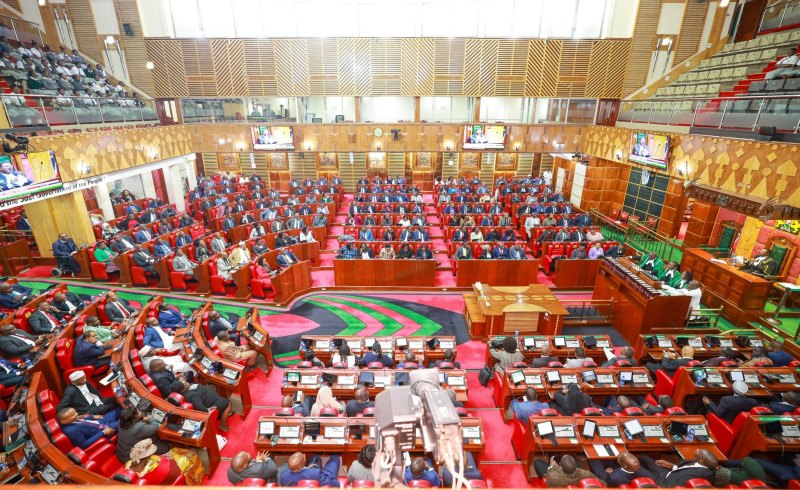
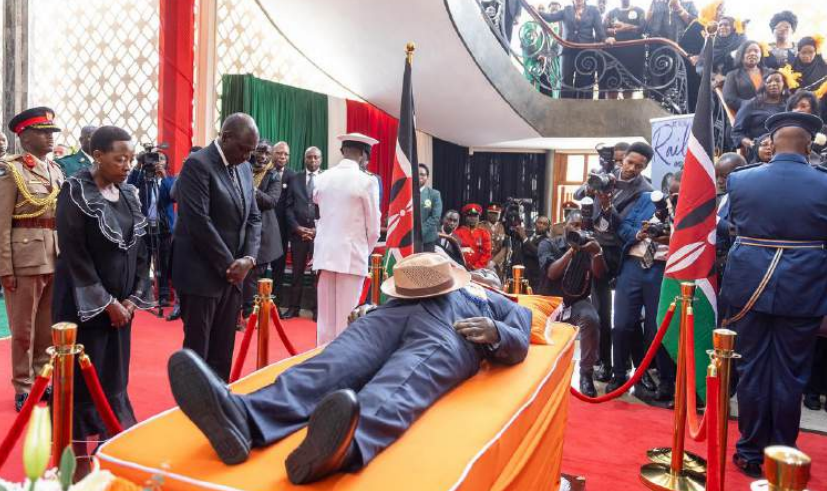
 President William Ruto pays his respects to former Prime Minister Raila Odinga as his body lies in state in Parliament
on Friday /EZEKIEL AMING’A
President William Ruto pays his respects to former Prime Minister Raila Odinga as his body lies in state in Parliament
on Friday /EZEKIEL AMING’A
Former Prime Minister Raila Odinga’s death has sent shockwaves through the political landscape, setting the stage for radical changes in the 2027 election matrix.
Raila, the country’s longest-serving opposition leader and a political enigma, died in India on Wednesday. His body was flown back to the country on Thursday.
Raila’s death — a man whose name had become synonymous with Kenya’s political struggles — signals major shifts and realignments in the nation’s political arena.
“Raila’s death will change the country’s politics dramatically. He has been a constant figure in every election since 1997,” governance analyst Martin Andati said.
He said Raila’s death has dealt a heavy blow to President William Ruto, with whom he had a political arrangement, while simultaneously boosting the opposition’s fortunes.
“Ruto is the biggest loser. He was banking on Raila to win the election. He hoped to inherit Raila’s bases. It was Raila who would have transferred his support to him. That loyalty cannot exist without Raila,” Andati said.
Without him, observers warn that his traditional support bases may not automatically transfer to Ruto.
“The President must go back to the drawing board. Even with Raila alive, there were murmurs and defiance. We saw the likes of Sifuna openly rejecting the partnership. What will happen now that Baba is no more?” Andati asked.
For the opposition, Raila’s departure from the political scene grants them an opportunity to fight for the bases that have traditionally been under Raila’s control.
“Nyanza will obviously split. Kisii is no longer a guarantee. The coast is also likely to split because that loyalty was only to Raila. Ruto may not enjoy that loyalty on his own,” he said.
University don Macharia Munene said Raila’s death could deepen the cracks in ODM as some party officials and members could “finally feel free” and be more independent.
“Some of the politicians, especially the young ones such as Babu Owino, will feel that they don’t have to hang on Raila’s coat in their push to attain their ambitions,” Munene said.
“We had already started seeing Babu pushing towards that line. However, when Raila was there, it was difficult to openly rebel.”
He said even among the high-ranking politicians such as Nyong’o and Orengo, they had in some instances shared some divergent views but in a limited manner, given they had learnt from history when they went out of Raila’s camp.
With Raila’s absence, analysts have also argued that new actors will emerge, making 2027 more fluid.
For nearly four decades, Raila dominated the country’s politics — commanding key voting blocs and enjoying near-fanatical support across several regions — influence that could have been crucial in shaping the 2027 polls.
The late ODM leader held sway in Nyanza, Western, Coast, parts of Rift Valley, Northeastern and Nairobi, making him a central player in Kenya’s political chessboard.
More than a politician, Raila was an institution — a rallying point for millions who believed in his call for justice, democracy and reform.
His passing, just two years to the 2027 general election, has not only left a deep emotional void but also disrupted the country’s political equation.
Observers say Raila’s firm political grip on various regions could have significantly influenced the outcome of the next polls.
Until his demise, the ODM leader had struck a political deal with Ruto under the broad-based government — a partnership that many believe would have been vital to Ruto’s re-election bid, particularly if Raila had publicly backed him.
This was, especially significant following Ruto’s fallout with his deputy, Rigathi Gachagua, a rift that weakened the President’s influence in the Mt Kenya – a key bloc that sealed his surprise victory in the 2022 polls.
“For Ruto to win, he needs a solid vote bloc. With Mt Kenya, which is likely to vote as a bloc, now out, he needed a replacement — which he found in Raila and his Nyanza backyard,” political observer Elias Mutuma said.
Though Raila never explicitly endorsed Ruto’s re-election in 2027, his decision to allow some of his key allies to cooperate with the President, coupled with his close working relationship with State House, spoke volumes.
Treasury CS John Mbadi, Energy’s Opiyo Wandayi, Mining’s Hassan Joho, Cooperatives’ Wycliffe Oparanya and AG Dorcas Oduor were some of Raila’s closest allies who were appointed to government as a result of the political deal.
“Don’t commit the party to things that have not been discussed. Who told you ODM does not have a candidate in 2027?” he cautioned ODM members last month.
“As ODM, we have a clear plan that we have agreed on and let us implement it. Other decisions will be made when the time comes.”
Munene said the President could take advantage of the deal they had with Raila and his public backing and seek to retain the support of the Nyanza bloc.
“You have seen how he has gone out of his way to ensure Raila gets a befitting send off, granting him a state funeral that is usually granted to presidents and former presidents,” he said.
Munene said those in government courtesy of the Ruto-Raila deal will likely continue backing the President for their own benefits, while others who my get future consideration for higher office such as Governor Gladys Wanga will remain put.
Raila’s cooperation with Ruto followed the back-to-back Gen Z–led protests that had nearly paralysed the Kenya Kwanza administration, prompting the President to seek national dialogue and inclusivity.
Analysts say Raila’s demise now leaves Ruto politically exposed, robbing him of a key ally whose influence could have stabilised his re-election path.
It had been widely expected that Raila — who unsuccessfully contested the presidency five times — would not run again in 2027.
INSTANT ANALYSIS
Raila Odinga was known for his kingmaker role. In 2002, his ‘Kibaki Tosha’ declaration ensured former President Mwai Kibaki’s victory and the end of 24 years of the Kanu regime. In 2007, Raila agreed to a grand coalition with Kibaki following the post-election violence, a move that stabilised the government and restored peace. This was the case during President Uhuru Kenyatta’s term when their “handshake” - a political truce - was secured, to quell the disquiet as Uhuru squabbled with his deputy.