

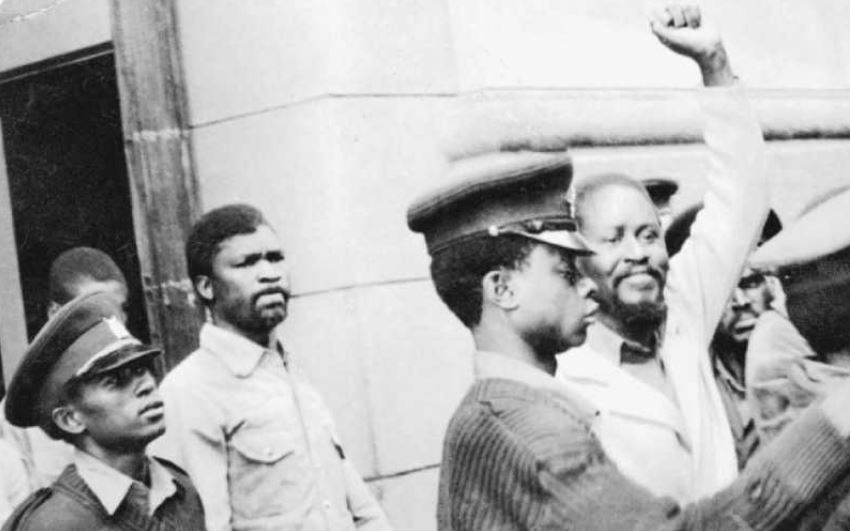
 Raila Odinga leaves the High Court during his detention years /FILE
The dominant reaction to the news of the death of ODM boss Raila Odinga on Wednesday morning was “it can’t be true!” Despite recent health challenges, Raila’s mortality was the one thing not many Kenyans had learnt to confront. With his larger-than-life, enigmatic profile and his domination of the country’s political sphere, there was always an element of “he will overcome this one too” in national discourse.
Any member of my generation, who grew up in my homeland, must have heard all the myths peddled about Raila’s father, legendary freedom icon, Jaramogi Oginga Odinga. Locals referred to him simply as “Oginga”. These myths and theories somehow extended to one of his sons, not widely known before the 1982 coup, but rumoured to be everything from “rebel trained in Russia” to “feared by the state because he has militias in Libya, waiting to overthrow the government”.
In his autobiography, The Flame of Freedom, the former Prime Minister stated that all matters to do with the 1982 coup, which he was widely accused of being involved in, would be cleared up in a future book. Obviously, there were political risks attendant to admitting any involvement, but it was the coup attempt that would finally “present” this son of Jaramogi to the public sphere. It came with a perceived reputation of hot-headed impatience; a man who didn’t suffer fools, and wanted change instantly.
Yet, it is possible that things may have turned out differently if events in Kenya had taken a different trajectory. Political upheaval in Kenya, following the assassination of Economic Planning Minister Tom Mboya, and the Kisumu massacre of 1969, at which hundreds of residents were shot dead by presidential security during the opening ceremony of the Russian-built hospital, culminated in Jaramogi’s detention, alongside state repression directed at the old man and his associates. His businesses took a massive hit too.
With Jaramogi’s eldest son Oburu Oginga still away in Russia, the function of steering and steadying the family ship fell on the second son, Raila. The German-trained engineer and then lecturer at the University of Nairobi, would take up the role with gusto, but like many university dons of the time, was already radicalised by the decline of democracy and freedom in the country. Of course, it is easy to state that the treatment of Jaramogi and the Odingas, after all the old man had done to help win independence for the nation, didn’t quite rest well with the idealistic Raila.
The 80s and early 90s would mark the period of Raila’s stints in detention, making him, at about nine years of lock-up, the longest serving detainee in the country. During his first stint, his mother passed away. It manifested the real personal face of the struggle. Meantime, the Moi regime and state apparatus would gradually build the profile of a dangerous man, out of Raila, depicting him as a power-hungry man who would use any means to get to power.
But the pressure to open up the democratic space would force President Moi and the ruling party Kanu to repeal the infamous Section 2(a), restoring multiparty democracy, in 1991. With it came the massive Forum for the Restoration of Democracy (Ford), before the powerful opposition outfit broke into splinter groups. Second liberation luminaries, like Raila, could finally find a voice in structured political organisations. Incidentally, the return of multiparty politics in 1991, ahead of the 1992 general election, exposed the soft underbelly of the democracy movement in Kenya, because the breakaway factions of Ford were almost entirely formed along ethnic persuasions. Predictably, the whole lot was whitewashed by President Moi in the 1992 polls.
As fate would have it, Raila’s father, the great Jaramogi, died barely 13 months after the elections, a death which quickly reset the country’s political map. After a vicious fight for control of Jaramogi’s Ford Kenya, Raila resigned from the party in late 1996, then resigned his Lang’ata parliamentary seat and recaptured the it on his new National Development Party ticket.
The NDP party symbol was the tractor. Its slogan was “Tinga”. There has always been the belief that Raila himself acquired the same nickname from the party’s symbol, but the truth is, NDP’s original symbol had been a bull, like that of Jaramogi’s KPU many years earlier. Raila had indeed acquired the nickname before, and bestowed it on the party. This political vessel would become the one Raila used in the 1997 election, conquering Luo Nyanza and rendering Ford Kenya practically dead in the region. In a sense, this marked the political burial of Jaramogi and the true birth of the Raila’s brand.
Up until the 1997 election, his overriding image, aided by effective state narratives, had been of a fierce, left-leaning Marxist. But post-1997 marked the beginning of his move to the centre, jolted by political realities in the land. To begin with, despite his consistent push for a joint opposition candidate to dislodge Moi ahead of that year’s polls, his opposition colleagues refused to budge, clearly having learnt nothing from their 1992 defeat. Even worse, it was only after the results had been announced that the trio of Mwai Kibaki, Wamalwa Kijana and Charity Ngilu were willing to issue a joint statement rejecting the results, while also plotting to disrupt Moi’s swearing in.
After the 1997 election, Raila moved closer to a cooperation framework with Moi, which ultimately led to a merger of Kanu and NDP and Cabinet appointments for the Lang’ata MP and a few of his associates to the Cabinet. The post-election co-operation would become his hallmark for the rest of his life, baffling friend and foe, due to his unique ability to work with erstwhile electoral rivals. According to Raila, all these actions were intended to achieve national stability in deeply divisive times. But depending on who you ask, the answers are as myriad as the thousands of his foes in the country.
I can state without fear of contradiction that between 1982 till his death, the departed icon was at the centre of every milestone in this country. Whether it is the second liberation movement in the 80s, the long journey of constitutional reforms within the last three decades or the election coalitions that have defined the landscape, you will not find one that doesn’t have the fingerprints of the ODM boss.
It is difficult to pinpoint which of these was the most consequential of all. Many commentators tend to settle on the 2002 decision to support Kibaki; the “Kibaki Tosha”, for the manner in which Raila’s support for Kibaki not only destroyed the then ruling party Kanu, almost for good, but also in how it returned the country to a progressive path after years of economic stagnation under the independence party. For me, this marked the entry of Raila into national psyche as the biggest political force in the land. Within just five years, he had moved from the NDP presidential candidate, clocking third behind Moi and Kibaki in 1997, onto a merger with Kanu, which elevated him to secretary general of Kanu, before leading a mass walkout from the ruling party, after Moi picked Uhuru as preferred successor, an onward to a massive campaign for Kibaki in 2002, which delivered a huge victory for the Narc-Rainbow coalition.
Perhaps that moment would end up laying the foundation for nearly every political event for the next two decades. Because as soon as the dust of elections had settled, the Kibaki and Raila wings immediately fell out over the MoU that had structured the delicate winning coalition. Incidentally, a key demand of Raila’s Liberal Democratic Party faction of the coalition had been that he be appointed Prime Minister upon Kibaki’s ascension to power. Things fell apart soon after the victory.
The Narc-Rainbow dream was dead. Even worse, the new ethnic hegemony created by power wielders around Kibaki went to work trying to clip the wings of Raila. It prompted then Vice President Wamalwa Kijana to make the immortal quote, “Those who love Raila love him absolutely, while those who hate him do so with a passion”. For then ODM leader, there was never a midpoint, never a grey area. Given that his stand on national issues was always firm and public, it was difficult for friends and foes to find such grey area in him too.
This October, the ODM party turns 20. It makes it the only large party in the country to have survived five electoral cycles. The consensus is that Raila’s persona played the biggest role in this longevity, a larger than life profile and a reliable support base that has made the movement the biggest in the country. ODM was born out of the embers of the 2005 referendum against the proposed constitution, when the ‘NO’ side, symbolised by a ripe orange and led by Raila, defeated the ‘YES’ side led by President Kibaki. The sacking of his team from Cabinet after the referendum laid the stage for a heavily contested 2007 election.
The jury is still out on who won that election. But the aftermath was countrywide violence and destruction that would end up known simply as the post-election violence. But the statesman Raila would show his credentials for the whole world to see, when, defying his party hawks’ desire to fight to the bitter end to reclaim what they saw as stolen victory, he broke ranks and opted to form a national accord government with President Kibaki, who had by then been sworn in. Raila took office as the PM, a title by which he would be known and defined for the rest of his life.
Between the signing of the national accord until his death, Raila did a ‘handshake’ with each subsequent president, following elections in which he and his supporters believed they had been denied victory by a fraudulent electoral agency. Between 2013 and 2022, he, in fact, lodged a petition at the Supreme Court challenging the validity of the elections. In 2017, the Supreme Court, led by Chief Justice David Maraga, agreed with him and nullified the results. But the ODM boss declined to participate in the repeat.
In judging the former premier, certain historical anecdotes will justifiably caricature him as a misunderstood man, from whom political opponents in some regions of the nation created a hate figure. However, just the same way Raila hate became a factor in creating and destroying political careers, there were hundreds of politicians mentored at the feet of the late icon, or who rode on his name to political glory.
Yet, in the heat of national grief, it will be forgotten just how many plots against Raila were made by many of the folks who will troop to his home to sing his praises. It is a reminder of the famous eulogy by lawyer James Orengo, at the 1994 burial service of Jaramogi,. Paraphrasing Mark Antony, in William Shakespeare’s play, “Julius Caesar”, Orengo famously stated that “I come to bury Jaramogi, not to praise him!”
In the last days of his life, the Raila may have departed on his own terms. I happened to have attended a meeting hosted by ODM secretary-general Edwin Sifuna, at which he held deliberations with members of a UNDP Electoral Needs Assessment Mission on Tuesday afternoon. At some point, his phone on the table rang, displaying the caller as “Baba Raila”. Sifuna immediately interrupted the session and walked out to pick the call. Quite shockingly, only hours later, early morning on Wednesday, news of the death of Raila was reported.
As he did with his SG, I understand that Raila spoke to some of his close associates on phone on Tuesday. Some of these now have the unenviable task of having to safeguard his legacy and unite his huge political base. I am certain that many will wonder just where to begin. Because the legendary icon had such large shoes that in 2003, when his LDP wing bemoaned Raila’s appointment as Roads Minister instead of Prime Minister as agreed in the disputed MoU, someone loudly retorted that it was Raila who made the office big, not the reverse, such that “if you appoint Raila the chair of a village cattle dip committee, that office will be the most visible and most important office in the country today”.
I don’t envy those charged with drawing up tributes and eulogies for the former PM. Where does one begin? A life that spans continents, offices, careers and so much political drama, can hardly be documented in one book, or one newspaper story. Raila was a giant who made huge sacrifices for the common good, fought a lifelong struggle for democracy and freedom and remained uncompromising in his ideals. The best way for the nation to honour him is to remain true to some of these ideals. Because in real sense, he was a whole movement rolled up into one enigmatic body!







