

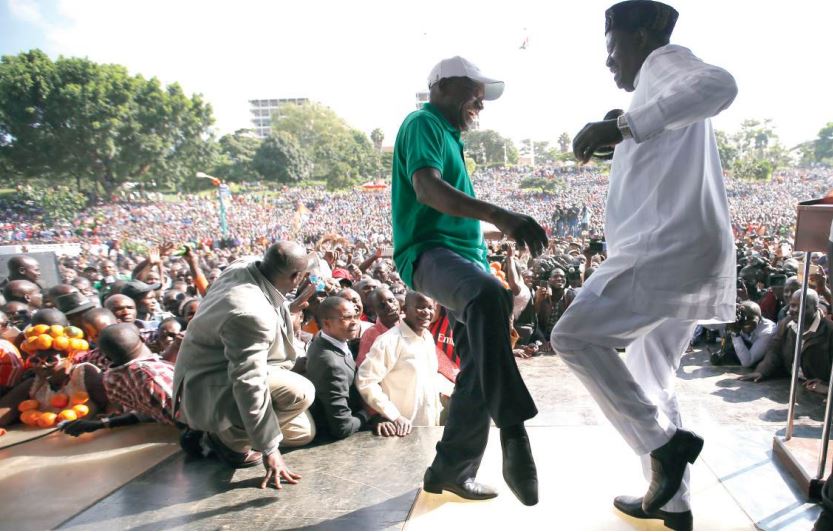
 Raila Odinga enjoys a jig with Kakamega Senator Boni Khalwale during a rally at Uhuru Park in Nairobi on June 1, 2016 /FILE
Raila Amollo Odinga was a true student of history. He did not merely study it, he lived and shaped it. His command of Kenya’s political past and his grasp of global affairs were remarkable.
He could draw a line from the Mau Mau struggle to Mandela’s imprisonment and the fall of the Berlin Wall without losing his audience. He possessed an encyclopaedic memory, a rich sense of humour and a voice that could hold both the streets and the scholars spellbound.
Raila was also a brilliant orator who used wit to make truth bearable. He had a gift for poking fun at his rivals in ways that drew laughter even from his critics, turning political debate into a stage for intellect and courage.
Raila’s story is woven into the fabric of modern Kenya. From the push for multiparty democracy to the fight for constitutional reform and devolution, his presence was constant. He stood up to authority when silence would have been safer, endured detention for his beliefs and refused to abandon the cause of justice even when it cost him politically. Whether in power or in opposition, he remained the moral compass of the political class and the conscience of the republic. His politics were not about power for its own sake but about what power could achieve for ordinary Kenyans.
He was also an extraordinary teacher of democracy. Even in defeat, Raila elevated national dialogue, reminding Kenyans that democracy is not measured by victory alone but by the maturity with which we handle loss. Through the turbulence of elections and the disappointments of betrayal, he never abandoned hope. He taught a nation how to fight for ideals without surrendering decency.
Raila’s political life was a journey through the ambitions, fears and contradictions of Kenya itself. He encountered every major figure of our post-independence era. Daniel arap Moi feared his defiance yet respected his courage. Mwai Kibaki, quiet and pragmatic, found in him the charisma and energy needed to galvanise change. The triumph of the National Rainbow Coalition in 2002, which ended Kanu’s long rule, was in large part the fruit of his vision and his willingness to unite a fragmented opposition.
Uhuru Kenyatta discovered in Raila an indispensable partner for national stability when the country faced division after the 2017 election. Their handshake in 2018 did not erase political rivalry, but it rescued the nation from descending into deeper turmoil. Even William Ruto, the current president, built his career in the shadow of Raila’s towering influence. To defeat Raila was to earn validation, and to receive his respect was to gain legitimacy. In one way or another, every leader of consequence has been defined through him.
What made the former ODM leader exceptional was not only his endurance but also his humanity. He could speak to a gathering in Kibera with the same clarity and conviction he brought to global forums. His words carried warmth and sincerity. Behind the laughter and humour lay the seriousness of a man who believed that Kenya could and must do better. He could disagree without malice, criticise without hatred and oppose without seeking to destroy.
For his community, Raila was both leader and symbol. He gave the Luo people a political identity, a voice that could not be ignored and a sense of belonging in the national story. His passing will open a new chapter that will test their ability to translate loyalty into leadership and emotion into political strategy. Without his commanding presence, a younger generation will need to learn the art of engagement that values ideas above inheritance and persuasion above protest. It will be a difficult transition but also a necessary one.
Raila’s departure also presents a turning point for President Ruto. Freed from the constant rivalry that defined the political landscape for decades, Ruto now has the space to consolidate his authority and recast his image as a unifying national leader. His journey has been one of resilience and strategic intelligence, traits that could serve him well if he chooses inclusion over isolation and dialogue over division. He has shown a capacity for adaptability and persuasion. If he channels that energy into healing old wounds and building consensus, he could emerge as the central figure of a new era of stability.
The absence of Raila’s balancing influence, however, may leave the country vulnerable to new tensions. He was the bridge between opposition and government, between dissent and duty. His voice gave legitimacy to protest while also tempering its extremes. With his exit, the shape of opposition politics will inevitably change. It may become more fragmented, spontaneous, and less disciplined.
Already, the Gen Z movement has shown that Kenya’s civic energy is shifting away from traditional political structures. It is leaderless and digitally driven, and guided more by frustration than by ideology. The current government is working hard to make life better for the youth. When Raila later joined Ruto in the broad-based government, he addressed the youth directly and encouraged the use of new ideas to address youth’s needs such as employment. He praised their courage and sense of justice but urged them to be patient and strategic. He reminded them that protest without vision becomes chaos and that real revolution strengthens institutions rather than tearing them down. Those words, now remembered more deeply in his absence, captured the wisdom of a statesman who understood both the passion of youth and the fragility of nations.
Raila’s legacy goes far beyond the offices he never held. It lives in the freedoms Kenyans enjoy, the institutions strengthened by his struggles and the democratic culture he nurtured. He made opposition politics a legitimate pillar of governance and turned disagreement into a tool for accountability. He exits the stage having changed Kenya more through his losses than many others did through their victories. His death will test Kenya’s maturity as a democracy. It will reveal whether the political class has learnt from his example or merely benefited from his endurance. The next phase of our politics will depend on whether leaders can replace confrontation with conversation, and whether the people can separate political vision from personality cults.
His life was a testament to the idea that greatness in politics is measured not by how much power one acquires but by how one uses influence to shape a nation’s conscience. He was a man who lived through the pain of betrayal and the joy of reconciliation, who never stopped believing in the possibility of a better Kenya. In the end, he was not just a participant in history but its architect, reminding all who lead that the true purpose of power is to serve, to unite, and to build. Kenya will move forward, as it must, but it will do so in the long shadow of a man who gave it both courage and direction. The task now is not to replace him but to live up to the ideals he embodied.







