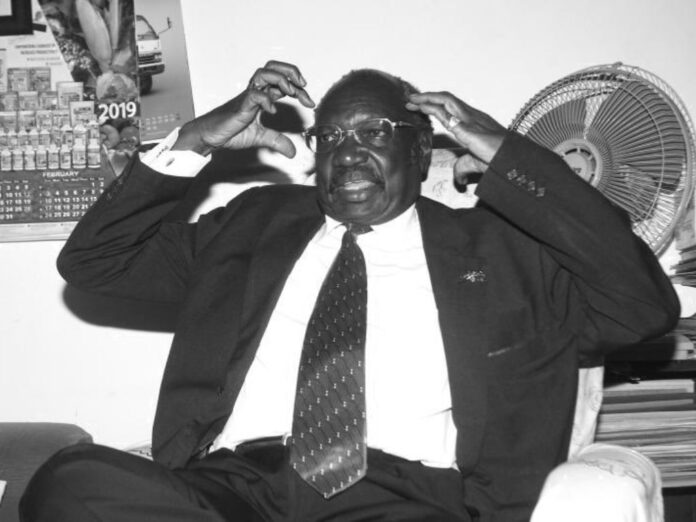
 Prof Arthur Obel./FILE
People who do medicine are clever people. So, I found out, when I first entered medical school, at the University of Nairobi. In the late 1980s, the medical school at the University of Nairobi was the only one in Kenya and admitted just 100 students a year.
The faculty that taught were not just clever but knowledgeable.
Medical school was intense, from 8 am to 6 pm every day, with Saturday half-days for the first two years. Then from the third year onwards, we added the wards, seeing and being taught at the Kenyatta National Hospital. It is here that I first met Prof Arthur Obel.
Obel, who died on September 27, taught pharmacology, which is the branch of medicine that deals with the use and effects of medicines. Within medicine, there is a hierarchy.
All medical doctors are clever people. But within medicine there are those who are also good with their hands. They become surgeons, especially if they have an arrogant streak to them. If they in addition to surgery are strong, then orthopaedic surgery is the thing to specialise in.
If they are good at puzzles, above average, but don’t do manual stuff, they become neuro-physicians. If patient with people, and like good food, then cardiology, matters of the heart is what they end up in.
Obel was a physician, very clever, bordering on genius, a scientist with an attention to detail. So he went to the sciences, which could either be in the laboratory or drug management.
A lecture by Obel was a masterclass in teaching. He would simplify a lesson on a topic for a third year medical student and add some elements for the fifth year student. For the first year postgraduate student, there would be more details they needed to know and the final year postgraduate student and junior consultant still more to know.
To this day, I still remember distinctly a class he taught. On painkillers, a class of drugs known as non-steroidal anti-inflammatory drugs. We are doctors, for the lay person aspirin and ibuprofen.
He would drive into medical school at great speed. Park carelessly in the car park, directly in front of the path that led to the lecture theatre, then stride into the lecture theatre bang on time, glance at his wristwatch and then announce the topic.
Taking a piece of chalk, he would lay out the sub-topics and then proceed to talk about each, finishing his lecture precisely on time, with five minutes to go. ‘Any questions?’ then he would stride out again, leap into his car, it was a big Mercedes or a big BMW and drive off. The security at the gate had to be alert to get out of the way.
HIV/AIDS was discovered in the mid-1980s. To get the disease then was terrible. People would get symptoms and decline in months. The laboratory test for diagnosis took two weeks to get results and at that time could only be done by the Kenya Medical Research Institute. Prof Obel was the chief scientist at Kemri and worked to find a cure.
I had the privilege to work as an intern in one of the Kemri labs, where he did trials on patients with HIV who were on Kemron. I learned first hand what it took to be a scientist, to try to find treatment for patients who would otherwise die a horrible death. Obel was a doctor with a mission.
Kemron did not seem to work. But that did not stop Obel from trying to help patients. After my graduation, a few years later in private practice, I was to interact with the professor. I had my clinic on Moi Avenue, Obel’s across the road in Commonwealth House. Because of stigma, patients did not want others to know they had HIV. Our patients would come to us and we would walk across the road, see professor and arrange to collect medicines for them. This helped us. Within a few years my clinic was one of the first private clinics in Kenya to offer HIV medicines and care at outpatient level.
Obel was a larger-than-life figure. Undoubtedly a genius. He stood out in the medical field as a scientist who worked to find a cure for a disease that though now controlled somewhat, has killed thousands of Kenyans. As a clinician he had time for his juniors.
He was also a great teacher. He imparted complicated knowledge in a simplified way that made it stick. One quote from a colleague of mine summarises his legacy: “Prof Obel was a walking enigma of knowledge that shaped great minds in pharmacology and medicine.”