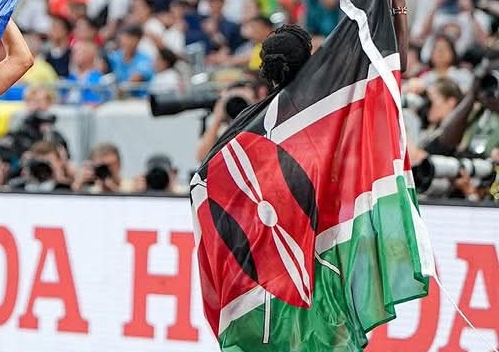
Kenya has secured a reprieve in its bid to avert international anti-doping sanctions after the World Anti-Doping Agency (WADA) indicated that its national watchdog had made “significant and demonstrable progress” towards meeting global compliance standards.
In a statement released on Friday, WADA confirmed that the Anti-Doping Agency of Kenya (ADAK) had submitted a corrective action plan ahead of the October 2 deadline.
The plan, it noted, outlines how the agency intends to address compliance shortcomings within the next four months.
As a result, ADAK will not, at this stage, be declared formally non-compliant, and the sanctions that had been scheduled to take effect from October 3 have been suspended.
The development follows WADA’s Executive Committee meeting held on September 11, 2025, in Prague, Czechia, where the body endorsed a recommendation from its independent Compliance Review Committee (CRC) to propose ADAK’s non-compliance.
The CRC’s position had been informed by a May 2024 audit, which highlighted several requirements that the Kenyan body was yet to fully meet.
“Until the CRC reassesses the case and potentially makes a further recommendation to the ExCo, and the ExCo reaches a subsequent decision, the aforementioned consequences for ADAK will not apply,” WADA said.
Under international anti-doping regulations, ADAK had been given 21 days to either dispute WADA’s findings or present corrective measures.
Failure to act would have led to severe penalties, including suspension from WADA structures, loss of funding, exclusion of its officials from global committees, and a ban on Kenya hosting future international sporting events.
The sanctions were due to begin on October 2 at midnight. The implications would have become greater if the matter had remained unresolved.
After six months of outstanding non-compliance, ADAK’s testing and results management would have been placed under the oversight of an independent third party at its own expense.
After twelve months, the penalties could have escalated to a level where Kenya’s national flag would not be displayed at international competitions, including the Olympic Games and World Championships.
Kenya’s record with WADA has been under close scrutiny, with a number of doping scandals over the years drawing international concern.
Since 2015, more than 200 Kenyan athletes have been sanctioned for doping-related violations, according to data from the Athletics Integrity Unit (AIU).
Cases have involved marathon winners and Olympic medalists, raising questions around the country’s reputation as a hub of natural endurance and talent.
The controversies led to the creation of ADAK in 2016 following pressure from WADA and World Athletics, then known as the IAAF.
The initiative was meant to reinforce Kenya’s commitment to clean sport.
Nine years later, however, WADA’s audit indicated that ADAK still faces challenges related to capacity, resources, and independence.
The update from WADA came just a day after President William Ruto announced that he had directed the Ministry of Sports to reorganise ADAK in line with international best practices.
He underscored that there should be no compromise on integrity in sports. Ruto stressed that Kenya’s international sporting image must be safeguarded.
He said doping scandals had the potential to erode decades of achievement and called for stronger systems of oversight.
“Kenya is a great sporting nation, and we do not want our sportsmen and women to be adulterated in any manner, for whatever reason, by anybody,” he said on October 2 when he hosted Kenya’s Tokyo medalists for a breakfast meeting.
“My instructions to Waziri are that we reorganise ADAK properly, inject professionalism, and make sure you work with best practice and international standards so that we safeguard the integrity of sports in Kenya,” Ruto added.
He directed the ministry to ensure that individuals whose involvement does not align with the best interests of athletes are kept away from the country’s sports sector.
“As we support our sportsmen and women, let us make sure that characters who have no good intention do not get in the way of our young people’s pursuit of excellence, from ball games to athletics and every discipline in between,” he said.