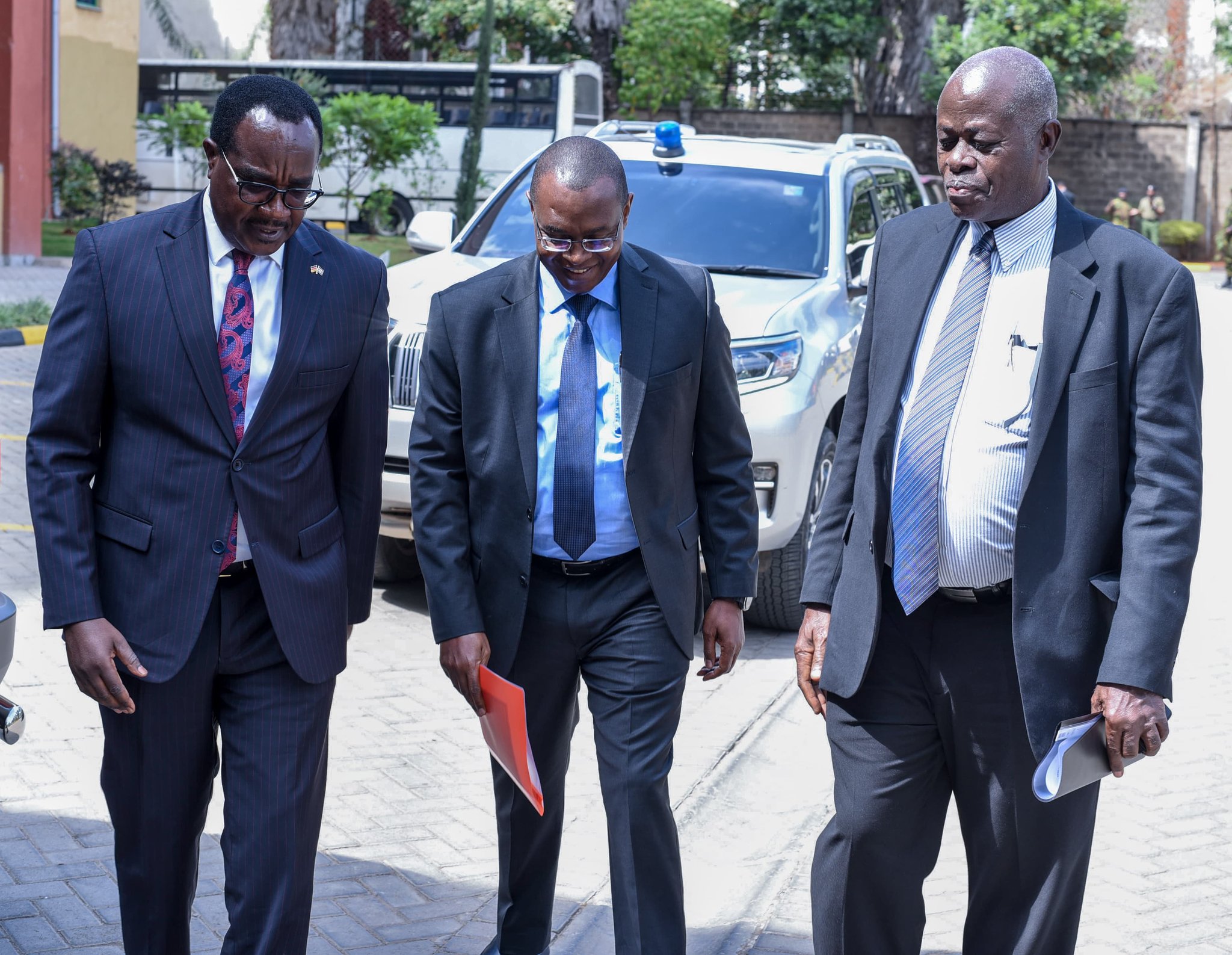
 Education Cabinet Secretary Julius Ogamba with KNEC CEO David Njengere and board chairperson Julius Nyabudi on October 3,2025/X
Kenya’s education sector is set for a historic moment this year as the country ushers in the first cohort of learners to sit the Kenya Junior School Education Assessment (KJSEA), marking a new chapter under the Competency-Based Curriculum (CBC).
According to the Kenya National Examinations Council (KNEC), a total of 1,130,669 learners will be the pioneers of this assessment
The assessment will run alongside the Kenya Certificate of Primary Education Assessment (KPSEA) and the Kenya Certificate of Secondary Education (KCSE) beginning October 17 through November 21, 2025.
The 2025 examinations and assessments season will involve a record 3,424,836 candidates across the three levels, making it one of the most significant in the nation’s academic history.
KNEC CEO David Njengere said Friday that the Council had conducted a pilot study in 265 schools in July 2024, whose findings informed the preparation of the inaugural KJSEA papers.
Sample formats were later shared with all junior schools through the CBA portal in January this year to familiarise both learners and teachers with the assessment structure.
“It is our hope that teachers have adequately exposed candidates to these formats to ensure they sit their exams with confidence,” Njengere said during the official launch of the exam season.
For the first time, he revealed, learners will sit personalised question papers each bearing the candidate’s name, index number, and signature.
Structured response papers will be answered within the booklets, eliminating the need for separate answer sheets, he added.
Njengere also used the opportunity to assure the stakeholders that all measures are in place to ensure smooth administration.
According to the examination body, over 24,000 centre managers and 125,492 invigilators will oversee the junior and primary assessments.
Security officers will only be deployed in sensitive regions to maintain a normal environment for learners.
The examinations come at a time when the country is determined to demonstrate that CBC can deliver credible and practical results.
The Ministry of Education has urged parents, teachers, and candidates to remain focused and confident as the country makes history with the first junior school national exam season.
The launch of KJSEA is more than just a new examination; it is part of the culmination of over a decade of curriculum reform in Kenya.
The Competency-Based Curriculum (CBC), which is replacing the long-standing 8-4-4 system, is anchored on developing learners’ competencies, creativity, and critical thinking.
In past policy briefings, education officials argued that the 8-4-4 system had outlived its usefulness, producing graduates ill-prepared for the modern economy.
CBC, on the other hand, promises to nurture learners’ talents and align education with national development goals.
President William Ruto has consistently championed the transition, calling CBC “a revolutionary step to prepare Kenyan children for a competitive, knowledge-driven world.”
Speaking during a teachers’ conference in 2023, Ruto underscored the government’s commitment to fully supporting the new curriculum through funding, training, and infrastructure.
“We are building a system that recognises every child’s ability and talent. Whether a learner excels in sciences, arts, or sports, CBC ensures that no Kenyan child is left behind,” he said.
KJSEA will play a crucial role in placing learners into senior school pathways, STEM, Social Sciences, and Arts and Sports Science, which will eventually shape their career trajectories.
“This is why we must ensure that examinations and assessments reflect the honest work of learners. We will have no mercy on anyone caught engaging in malpractices,” Ogamba warned during the 2025 exams launch at Mitihani house in South C.