The Independent Electoral and Boundaries Commission has ruled out the possibility of a boundary delimitation before the 2027 general elections.
This is even as the commission targets to add 6.3 million new voters to its register ahead of the 2027 polls.
The electoral body, citing time constraints, appealed to MPs to consider legislative interventions to avert a constitutional crisis that could emanate from failure to review boundaries.
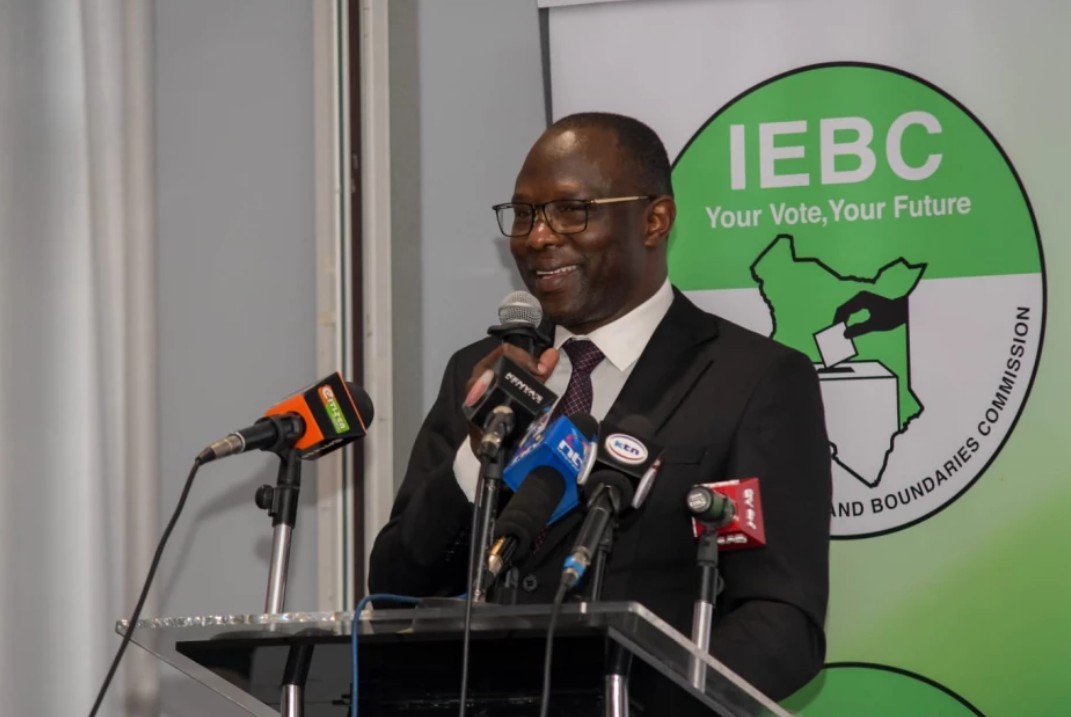
When appearing before the National Assembly’s Constitutional Implementation Oversight Committee, IEBC chairperson Erastus Ethekon said time and legal constraints make it impossible to complete the process before 2027.
“We need two to three years to conduct this technical and emotive issue,” Ethekon told the committee chaired by Suba South MP Caroli Omondi.
The law requires the commission to conduct the review after eight years and before the 12th year following the last review.
The eighth year elapsed in 2020, while the upper 12th year expired in March 2024.
With the electoral calendar already in motion, IEBC said the process cannot feasibly be carried out without throwing the election timetable into disarray.
The commission appealed to Parliament to urgently legislate clear frameworks to avert a constitutional crisis.
“My fear is that we might not meet the threshold. We call upon Parliament to do certain things,” Ethekon stated.
He also informed the committee that the agency will, within a month, give a final verdict on the possibility of having a review before the general elections.
“Let us give ourselves one month and we will report back on the resolution of the commission,” Ethekon noted.
The planned commission meeting follows an advisory opinion of the Supreme Court rendered on September 5, that directed IEBC chiefs to submit before it their decision on whether they want to proceed with the exercise.
The apex court was ruling on a 2024 reference application by the IEBC seeking clarification on whether it could conduct a review beyond the timelines.
The application also sought whether the delimitation timelines could be extended and if so, by whom and under what conditions.
The electoral body, which was operating then without commissioners, also sought clarification on whether delimitation and other electoral functions could be undertaken in the absence of commissioners or without a quorum.
“On September 5, 2025, the court rendered itself on the advisory opinion in which it struck out the reference filed by the commission. The court opined, among other things, that only a duly constituted commission, comprising the chairperson and other members could bring the matter before the court for its determination,” IEBC legal affairs director Chrispine Owiye told MPs.
“As such, the commission is considering its options noting the timelines, competing commission activities and the necessity of the boundary delimitation exercise.”
Tiaty MP William Kamket raised the alarm over the potential constitutional implications of not carrying out the reviews.
“Already it (boundary review) is a constitutional crisis and you may not unlock it. What is the worst that can happen—in case you are not able to do it before elections?” posed Kamket, who is also the committee’s vice chairperson.
Already, the fate of up to 27 constituencies is in limbo over low population.
These are Voi, Wundanyi, Mwatate, Galole, Bura, Isiolo South, Samburu East, Laisamis, North Horr, Saku, Kilome, Mukurweini, Mbeere North, Mathioya and Ndaragwa.
Others are Budalang’i, Vihiga, Othaya, Kangema, Marakwet East, Keiyo North, Tetu, Mogotio, Lamu East, Lamu West and Mvita.
During the review, the electoral agency is to confirm that the units meet the population threshold.
The quota is obtained by dividing the country’s population by the number of constituencies.
In 2012, the population threshold stood at 164,000, which the 27 constituencies did not meet.
They were, however, protected in the last review, but not in the second review—whose timelines have already expired.
Ethekon also informed the Caroli-led team that they are targeting to add 6.3 million new voters before the 2027 elections.
The commission, he noted, will launch countrywide continuous voter registration in all the 290 constituencies and Huduma Centres.
“The commission aims to register 6.3 million new voters in addition to the current 22.1 million registered voters ahead of the 2027 general election. This target is based on the voting age population,” Ethekon said.
“The commission has, in the past, relied on census data to map the eligible population and estimate voter registration targets by calculating the population of persons who would have attained the voting age of 18 years by the time of the general election,” added IEBC boss Hussein Marjan.
“The above trend confirms that the commission’s strategy of using Voting Age Population for target setting, has not been accurate, sustainable and veritable noting the impractical targets on the commission.”
According to Marjan, the commission has now shifted to Voter Eligibility Population (VEP) which is more accurate.
“This actual National ID/Passport data-driven approach ensures that resources are deployed efficiently and performance benchmarks are realistic and attainable,” he stated.
INSTANT ANALYSIS
The electoral commission is required by law to review the names and boundaries of constituencies after not less than eight years and not more than 12 years.