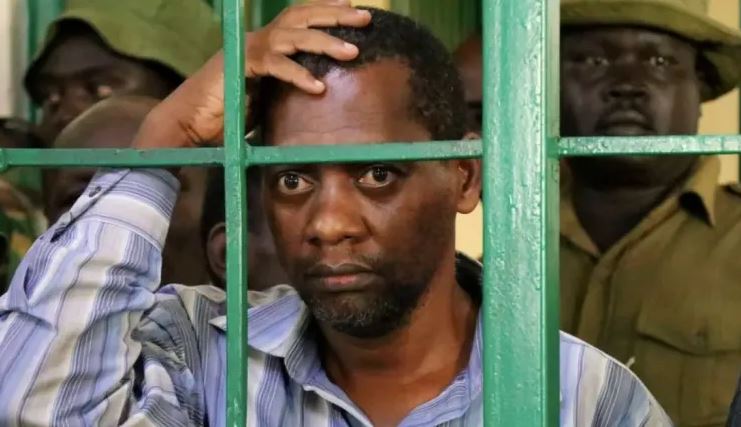
 Main suspect in Shakahola Massacre case, Paul Mackenzie, in Court/FILE
The state has closed its case in the sensational Shakahola child cruelty and torture trial, ending 14 months of often grisly and heartbreaking testimony from 75 witnesses.
The prosecution’s case, which began on July 24, 2024, ended on Friday before principal magistrate Nelly Chepchirchir at the Tononoka Children’s Court in Mombasa.
Controversial preacher Paul Mackenzie and 35 co-accused are facing charges of cruelty to children, torture and denial of the right to education.
Mackenzie and other co-accused face separate murder, manslaughter and terrorism- related charges in Mombasa courts and in Shanzu.
The offences stem from the Shakahola massacre in Kilifi county, where hundreds of victims are alleged to have starved to death under Mackenzie’s instructions. Their aim was to reach heaven swiftly by ending their time on earth.
Over the past 14 months, the court has listened to accounts from law enforcement officers, survivors, child protection officials and technical experts.
The witnesses provided critical evidence on the operation of Mackenzie’s Good News International Church and the conditions under which children and families lived in Shakahola.
The 75 witnesses included children who survived the ordeal, relatives of the accused, police officers who rescued victims and Safaricom data analysts who traced phone activity and mobile money transactions linked to Mackenzie and his followers.
Their testimonies painted a grim picture of indoctrination, starvation, forced withdrawals from school and physical abuse.
The prosecution closed its case with three final witnesses.
They were Dennis Muriithi, a Safaricom data analyst who produced call data records and M-Pesa registration details for phone numbers linked to Mackenzie and 21-year-old Israel Veronica. She gave a harrowing account of being pulled out of school by her parents in 2019 and later taken to Shakahola.
The last witness was Inspector Phoebe Okomo, a children’s officer who participated in the rescue and assessment of 27 children.
Muriithi testified that Safaricom received a court order requesting call data, M-Pesa registration details and other information crucial to the investigation.
He confirmed that from the retrieved numbers, including four registered to Mackenzie, they were able to trace registration dates and the last activity before some numbers were recycled.
Israel, whose parents and uncle are among the accused, offered a disturbing account of her childhood.
She revealed that she and her six siblings were taken out of school in 2019 by their father, who claimed education was sinful.
Her family relocated from Kasarani, Nairobi, to Shakahola after selling all their belongings, including land.
The court also heard from Inspector Okomo, who participated in the assessment and rescue of 27 children in Malindi, aged between one-and-a-half to 17 years.
She recounted how the team interviewed the children to understand their background, the conditions under which they lived and their experiences at Shakahola.
Most of the children had escaped at a time when fasting had intensified, and all described life in estates named Judea, Samaria, and Jerusalem, where they would congregate under a large tree for prayers and burial ceremonies.
Inspector Okomo testified that the children identified Mackenzie in a parade and recounted being denied food and sometimes being subjected to beatings.
“Some were withdrawn from school,” she said.
Okomo cited specific cases of abuse, including victims such as A B (PW 8), J N K (PW 1), S B B (PW 9), and E I (PW 7), the latter requiring corrective surgery due to injuries sustained in Shakahola.
She also detailed the psychological toll on the children, explaining how Play Therapy Kenya and the Director of Children Services provided counselling during interviews, as many children displayed signs of deep trauma and emotional breakdown.
Inspector Okomo concluded her testimony by establishing familial links between some of the accused and the rescued children, including parents, uncles and even guards.
In closing, the prosecution thanked the court, the defence and all the witnesses who came forward to give their accounts.
The prosecution was led by Assistant Director of Public Prosecutions Jami Yamina, alongside principal prosecution counsels Victor Owiti and Betty Rubia, and prosecution counsels Biasha Khalifa and Eunice Odongo.
The matter is scheduled for mention on October 14 to confirm if the proceedings have been typed for purposes of submission.
Instant analysis
The closure of the prosecution’s case in the Shakahola trial marks a pivotal moment in one of Kenya’s most disturbing criminal proceedings. Over 14 months, the prosecution painstakingly assembled a narrative through 75 witnesses, including children, law enforcement officers, and technical experts. Their testimonies illustrated the depth of alleged indoctrination, cruelty and systematic abuse linked to Mackenzie and his co-accused.