Kenya is among countries targeted in a £1.9 billion (about Sh332.1 billion) foreign direct investment programme for Africa by the UK before 2027.
This comes as the UK moves to affirm its commitment to support growth of Kenya’s manufacturing sector, enabling the country to tap into the strategic trade deal between the two countries.
The 'Manufacturing Africa' programme is expected to create at least 100,000 jobs.
It provides manufacturers and investors with fully funded transaction advisory services to fast-track investment and delivers technical assistance to help transform sub-sectors or unblock challenges in the enabling environment.
“Kenya’s manufacturing sector is bursting with innovation and potential. The UK is proud to support entrepreneurs who are building a more sustainable future. The Manufacturing Africa programme is an investment solution tailored to the needs of rapidly scaling manufacturing business run by ambitious entrepreneurs,” Acting British High Commissioner to Kenya, Ed Barnett, said.
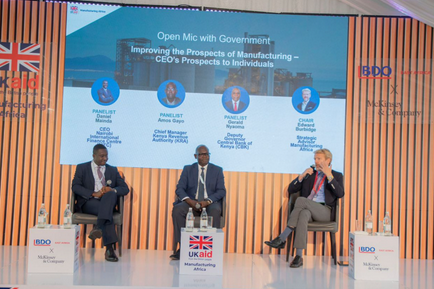
He spoke in Nairobi during an investment forum on unlocking new funding opportunities for the industrial sector, which attracted manufacturing companies from Kenya, Ethiopia, Rwanda and Tanzania.
“The Kenya-UK strategic partnership is rooted in shared values and bold ambition, for people, planet and prosperity. Kenya and the UK are working hard to go far, together,” Barnett said.
The forum served as a platform for industry leaders to present their businesses to potential investors, including British International Investment (BII), the UK government's development finance institution and impact investor.
Some of the sector challenges identified include access to financing, infrastructure development and trade facilitation.
The programme aims to catalyse economic transformation by enabling African manufacturing companies to attract the FDIs they need to scale, create jobs and boost local production capacity to alleviate poverty.
Through the programme, the UK government has delivered investment advisory support to over 230 manufacturing companies across Ethiopia, Kenya, Tanzania and Rwanda, facilitating the mobilisation of $2.4 billion (Sh419.5 billion) in Foreign Direct Investment.
This initiative has directly strengthened commitments from manufacturers to create approximately 120,000 jobs, driving economic growth and industrial development across the region.
Manufacturing Africa programme Team Leader,Thomas Pascoe, said: “ Investment in Kenya’s manufacturing sector will drive better quality jobs with greater security than the informal sector which is good for the country’s growth and its people. Investors meanwhile have the opportunity to meet firms operating in a growth market with a young population and significant domestic demand.”
In July this year, Kenya and the UK renewed their Strategic Partnership, which includes agreements on trade, investment and green growth, building on a 2020 framework and the 2021 post-Brexit trade continuity pact.
The renewed partnershipaims to double bilateral trade in five years and focuses on areas like digital start-ups, climate action and the flagship Nairobi Railway City Project.
Kenya’s export earnings from the United Kingdom rose from Sh54.7 billion in 2023 to Sh61 billion in 2024, the Economic Survey 2025 indicates, partly driven by an increase in domestic exports of tea and cut flowers.
During the same period, expenditure on imports from the UK increased by 9.4 per cent from Sh40.9 billion to Sh44.8 billion.
“The rise was largely occasioned by increased importation of aeroplanes, other aircraft and parts thereof from this source,” Kenya National Bureau of Statistics says in its report.
In the year under review, the manufacturing sector’s share of GDP stood at 7.3 per cent with the country having an ambitious plan of driving this to 20 per cent by the year 2030.
The government has been keen on attracting more FDIs, with a plan to double the value of these investments in the medium-term, from the $800 million (Sh103.4 billion)attracted in 2023, to at least $1.6 billion (Sh206.8 billion).
Nairobi International Finance Centre (NIFC) CEO Daniel Maindanoted that strategic tax incentives have been put in place to attract long-term investments.
They include reduced corporate tax rates (15% for 10 years, then 20% for another 10 for large investments and a 15% rate for the first three years for startups).
Certified companies also benefit from dividend tax exemptions upon reinvesting locally (Sh250 million annually), a single-window approval system, expedited work permits for specialised staffand regulatory clarity and stability.
Kenya Association of Manufacturers has been advocating for tax incentives such as tax relief for clean energy investments and the removal of the VAT on plant and machinery, to support and grow the local manufacturing sector.
They also call for policy consistency, targeted financing and improvements to infrastructure like energy and supply chains to foster a predictable environment for local businesses to thrive and contribute more to Kenya's GDP.