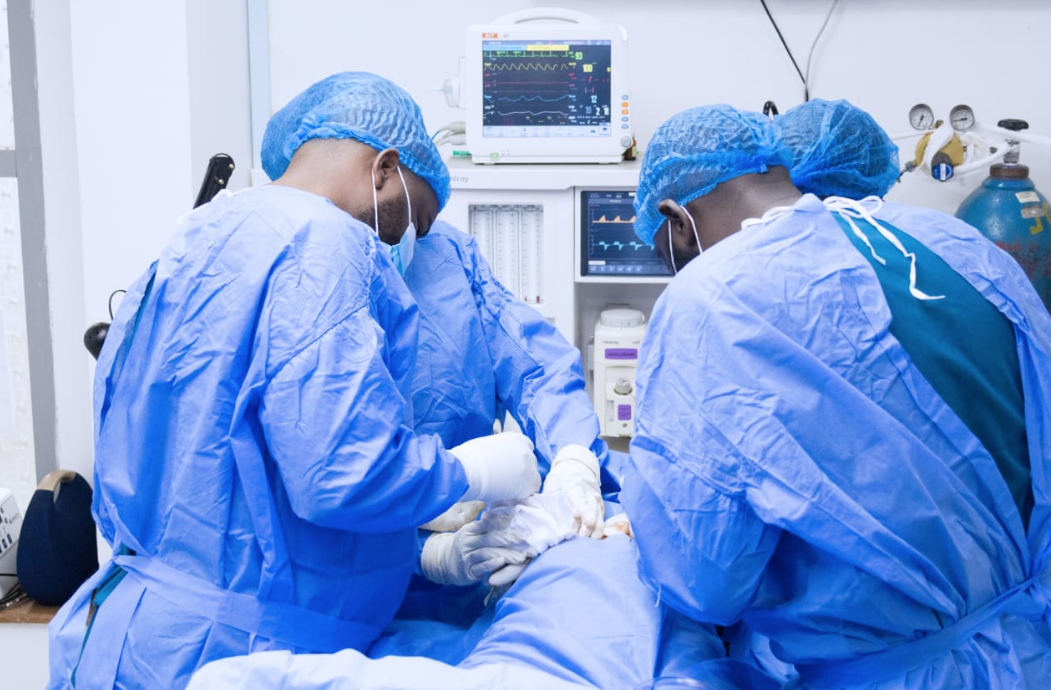
 Surgery room/FILE
Craniofacial surgery is emerging as one of the most complex and life-changing fields in medicine, blending advanced technology with intricate surgical skill to restore not just appearance but also function and confidence.
At Kenyatta National Hospital, preparations are underway for a historic operation that will mark the first time in Kenya a young patient will receive patient-specific implants designed to grow with him.
The case involves seven-year-old Ian Baraka, who was left severely disfigured after being shot in the face by bandits in December 2023.
The bullet travelled through the lower part of his face and exited the anterior side, damaging his jaw and injuring his eyes.
According to oral and maxillofacial surgeon Dr. Andrew Okiriamu, the boy’s lower jaw was initially stabilised, but the complexity of reconstructing his upper jaw presented a greater challenge, requiring a more advanced solution.
"We had to put a feeding tube through his mouth to allow him to feed because he had no oral functions. All the tissues on his face were open," he stated.
"The roof of the mouth was sealed up, so that means he is able to perform the swallowing function without any problem."
It is in response to these complexities that doctors have planned a historic procedure for September 25, 2025.
Hospital officials note that Ian has undergone multiple preparatory evaluations—including CT scans, dental impressions, and nutritional assessments—to ensure he is fit for the long surgery and subsequent recovery.
About craniofacial surgery
Craniofacial surgery is a specialised type of reconstructive surgery that focuses on correcting deformities or injuries of the skull (cranium) and face (facial bones and soft tissues).
Unlike many surgical fields that are tissue-specific, craniofacial surgery spans across bone, skin, muscle, nerves, and teeth, making it an inherently multidisciplinary effort.
Typical procedures can last several hours and often require intensive postoperative care, including physiotherapy and speech therapy, to help patients regain normal function.
While Ian’s case stems from trauma after a gunshot wound to the face, craniofacial surgeons also treat congenital conditions such as craniosynostosis, a disorder where a baby’s skull bones fuse too early, altering head and facial growth.
At KNH, surgeons, anaesthetists, prosthodontists, and rehabilitation experts are now coming together to perform a surgery that aims to restore not just the boy’s facial structure but also his social and functional ability.
The team is also working with clinical psychologists to help Ian and his family cope with the psychological effects of both the injury and the lengthy recovery process.
According to the medical team in the institution, the surgery will rely on cutting-edge 3D printing technology to produce a prosthetic designed specifically for Baraka.
The first step will involve the use of patient-specific implants created through 3D modelling and tailored to the unique contours of Ian’s face.
These implants are produced from medical-grade titanium and biocompatible polymers, materials chosen for their strength and ability to integrate safely with human bone.
Doctor Okiriamu explained that these implants will provide immediate structural support, particularly for the teeth, nose, and lip, sitting directly on the bone where natural anatomy was lost.
He added that the implants have been designed with special characteristics to expand as Ian grows, ensuring his facial development is not hindered.
"The first stage of surgery is to have the implants, and at least give him some proper facial appearance to function socially," he stated.
Later, when he reaches about 18 years of age and his bones have fully matured, the second stage of reconstruction will be performed.
"We have planned to do more definitive surgery when he's at least 18 years old, meaning his bones will have completed their growth. We can harvest bones and other tissues from other parts of the body, to use them to reconstruct the missing parts of his face," he explained.
Surgeons estimate that the initial procedure will last between eight and ten hours and will require a team of more than a dozen specialists working in shifts.
This growth-friendly feature is central to the innovation, as it allows reconstruction to adapt to the natural changes in a child’s facial structure.
Globally, craniofacial surgery has been applied to conditions ranging from cleft lip and palate to severe trauma and tumours.
Craniofacial surgery as a defined medical and surgical speciality was established in 1967 following the pioneering work of Dr. Paul Tessier, who presented his techniques and concepts for operating on the skull and face together in Rome.
Before Tessier's groundbreaking work, there was no formal craniofacial speciality, though various components of the surgery had historical precedents in other fields.
In a study of congenital oral and craniofacial anomalies (CFAs) among births at two Nairobi hospitals (Kenya, 2006-2007), CFAs appeared in 1.8% of total births (7989 births studied).
Surgeons in this field often work with prosthetics and implants, sometimes using 3D technology to plan and execute complex reconstructions.
Kenya currently has only a handful of trained craniofacial surgeons, making this procedure a significant benchmark for the country’s surgical capacity and training.
What sets Ian’s case apart, according to KNH, is that it will be the first time in Kenya that patient-specific implants of this nature and functionality are being used in a young child who is still growing.
This marks a significant milestone in local surgical capacity, demonstrating that Kenyan specialists can deliver care on par with cutting-edge global standards.
If successful, doctors hope the operation will pave the way for more local treatment of similar cases, reducing the need for costly overseas referrals.
As the surgery approaches, expectations are high but cautiously optimistic. The procedure will require seamless collaboration across disciplines.