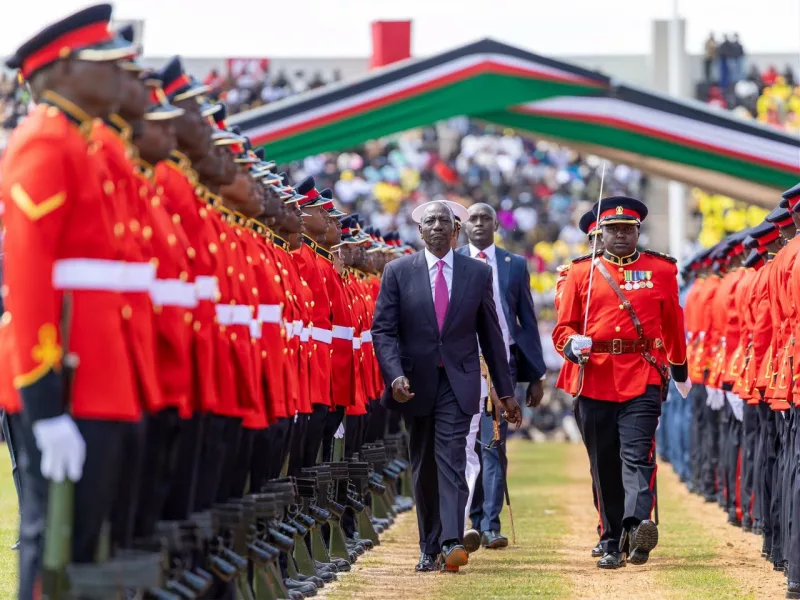
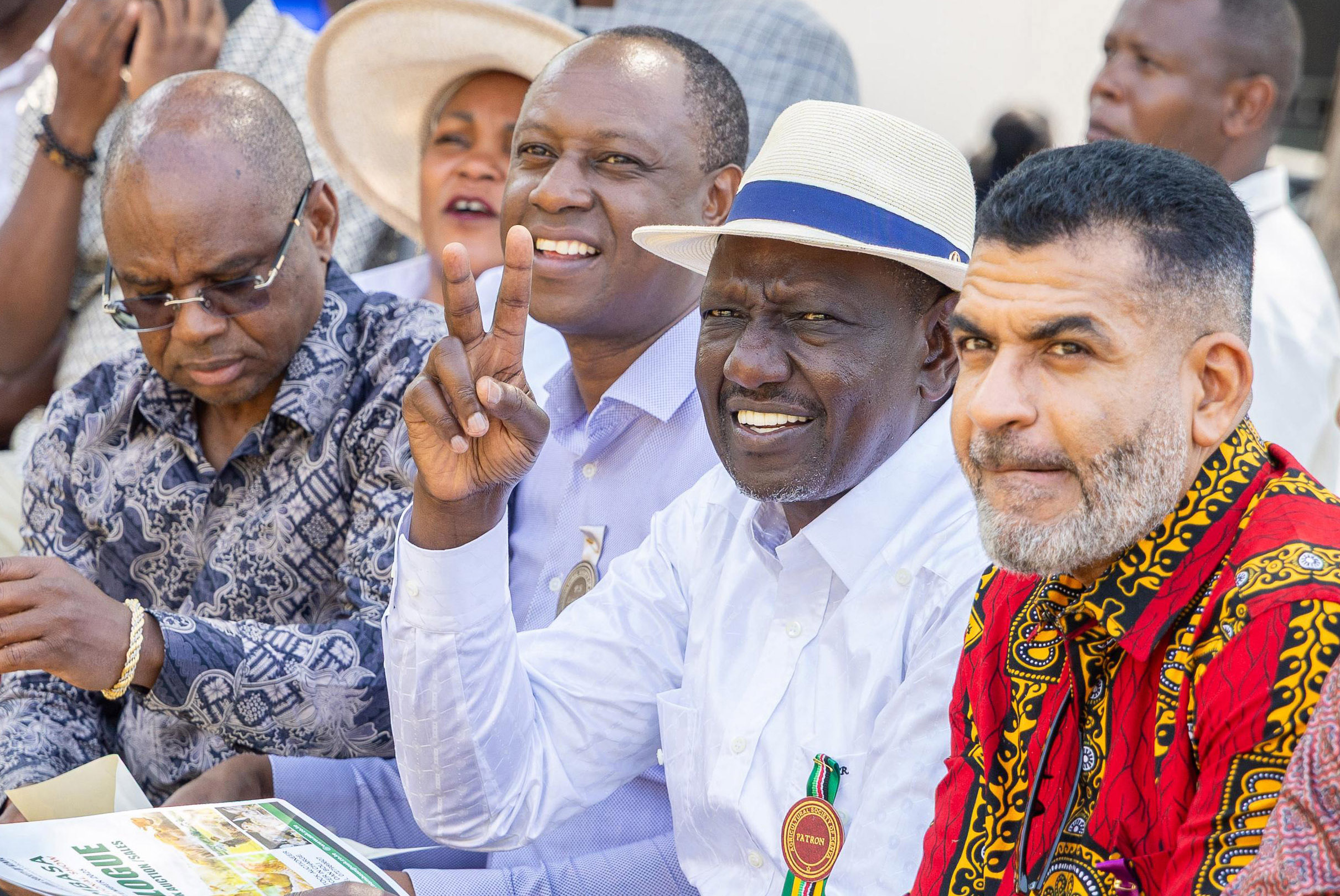
 President William Ruto with Senate with Amason Kingi (Left), PS Livestock Development Jonathan Mueke and Mombasa Governor Abdullswamad Sherrif Nassir (Right), during the Official opening of the 2025 Mombasa ASK International Show, Mombasa County on 4/9/2025 /EDWARD ALUSA/PCS
 Marking three years at the helm, President William Ruto’s Kenya Kwanza administration has laid out a comprehensive account of its performance.
The brief presents a narrative of resilient economic recovery and deep structural reforms across key sectors despite facing what the Ruto team describes as "global headwinds”.
In a detailed report, State House contends that bold decisions have steered the Kenyan economy through a turbulent post-COVID environment, a historic drought, rising global interest rates and a crippling debt crisis.
The government’s central claim is that its policies have not only stabilised the economy but have positioned it for transformative growth.
The economic figures presented in the State House brief are striking, detailing how the country has been on a recovery path since the current administration took over.
It states that since August 2022, Kenya has recorded an average annual GDP growth rate of five per cent, arguing that it surpassed both the global average of 3.3 per cent and the regional African average of 3.8 per cent.
“The economy has demonstrated remarkable resilience and recovery through bold decisions by President Ruto, reflecting the strength and effectiveness of his economic reforms,” State House said.
The government says the evidence of its interventions is through the positive ratings by the International Monetary Fund (IMF).
The trajectory propelled the economy to a projected size of Sh17 trillion ($132 billion) by May 2025, as per IMF estimates.
“This has positioned Kenya as the largest economy in East and Central Africa and the sixth-largest economy on the African continent.”
For ordinary Kenyans, the government holds that the macroeconomic stability has translated into tangible relief.
It cited the drop in inflation, which, despite having peaked at 9.6 per cent in October 2022, had been tamed to 3.8 per cent by May of this year, easing the cost of living.
President Ruto has also taken credit for strengthening the Kenyan shilling, appreciating from Sh162 to Sh129 against the US dollar, saying the performance is ranked among the world’s best.
Consequently, the Central Bank Rate fell from 13 per cent to 9.75 per cent, lowering the cost of credit.
Perhaps most symbolically for Kenya Kwanza, some seven million Kenyans were delisted from the Credit Reference Bureau (CRB), unlocking their access to formal financial services.
FOOD SECURITY
A cornerstone of the Ruto administration’s agenda has been the transformation of agriculture.
The government highlights a decisive shift from consumption subsidies to production support, coupled with reforms aimed at dismantling cartels.
The registration of 6.6 million farmers on a digital platform is credited with eliminating fraud in fertiliser subsidies.
“As a result, food production has increased by 50 per cent, improving both rural livelihoods and national food security,” the brief reads.
Ruto team says that from the moves, milk prices rose from Sh35 to Sh45 a litre, coffee prices surged from Sh65 to between Sh110 and Sh150 per kilogramme, and tea earnings grew from Sh138 billion to Sh215 billion.
Kenya Kwanza further holds that sugar production has nearly doubled to 815,000 tonnes, and maize output jumped from 40 million to 64 million bags.
As per the brief, the focus is on revitalisation of cotton, rice and edible oils value chains. It also wants to pursue tax reliefs for various agriculture value chains.
Kenya Kwanza further eyes the completion of sugar mill leasing “to set Kenya on the path to becoming a net sugar exporter.”
In education, the government points to major structural reforms tackling underfunding, infrastructure gaps and teacher shortages.
The hiring of 76,000 new teachers and 23,000 new classrooms, and the Competency-Based Curriculum reforms are cited in the report.
It is emerging that the programme was renamed as Competency-Based Education and Training (CBET). In this period, the university funding model was shifted to a student-centred approach.
The target is to recruit an additional 24,000 teachers by January 2026, construct 1,600 new science labs and overhaul the student placement criteria.
On healthcare reform, a long-promised goal, is cited as a key achievement with the launch of the Social Health Authority (SHA) in October 2024.
The report details that SHA has registered 24.7 million Kenyans, a massive increase from the seven million covered under the previous NHIF system.
“Universal healthcare, long promised, long delayed, is now becoming a reality under President Ruto’s administration,” the brief adds.
The government holds that the launch of SHA was the “turning point in health financing and access.”
It provides free primary healthcare, emergency services and coverage for critical illnesses.
The funding model requires all Kenyans to contribute 2.75 per cent of their income, replacing a system deemed unfair to the poor.
A network of over 107,000 community health promoters has conducted millions of household visits, the state said.
“By June 2025, the scheme had benefitted 5.75 million patients and mobilised Sh49.2 billion,” State House said.
Ruto has also fronted the Affordable Housing Programme, a flagship project, as among his milestones in his legacy plan.
He reports that the venture is active in 44 counties and aims to deliver 150,000 units.
The government says it has already created over 320,000 jobs under the programme, citing the recent handover of homes to 1,000 families in Nairobi’s Mukuru Estate as testament to its commitment to give Kenyans decent housing.
“For the first time in post-independence history, the dream of affordable, dignified housing for all is within reach,” State House said.
Financial inclusion has been driven by the Hustler Fund, launched in the government’s first 100 days.
On this, Ruto says over 25 million Kenyans have accessed loans worth Sh70 billion, mobilising Sh4.5 billion in savings.
Its revolutionary credit scoring model is credited with enabling those previously excluded from the formal credit system to access loans.
“This marks a major milestone in democratising finance and empowering grassroots entrepreneurship,” the notes read.
On job creation, the government reports 320,000 jobs from the housing programme, 110,000 from the green ClimateWorx initiative, and 185,000 digital jobs.
Internationally, as per the brief, over 400,000 Kenyans have secured jobs abroad through new bilateral labour agreements.
Furthermore, the NYOTA programme, in partnership with the World Bank, is expected to provide Sh50,000 grants to 100,000 young entrepreneurs identified from every ward in the country.
Also cited is the historic shift in national savings following the overhaul of the NSSF contribution model after 57 years.
Moving from a flat rate, employees now contribute six per cent of their gross pay, matched by their employers.
Ruto says the change has already caused a massive inflow of capital.
Contributions since 2023 total Sh280 billion, quickly approaching the Sh320 billion collected over the previous six decades.
“By December 2025, NSSF contributions will have doubled to Sh640 billion,” the brief adds.
The fund is projected to hit Sh1 trillion by 2027, providing a vast pool of domestic investment capital.
Finally, the government has highlighted Kenya’s digital transformation, positing it has accelerated dramatically.
It is emerging that the country has installed 24,000km of new fibre optic cable and deployed 1,494 public Wi-Fi hotspots.
The government further reported that it has onboarded 22,500 government services onto the e-Citizen platform, up from just 353 in 2022.
Some 316 digital hubs are operational, with 404 more under construction, with State House saying the infrastructure supports skills training for 1.8 million youth and has facilitated 300,000 digital jobs.
A growing local manufacturing sector has produced 3.5 million devices and 30,000km of fibre, boosting self-reliance, the brief shows.
With two years to the elections, it is a race against time for President Ruto to deliver his 10-point manifesto, while balancing the cross-cutting interests.
INSTANT ANALYSIS
Presented as a unified track record, the report from State House offers an optimistic assessment of the past three years. It frames the Ruto administration as the architect of a resilient and rapidly transforming nation. The document serves as a comprehensive rebuttal to Ruto’s critics and a foundation for the government’s continuing policy agenda ahead of the 2027 election campaigns.