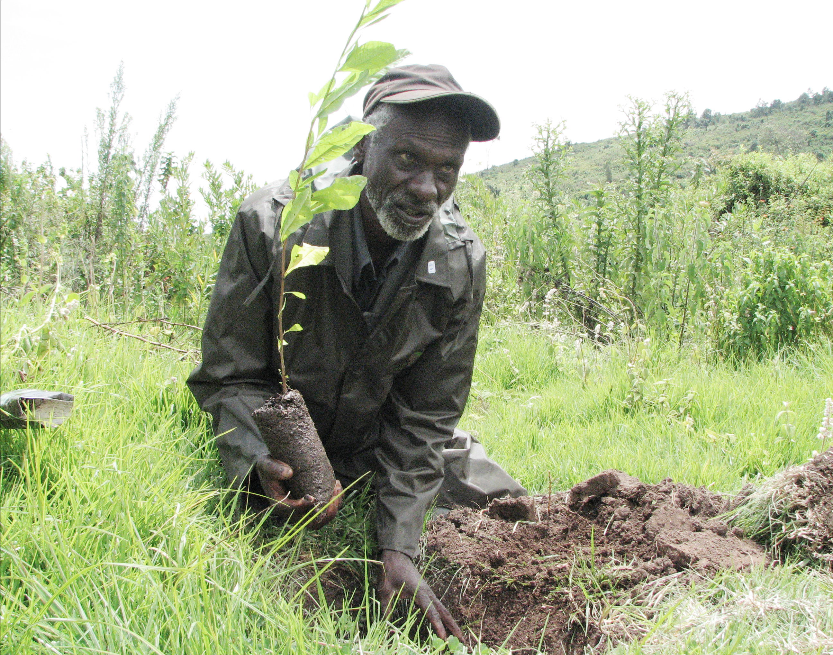
Communities bordering forests could soon get a windfall from the government if a proposed law that provides incentives for conservation is passed.
If enacted, the Forest Conservation and Management Bill, 2025, would provide for payment for ecosystem services for forest-adjacent communities.
It mandates the Kenya Forestry Research Institute to create a framework for the payments.
“The institute shall, in collaboration with stakeholders, establish a framework for the payment for ecosystem service schemes in public, community and private forests,” the Bill reads.
President William Ruto's administration has heightened forestation and promised incentives to conservators. Two national tree planting drives have been held in this regard.
To shore up the gains, the Kenya Forest Service and Kefri would be required to undertake a total economic evaluation of the forest ecosystem, such as carbon storage, water regulation and soil conservation, to form the basis for payments.
The institute shall develop operational guidelines to determine incentives for the ecosystem service and these shall be mainstreamed by the cabinet secretary (forestry) in consultation with the National Treasury.
Payments would be offered to landowners or communities in exchange for managing their land to provide ecological benefits such as protection of water catchment areas, reducing carbon emissions and general conservation.
Forest-adjacent communities, particularly those participating in Community Forest Associations (CFAs), will be the primary recipients if the law sails through the approval stages.
The Bill has been fronted amid the tension over alleged irregular human activities in Karura and Ngong forests.
Forestry CS is also being empowered to declare a specific cadre of the staff of the KFS as uniformed and disciplined officers of such ranks as shall be determined by the service.
Presently, the law requires the board, on the recommendation of the CS for Interior, to designate a category of officers to be uniformed and disciplined officers.
“The amendment also introduces mandatory training and oath of office for designated staff,” the Bill says.
The government, through the proposed law, further seeks to create a leeway to use forests for development projects. Currently, there is no express legislation on the same.
If enacted, the Kenya Forest Service would be empowered to grant easements in public forests, but strictly for public roads and critical installations and wayleave for public utilities.
The Bill also enhances fines for export or import of banned forest products to Sh5 million or three years in jail or both.
Fines for conducting illegal activities in forests like unauthorised felling, erecting illegal structures, allowing livestock in banned areas, clearing land for cultivation or smoking in restricted zones are also being enhanced from the current Sh100,000 to Sh1 million.
Irregular construction of roads, setting fire to forests, illegal possession of logging tools, moving forest beacons and collecting honey or beeswax without a license would also attract the enhanced fine for the culprits.
The Bill also seeks to reform forestry institutions and establish the Kenya Forest Academy to train forest officers.
It further creates the Office of the Director of Forest Regulation to standardise and oversee forest management practices, certification and compliance.
The officer’s responsibility would be to advise the ministry, receive complaints regarding the sector and maintain a national forestry registry to be linked to the carbon emissions database.
The officer would also be required to review licenses relating to dam construction projects, infrastructure projects in forests, including water pans, roads, pipelines, communication masts and base transceiver stations.
The officer would also be the one to authorise large tourism projects of more than Sh20 million and keep a register of licensed forestry professionals.
“A person shall not undertake timber grading unless the person is registered and licenced by the director to undertake timber grading,” the Bill says.
In the proposed law, Kefri is elevated from being under the Science, Technology and Innovation Act to a standalone entity - with a clearer and expanded mandate.
“The headquarters of the institute shall be in Kiambu county and may establish research centres, innovation and incubation hubs within the counties and agro-ecological zones in Kenya.”
The proposed law sponsored by Majority leader Kimani Ichung’wah further introduces forest certification and timber grading by licensed experts.
It also mandates buffer zones in forests to reduce edge effects and enhance ecosystem services.
“A forest owner shall identify and designate specific areas of forest as buffer zones to reduce negative edge effects and enhance ecosystem services,” the bill reads.
It also spells that county governments would implement national policies on forest management and conservation.
INSTANT ANALYSIS
The bill correctly identifies that you cannot protect forests without supporting the people who live in them, pioneering a shift from pure policing to incentivised stewardship. The proposed payments for ecosystems represent a visionary and globally relevant approach. However, the very provisions designed to empower, like boundary changes for development and enhanced enforcement, could become tools of exclusion if not implemented with transparency and community consultation.