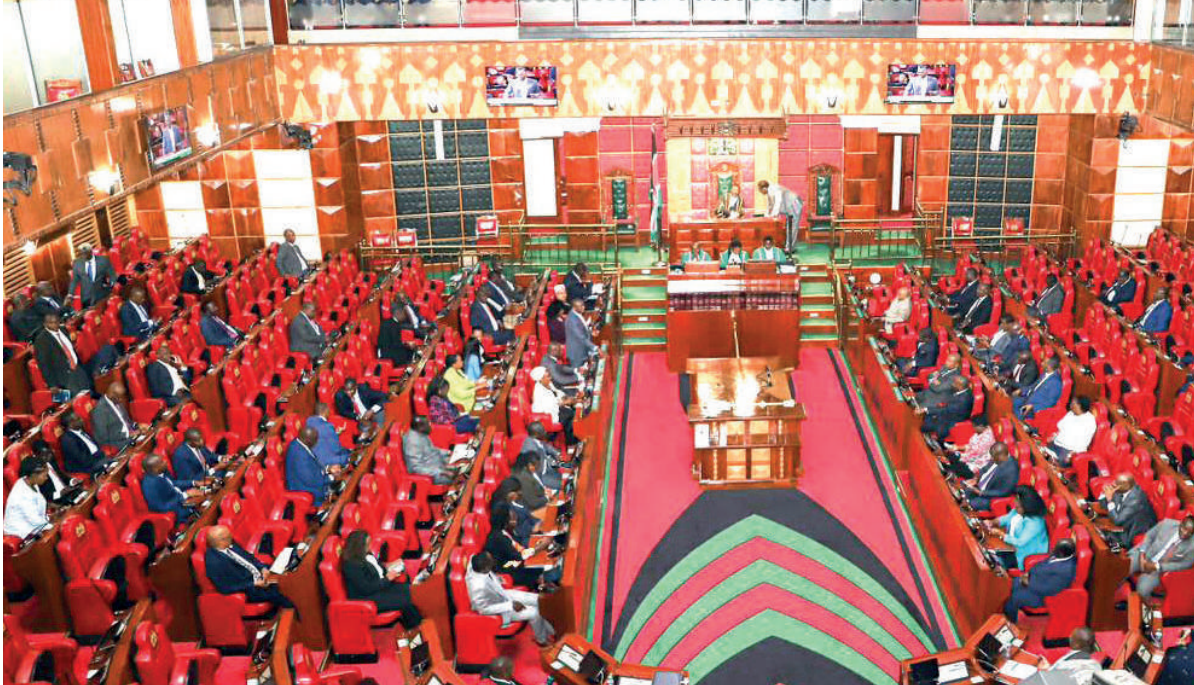
 National
Assembly in
session /FILE
National
Assembly in
session /FILE
The Law Society of Kenya has filed a case which, if upheld, would threaten the careers of MPs and shatter the ambitions of countless aspirants gunning for the country’s high political offices in the 2027 elections.
In the suit filed at the High Court by advocate Wasonga Ouma on behalf of LSK, the society accuses six agencies of allegedly failing to enforce the Leadership and Integrity Act as well as the Public Officer Ethics Act.
If the prayers are granted by Justice Chacha Mwita, serving political leaders and tens of aspirants with criminal cases, including corruption, would be stopped from contesting.
The LSK has called out the agencies, including the Independent Electoral and Boundaries Commission, for perpetuating a political culture of impunity.
Apart from IEBC, the LSK has also sued the Ethics and Anti-Corruption Commission, Registrar of Political Parties, Parliamentary Service Commission, National Cohesion and Integration Commission and the Attorney General.
It argues that the agencies have for 15 years failed Kenyans on the vetting of political aspirants, thus have “collectively neglected their duty to craft and enforce a mandatory code of conduct for MPs and aspirants.”
“All the respondents to this suit are capable of being found to be wholly culpable of the constitutional violations towards the public of Kenya by not crafting or facilitating the creation of a code of conduct to vet and sustain the highest possible levels of integrity in elected civil servants in the country,” the petition reads.
The lawyer’s body, in the petition before Justice Mwita, wants the road made narrower for persons of questionable integrity, with the consequence of stopping them from the ballot.
The LSK seeks an order compelling the IEBC and the Registrar of Political Parties to vet not just academic papers but also the moral and ethical fitness of every person seeking nomination.
It also wants an order that all information provided to the agencies relating to persons who have fallen short of the integrity threshold be admitted as proof, ipso facto, in legal parlance.
The suit aims to move the country from the current system, where one must be convicted of a crime, to one where a proven pattern of unethical conduct, hate speech, or corruption allegations could be grounds for disqualification before an election.
The LSK seeks orders that Kenyans can provide information on the lack of integrity of individuals seeking or presently holding elective public office before they are cleared to run for office.
“All the respondents have the obligation to ensure that positions and individuals both seeking to be publicly elected, are serving, or derive social capital from elective leadership in Kenya, are staffed by individuals that not only fulfil the requirements of the Leadership and Integrity Act but also the Public Officer Ethics Act of Kenya,” the LSK suit states.
The lawyers argue that the agencies have not gazetted the code of conduct and ethics for public officers as required by law.
“In the same vein, there has been no discernible attempt to implement the general code of conduct in vetting the integrity and suitability of such individuals before, during, and after the elective process for Members of Parliament.”
The LSK further says no code has been enforced to address the integrity shortfalls among elected civil servants in Kenyan politics.
For IEBC, the lawyers argue that the commission has failed to investigate and prosecute electoral offences by candidates, political parties or their agents.
The LSK points to a legal gap in the failure by MPs to enact the law empowering IEBC to establish the prosecution arm of its operations.
“Tellingly, Parliament has not simply passed the legislative addition that would create this body to prosecute electoral and political offences.”
In 2022, the EACC blacklisted more than 240 aspirants, saying they were unfit to vie for public office. It held that they had fallen short of the moral and ethical standards for public office.
The anti-graft agency asked the IEBC to bar two presidential aspirants, 61 governor and deputy governor candidates, 19 woman representative hopefuls, and 58 who sought MP seats.
In response, the IEBC only flagged fewer than five candidates, citing legal complexities, and that the individuals were required to exhaust appeals before they were disqualified.
The LSK argues that the IEBC has no excuse to disobey the constitutional requirement for good governance and has a duty to ensure that candidates allowed to run meet the set threshold.
“The IEBC is tasked by the law to be the ultimate creator, improving agency, and enforcer of the integrity of individuals seeking elective office, given that it is the gatekeeper and facilitator of the electoral process.”
They further posit that the EACC be compelled to fulfil its duty to vet the integrity of nominees political parties allow to run.
For PSC, the lawyers hold that it has to live up to its obligation of using internal processes to ensure members operate according to the law.
They state that as a result, “Kenya, as a country, has suffered immensely under the weight of elected public servants whose integrity was questionable before, during, and even after the electoral process.”
For sitting MPs, the society wants the court to order the PSC and the Salaries and Remuneration Commission to “immediately cease to facilitate the payment of any monies to elected civil servants…the instant that any such individual is proven to have violated the standards of integrity.”
Past attempts to enforce integrity rules in elections have failed, raising the question of whether the decision will transform the country’s ethics framework and tame the political elite.
In 2021, the then-handshake team mooted a plan to lock out graft suspects from being cleared to vie in the 2022 general elections.
The lawmakers pushed for amendments to the Leadership and Integrity Act, which were aimed at blocking anyone facing serious crimes from contesting any seat.
“We want to ensure that Chapter Six of the Constitution of Kenya 2010 is given proper effect,” the team, which was led by then Leader of Minority Opiyo Wandayi (now Energy CS) argued.
The constitution provides that a person is disqualified from vying as an MP if they are subject of imprisonment of at least six months as at the date of registration as a candidate.
Persons found to have misused or abused a state or public office or in any way contravened Chapter Six of the constitution can also be barred.
But in the face of the legal complexities, governors, MPs, and other politicians who faced criminal, fraud and murder charges were cleared by the IEBC to run.
The EACC at that time said it could only raise the red flag, but the final call must made by the polls agency.
Lawyers representing some of those who were targeted in the clampdown argued that, “You cannot limit political rights granted by the constitution.”
The LSK case targets the life cycle of a politician from the point of nomination, during elections, and during their tenure.
INSTANT ANALYSIS
The ripple effects of the suit would fundamentally alter the country’s political landscape. Political parties, regulated by the registrar, would be forced to put their houses in order. If the court so orders, they would no longer be able to nominate controversial but popular candidates for electoral expediency. Their internal nomination processes would be subject to stringent integrity oversight, forcing them to develop proper internal ethical committees or face deregistration.