
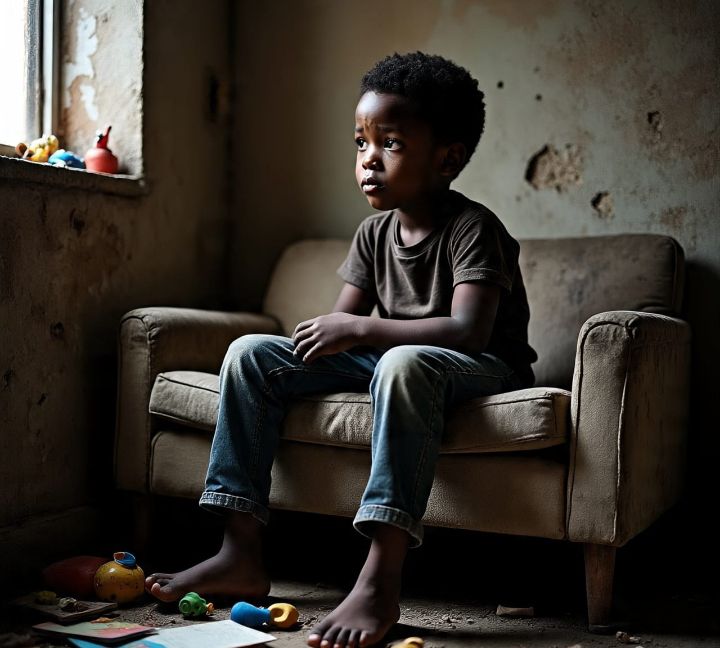
In the heart of Pangani, where the rhythm of life is set by the chatter of hawkers and the shuffle of hurried feet, 25-year-old Millicent Akinyi told her story with a quiet strength.
A hawker by trade, she spoke of a childhood marked by scarcity- a past that still lingers in every struggle she faces today.
Growing up in Kitui under the harsh Kenyan sun, she learned the weight of responsibility before she even learned the weight of her own dreams.
“The eldest of six, I became the quiet backbone of my family while still being a child,” Akinyi said.
When her classmates raced home to play, she hurried back to a house that was not a home, but a test of endurance.
Washing her siblings, coaxing them through their homework, and stirring thin porridge over a fire that coughed more smoke than flame- she did not have a moment of rest.
“By the time I turned 7, I was forced to take the role of a third parent at home,” Akinyi stated.
Her parents returned late from menial village jobs, too tired to notice that their firstborn had already traded her childhood for survival.
“Even at school, my mind wandered away from the blackboard and into the endless lists of evening chores,” Akinyi said.
She thought less about arithmetic and more about the three heavy jerry cans waiting to be refilled by the stream.
Or how she would stitch and re-stitch her frayed uniform in secret, praying the seams held long enough.
Poverty branded her different. While other students carried new books, hers were borrowed and tattered. Her peers walked with ease.
On the other hand, he carried the invisible burden of school fees, always on the verge of snatching her future.
“The shame of it all made me crave an escape- a chance to feel ordinary,” she said.
Therefore, the moment she finished high school, she leapt into a relationship, desperate for belonging.
When pregnancy came six months later, she felt no fear—just resignation.
“I thought a better life was never meant for me,” Akinyi said.
However, when her boyfriend denied the child without hesitation, the truth struck harder than the gossiping whispers of the village- she was alone.
Now, five years on, she stands in Nairobi’s choking traffic, hawking sweets and handkerchiefs with her son tethered to her side.
Her hands are blistered, her spirit worn, yet her voice is sharp, hustling for coins that never add up.
“Each day I wonder if life could have been different had I been born into ease, not scarcity,” Akinyi lamented.
“And yet, despite the weight of all I carry, I still have a stubborn flicker of hope- maybe the cycle of poverty will end with me,” Akinyi added.
While Akinyi’s journey unfolds on the bustling streets of Pangani, just a few miles away in Juja, Brian Kimani’s story is written in soap suds and sweat- two lives shaped by hardship, yet driven by the same quiet resilience.
At first glance, the 30 year-old looks like just another young man hustling at a car wash, but his story runs deeper.
“Poverty was never in my cards during the first years of my childhood,” Kimani admitted.
Life back then- before tragedy carved its deep scars- was simple, steady, and safe. His father’s job at a reputable company might not have made them wealthy, but it gave them stability.
Rent was paid, meals were hot, and once a month, amusement parks became their ritual.
“I still remember the taste of cotton candy on my tongue and the laughter of my younger sister echoing through Rock City,” Kimani recounted with a smile.
“Our parents would spend the day running after my sister and I throughout the amusement park,” Kimani added.
That world collapsed the day his father’s life was snatched away in a horrific accident. The grief was crushing, but the cruelty that followed was worse.
His father’s relatives arrived with sharpened tongues and iron fists, evicting them from the one-bedroom house his father had built.
“They claimed it was family property and since my father had passed, we were no longer part of that family,” Kimani expressed.
“My mother, too broken to fight, accepted defeat,” Kimani added.
Within weeks, he found himself staring at rusted iron sheets and cracked walls in a tiny bedsitter in Mathare- a downgrade so sharp it sliced through his childhood innocence.
Meals became negotiations with fate. His mother’s receptionist salary stretched thin, and grief shadowed her every step. At ten, he should have been chasing footballs.
Instead, he was pushing a mkokoteni cart through narrow alleys, hauling loads heavier than his body for a few coins.
“I learned early that the world doesn’t pause for your pain,” Kimani emphasized.
Years later, he still drowns in the relentless undertow of poverty’s abyss. Almost every shilling goes back into the black hole of survival.
His mother’s blood pressure medication, his sister’s school fees, and rent that swallows half his income.
He knows other men his age who are saving for cars, land, even weddings.
“I can’t even imagine affording a date,” Kimani commented.
Every day is a grind for survival, an endless wrestle with debts, burdens, and ghosts he never asked to inherit.
Love, for him, feels like an indulgence reserved for people whose lives are not shackled to generational misfortune
“My battlefield is poverty, and though scarred, I fight on for the fragile hope that my sister’s future won’t look like my past,” Kimani emphasized.
While many who grow up underprivileged struggle later in life, others defy the odds, breaking free from the cycle of poverty.
In Kilimani, where the streets hum with music and neon lights, 32-year-old club owner Jackline Chebet stands as a symbol of grit.
She explained that her story does not begin with the glamour of nightlife, but with the silence of growing up underprivileged.
Raised with little to her name, she quickly learned that being without parents did not soften the harshness of poverty- it magnified it.
“Orphaned too young to remember my parents’ faces, I was left in the care of her aunt who resided in Nairobi,” Chebet said.
“Even though my aunt was woman with a good income, her heart turned cold at the sight of me,” Chebet stated.
While her cousins wore neat uniforms and packed heavy lunchboxes, she wore secondhand rags.
Every smile she offered was met with indifference- every hope of comfort with silence.
“Can you imagine that after years of keeping my head down and enduring mistreatment, my aunt kicked out when I turned 18?” Chebet grimaced.
“With a single bag and a thousand emotional scars, my only option was to live in the streets,” Chebet added.
For a girl who had never been charmed by academics, she knew that succeeding through academics was not feasible for her.
Nairobi streets greeted her with chaos- the kind that either swallows you or teaches you to swim.
“The streets became both my home and battlefield,” Chebet voiced.
Nights were spent shivering on cold pavements, clutching the little she owned while fending off other desperate souls who tried to snatch it away.
Hunger gnawed at her daily, but it was the constant threat of violence that carved the deepest scars.
Moments when shadowy figures loomed too close, and narrow escapes from sexual assault became part of her survival story.
“Each dawn was less a promise and more a question- would I make it through another night?” Chebet commented.
“However, my extroverted spark, the one thing my aunt could never dim, became my weapon,” Chebet expressed.
After a year of barely surviving in Nairobi streets, her lucky stars finally aligned. Through a friend, she landed a job as a bottle girl in a Westlands club.
“My friend was even gracious enough to host me till I became financially stable,” Chebet mentioned with a smile.
To outsiders, it was a label dripping with judgment. However, for her, it was survival dressed in sequins. And survival was dignity.
“Knowing that ultimately these people could not even offer to pay my rent, their mean comments became background noise,” Chebet said.
She embraced the work with a fire that made her stand out. She was not just serving drinks- she was selling an experience.
Her laughter filled corners, her presence kept regulars coming back, and her work ethic turned heads.
“Nairobi’s nightlife became my classroom,” Chebet said.
She studied people, built networks, and mastered the business beneath the flashing lights.
In five years, she had not only saved enough money but also earned the trust of investors who had seen her grit up close.
“With pooled savings and boldness that had carried me that far, I opened my own club in Kilimani,” Chebet expressed.
Today, she walks through the neon-lit doors of her establishment with her head high. The girl once thrown out with nothing but despair now signs paychecks, creates jobs, and chooses her own destiny.
Her story is not wrapped in polished degrees or fairy-tale rescues- it is carved out of sweat, resilience, and a refusal to let her background dictate her worth.
“I found my freedom in the very place people thought I would lose it- I wouldn’t have it any other way,” Chebet stated.
Akinyi hustling through Nairobi’s traffic, Kimani scrubbing cars with calloused hands, Chebet commanding her own nightclub empire, each story carries the same heartbeat- resilience.
These stories remind us of the cost of poverty and the human potential that emerges when survival becomes a classroom.
Their lives may be scarred by struggle, but they burn with a stubborn resilience- a reminder that while poverty shapes beginnings, it does not have to dictate endings.







