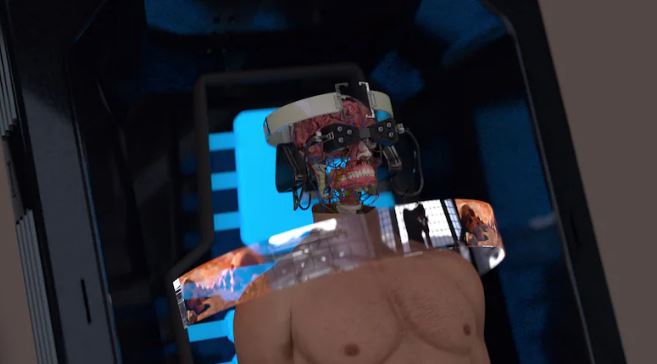
 A model on the Cognify AI machine./Courtesy of Hashem Al-Ghaili
Imagine a prison model that prioritises rehabilitation over punishment, offering inmates a radically different path.
Instead of serving a traditional sentence, offenders could choose a revolutionary alternative: undergoing an AI-driven memory-implantation process that places them in the shoes of their victims, designed to awaken genuine remorse and understanding.
At the heart of this speculative system—called Cognify—is the concept of transmitting vivid, artificial memories into a person's mind to deepen empathy.
Cognify became known to many online users last year June after a a short video was circulated on Instagram sparking heated debate about what prisons might one day look like.
The animated clip introduced viewers to Cognify-a concept that replaces prison cells with high-tech pods where offenders undergo AI-driven memory modification.
The vision is unsettling. In the render, prisoners are strapped into futuristic pods, fitted with headsets, and exposed to artificially generated memories designed to reshape behavior.
According to the idea, violent offenders could be forced to relive their crimes from the viewpoint of their victims.
People convicted of drug offenses might experience fabricated memories that mimic the challenges of addiction and recovery.
At the same time, neuroscientific techniques would manipulate hormones and neurotransmitters to provoke emotions like remorse and regret.
Unlike a conventional sentence, the system is presented as a choice: prisoners could either serve time in the traditional way or undergo Cognify treatment.
The pitch is that the entire process could take only minutes, after which the individual would be considered rehabilitated and released.
For the prisoner, it might feel like years of punishment and reflection had passed, even though in reality, no time had elapsed.
While the concept sounds like something from a dystopian film, it is loosely rooted in real scientific progress. Researchers have already implanted false memories in laboratory mice and even altered emotional associations, turning fearful recollections into positive ones.
In 2018, scientists managed to transfer a memory from one marine snail to another, and years earlier, DNA from gut bacteria was used to store moving images.
Combined with rapid advances in artificial intelligence, including text-to-video systems like OpenAI’s Sora, these developments form the speculative foundation for Cognify.
For now, it remains only an idea. But the conversation it has ignited—about punishment, rehabilitation, and the limits of technology—suggests society is already grappling with what the future of justice might hold.
The concept of Cognify was developed by Hashem Al-Ghaili, a Berlin-based filmmaker and science communicator.
In a recent interview with US-based online publication Dazed, Al-Ghaili explained that the idea was partly a response to the shortcomings of existing justice systems.
Issues such as overcrowded prisons, wrongful convictions, and limited success in rehabilitating offenders, he argued, could all be tackled through a system designed to provide “a more effective path to reformation and societal reintegration.”
Under the proposal, the process would begin with a detailed brain scan. This scan would map the prisoner’s neural structure, allowing Cognify to identify where to implant artificial memories and how to adapt them to each individual.
The implanted experiences would be intended to alter future behavior, creating feelings of remorse or empathy that traditional incarceration often fails to instill.
At the same time, the data collected from these scans would be stored in a central system for research purposes.
The stated goal would be to gain deeper insights into criminal psychology and to refine strategies for preventing future crimes.
Critics, however, are quick to point out the risks. The idea of surrendering brain data to a central authority and undergoing direct neurological manipulation raises concerns about privacy, consent, and potential misuse.
For many, the vision of Cognify blurs uncomfortably into a high-tech form of social control.
How It Works
Inmates would face a clear choice: either serve time in the usual way or opt for a “fast-track rehabilitation” via implanted memories.
These aren't pleasant daydreams, but carefully crafted recollections based on what the victim might have felt—an emotionally immersive experience simulated through cutting-edge AI.
Proponents argue that this method might address the underlying motivations for criminal behaviour more effectively than conventional incarceration.
By experiencing the emotional consequences of their actions firsthand—albeit artificially—offenders might be less likely to commit future crimes.
Faster rehabilitation and reduced recidivism could translate into major savings and a more constructive correctional environment.
Promises and practical challenges
Al Ghaili says. “Every technology carries risks, but with strict ethical standards, legal frameworks, and oversight, we can overcome these risks.”
Cognify is envisioned as faster, more cost-efficient, and more humane—potentially creating rehabilitation-focused prison systems. However, the concept raises serious concerns.
Scientific feasibility: Human memory is extraordinarily complex. Crafting realistic, emotionally accurate memories for implantation is far beyond our current capabilities and could result in unpredictable psychological impact.
Ethical implications: Questions about genuine consent loom large. Would prisoners truly be free to decide, or pressured by the promise of a lighter sentence?
Moreover, could this technology be misused or applied inequitably, deepening existing biases within the criminal justice system?
Why it matters
While still firmly speculative, Cognify provokes a valuable conversation about the future of criminal justice.
It challenges the world to reconsider punitive approaches and imagine systems grounded in empathy and transformation rather than retribution.