

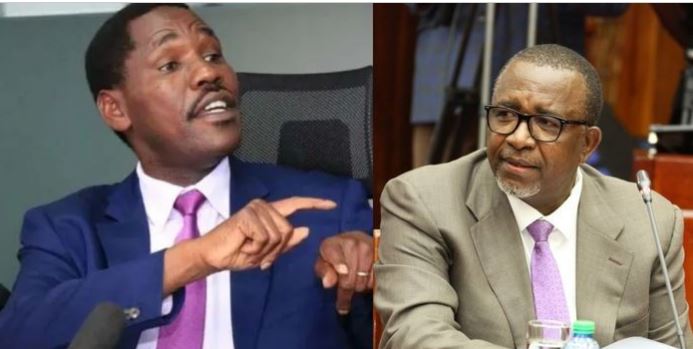
 A collage of former Agriculture CSs Peter Munya and Mithika Linturi./FILE
A political storm is brewing in Meru as Party of National Unity leader Peter Munya and Democracy for the Citizens Party official Mithika Linturi lock horns in what political observers warn could revive echoes of the bitter Uhuru–Gachagua 2022 rivalry.
The two are setting the ground for 2027 election as they prepare to contest for Meru gubernatorial seat.
Political analysts note that Munya, a close ally of former President Uhuru Kenyatta, and Linturi, a key supporter of former Deputy President Rigathi Gachagua, represent the two rival camps that bitterly contested the Mount Kenya vote in 2022.
Their renewed confrontation, they warn, could reopen old political wounds, polarise local leaders and reignite factional battles that once divided the region along pro-Uhuru and pro-Gachagua lines.
Munya has already accused Gachagua of undermining multiparty democracy by pushing DCP as the sole political vehicle for the Mt Kenya region.
Speaking during the launch of a new PNU office last week in Meru, Munya dismissed Gachagua’s calls for a single political front.
“Usituambie mlima chama ndio hii (Don’t lecture us about just one party).Every Kenyan has the right to join the party they want. If you have your party, sell your manifesto and let the citizens decide,” Munya said.
On the other hand, Linturi has portrayed Gachagua as the legitimate leader of the larger Mount Kenya region.
Linturi, while addressing a rally in the region, said that Meru is not short of capable leaders, emphasising that the DCP party remains firmly rooted and will continue to dominate the area’s political landscape.
He urged local leaders to stand firm and refuse to be cowed by emerging political factions or external pressure.
“Meru has no shortage of formidable leaders who can liberate this region. The DCP wave is unstoppable, and we must restore the dignity and respect of the Meru people,” he said.
“We must rally behind Gachagua to reclaim Kenya’s leadership and send Ruto and his team packing. Once that is done, we can chart the way forward together and decide who will take over from who.”
Since Gachagua was ousted as DP, he has aggressively marketed DCP as the defender of Mt Kenya’s interests, branding rival outfits as “small wheelbarrows” aligned to President William Ruto’s UDA.
Already, TSP leader Mwangi Kiunjuri has warned Gachagua of his style of tribal politics saying that the Mount Kenya region risks being alienated by other communities.
Kiunjuri has accused Gachagua of vendetta-driven politics, claiming that the former DP has lost sight of the region’s real needs and is instead pushing a personal agenda.
“Gachagua has become a man on a revenge mission. He is not offering any solutions. He is attacking others to hide his failures,” Kiunjuri said, calling on the Mt Kenya electorate to rise above divisive politics.
In 2022, Uhuru and Gachagua were on opposite sides of the political divide — Uhuru backing Raila Odinga while Gachagua rallied behind William Ruto. The two completely fell off, as Gachagua would publicly insult Uhuru and his mother Mama Ngina Kenyatta.
Although Gachagua later apologised to the Kenyatta family, the current exchanges between their followers suggest the rivalry could be reignited, this time under new party colours.
With PNU rumoured to be in coalition talks with Jubilee and DCP expanding its grassroots networks, Meru is emerging as a political flashpoint where Mt Kenya’s old wounds could reopen.
Political analyst and Kandara parliamentary aspirant John Mburu has warned that the ongoing divisions could destabilise the Mount Kenya voting bloc and undermine the region’s bargaining power.
He argued that the alleged fight between Munya and Linturi is “a new version of the broader Mt Kenya succession battles.
Mburu argued that although the two have not differed publicly, the recent move by Munya to attack Gachagua whom Linturi subscribe to his ideology might create political tension among followers.
“Munya is defending the multiparty legacy that Uhuru’s allies cherish, while Linturi is executing Gachagua’s consolidation strategy. The moment the two clash, the Uhuru–Gachagua fault line becomes active again,” he said.
Kiamwangi MCA Kung’u Smart echoed similar sentiments noting that Meru contest is more than party branding.
He argued that Linturi has been positioning himself as Gachagua’s chief lieutenant in Meru while Munya leans on his legacy as a seasoned “old guard.”
“This is not just about PNU versus DCP. It’s about who will control Mount Kenya east political machinery in 2027. Munya and Kiraitu Murungi have long seen themselves as Mt Kenya East’s gatekeepers — new entrants like Mithika might find themselves are finding the region heavily guarded,” Kung’u said.
Ironically, the two early this year once hinted at working together to counter President Ruto’s influence — a partnership that now appears unlikely after Linturi’s recent political shifts.
“When you see me with Munya, know that we are sending a message: all Merus are aboard this vehicle,” Linturi once declared, in remarks that puzzled observers given their earlier political differences.
However, some players argued that the tensions are part of the natural way of democracy.
“Healthy competition within a political region can be a good thing. It forces leaders to be more accountable to the people, sharpens policy debate and prevents complacency,” Jomo Kenyatta University of Agriculture and Technology lecturer Charles Mwangi.
Mwangi said that Mount Kenya region has weathered similar internal rivalries before without losing its national influence.
DP Kithure Kindiki, who also hails from the Mt Kenya East region, is reportedly grappling with similar turf wars as rival camps jostle for political dominance.
Earlier, reports emerged that Kindiki had fallen out with Embu Governor Cecile Mbarire — a rift so deep it nearly pushed her to quit the UDA party.
Additionally, he is said to have had bitter fallout with former Public Service Cabinet Secretary Justin Muturi, as he sought to assert his authority and consolidate influence in his role as DP in the region.
Already, Kindiki has managed to rally almost all elected leaders from Meru, Embu and Tharaka Nithi counties, consolidating significant influence in the region.
Ruto has repeatedly lauded Kindiki for fostering unity within the community—often in stark contrast to his criticism of former DP, whom he has accused of promoting tribal politics and sowing discord within government.
“I have become a lonely voice in the presidency, speaking about our projects and programmes. My brother Kindiki, you are eloquent and intelligent. I am confident that you will do that which I have missed for the last two years,” Ruto declared last November, during Kindiki’s swearing-in.
Since then, Kindiki has embarked on a flurry of meetings with regional leaders in a bid to rally them under one political umbrella within the Kenya Kwanza administration—a move aimed at solidifying both his influence and the coalition’s grip on Mt Kenya East.
Njuri Ncheke secretary-general Josphat Murangiri has warned that the persistent political wrangles among leaders in the Mount Kenya region risk derailing the community’s development agenda.
He urged Kindiki, Gachagua and other political leaders to put aside their differences and work towards unity.
“We have numerous leaders within the Mount Kenya region, and they should rally behind one leader to unite the region. Mount Kenya East and West are one community, which is why we operate under the Gema umbrella. We have even incorporated the Kamba community into our fold,” Murangiri said.
He further proposed the formation of two strong political parties—one representing Mount Kenya East and the other Mount Kenya West—before the 2027 election.
According to Murangiri, the parties should enter into a pre-election agreement and sign a binding memorandum to ensure a united front.
Thuo Mathenge, the national chairman of the New Democrats Party, has affirmed that the Mount Kenya region has fully embraced multiparty democracy, giving residents the freedom to choose their preferred political affiliation.
He said that the region does not belong to any single political party and cautioned against attempts to impose political choices on the electorate.
Mathenga also warned leaders against fanning tribal divisions or engaging in rhetoric that risks polarising the region, urging instead for respect of democratic freedoms and political diversity.
“Whether east or west, Mount Kenya region is one and we will not allow anyone to divide the region and bring enmity to our people for personal interests,” he said.
The recently impeached former Governor Kawira Mwangaza has also re-entered the political arena in Meru, rebranding the Umoja na Maendeleo Party once led by former Embu Governor Martin Wambora.
Political players claim that her move could complicate both Munya’s and Linturi’s equations, fragmenting the Meru vote even further.
They have cautioned that the growing party wars risk “splintering Mt Kenya’s bargaining power nationally.”
“Our strength has always been unity in diversity. When personal ambition overtakes collective strategy, we risk losing our negotiating edge in 2027,” John Wahinya, a political analyst and aspiring MCA in Nakuru county, said.
He said that with multiple parties opening offices, recruiting members and staking claims in all nine constituencies in Meru, the 2027 election in the region might be playing a different political game plan.
Wahinya warned that the political duel in the region could become a litmus test for Mt Kenya’s political cohesion:
“If this contest escalates, it won’t just be about Meru, Embu or Tharaka. It will influence alliances, national negotiations, and potentially, the presidential race,” he said.
During his tour of Mount Kenya, Ruto made a stop in Meru county on April 2, where he openly addressed the political tensions that had recently unsettled the region.
While urging the residents to rise above past differences, the President he appealed for unity and a collective focus on building a stronger future for the community and the nation at large.
He dispelled rumours that he had a hand in the impeachment of Mwangaza, noting that she has continuously supported women leadership.
“Here in Meru, there was turmoil, but by God’s grace, the court has settled the matter, and now you have a new governor. I urge my brothers and sisters from Meru—you have seen the losses that come with division among leaders. There’s no development, no plan, no progress,” he said.







