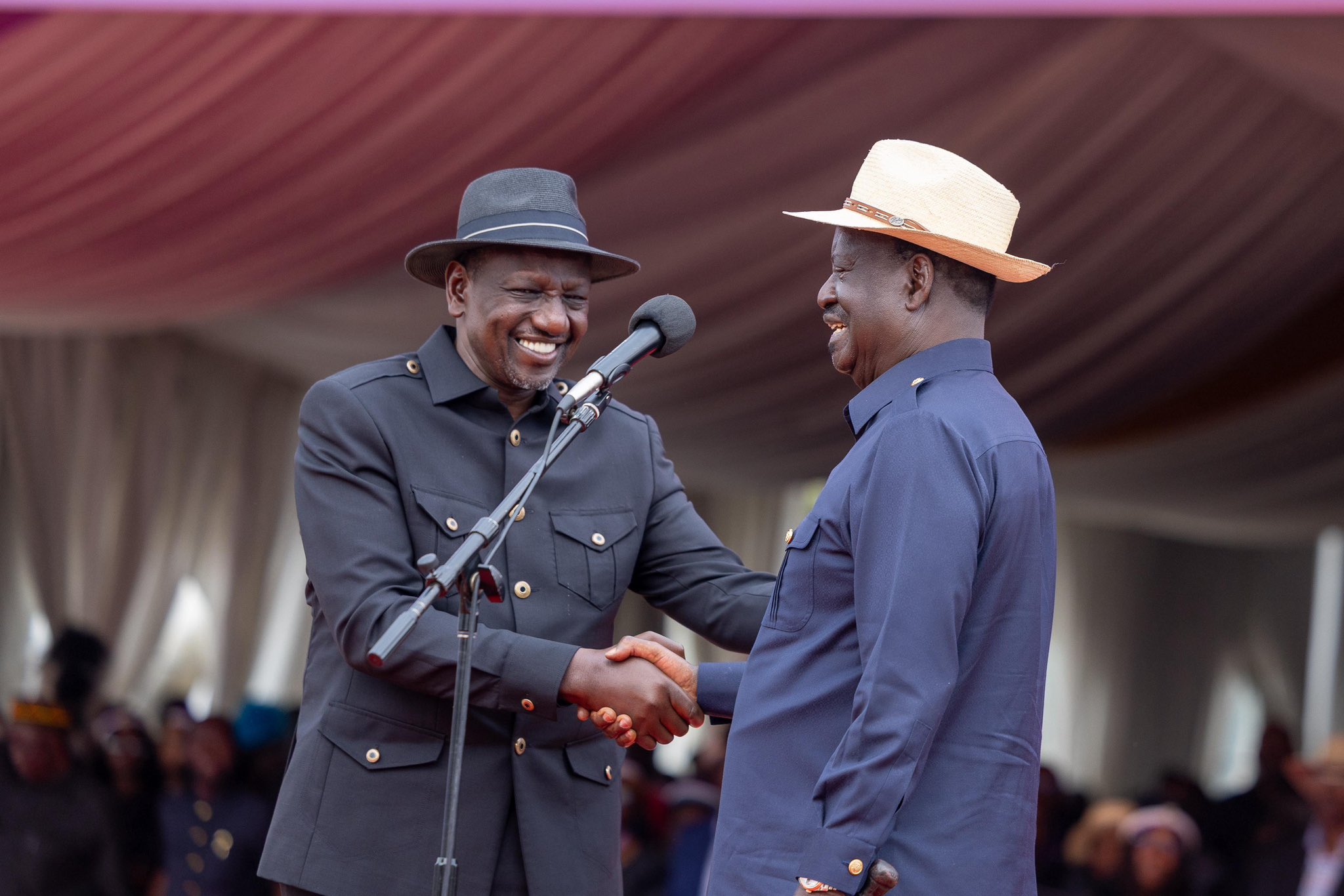
As the clock ticks towards 2027, the presidential race is slowly shaping up as a high-stakes political showdown with an unrelenting push to have Raila Odinga on the ballot.
President William Ruto is seeking reelection and potentially, could be challenged by Raila on one side and Wiper leader Kalonzo Musyoka on the other.
Already, alliances are shifting—some openly, others covertly—as other key political players make ethnic calculations, with voter fatigue looming large.
As much as Raila, 80, has maintained that the election is two years away, hence too early for discussion, he has left the door open for a possible sixth bid.
The former Prime Minister will be 82 in 2027, hence his candidacy is uncertain, with mixed signals about his ambitions.
But his party is busy preparing for the race. The Orange Party has scheduled county and national elections by October and will thereafter hold ‘ODM@20’ celebrations in Mombasa.
County meetings, which started in Kakamega, are also lined up in Wajir before being cascaded to all other counties, according to top officials.
“All that is geared towards strengthening our party, ODM, ahead of 2027. We have said we will field candidates in all positions, including presidency,” deputy party leader Godfrey Osotsi told the Star.
“What I don’t know is who will be our presidential candidate. It can still be Raila Odinga. If Baba wants to run, no one can stop him and no one can ask him to run,” he said.
The Vihiga Senator added, “Time will tell whether Baba will run or not, but ODM will definitely have a presidential candidate.”
Ruto enters the 2027 race as the incumbent, a position that historically favours reelection in African settings.
His Kenya Kwanza coalition has been consolidating power, co-opting opposition figures and has state machinery that could bolster his campaign.
If the message at his whistle-stops is to go by, Ruto’s narrative would revolve around economic transformation, infrastructure development and portraying himself as a "hustler".
Kalonzo Musyoka, the Wiper leader and former Vice President, has declared his intention to run in 2027, framing it as his "last shot" at the presidency.
His prospects hinge on several factors, key among them opposition unity, his response to Ruto’s criticism and whether he builds a successful coalition against the President’s alliance with Raila.
The Wiper boss has positioned himself as the lead candidate for Azimio, but internal competition and Raila’s confounding signals complicate his path.
Despite other candidates lining up for the bid to unseat Ruto, pundits hold that a race involving the big three would occasion a cut-throat competition.
“The interest would be an effort to try and forestall President Ruto's possible 50 per cent plus one when Kenyans go to the polls,” Javas Bigambo said.
While IEBC’s plan for listing 5.6 million new voters could tilt the numbers, coalitions are touted as a factor for the prospective candidates.
Ruto’s Rift Valley backyard had 4.03 million voters in the 2022 election register, excluding Nakuru’s 1.05 million.
If he runs with Raila, thereby consolidating Nyanza (3.1 million) and Western blocs in his favour, they are likely to control a chunk of the 5.3 million votes of the two bases.
“The aim is for a lesser percentage so as to force a run-off, so that there can be a post-election coalition enabled by the run-off negotiations,” Bigambo explained.
Ruto has also lost considerable ground in Mt Kenya, slicing a pie of the 4.7 million votes that he enjoyed almost to the last man in 2022.
The outcome of the vote would depend on the “wholesome extent that Kenya Kwanza will have implemented its manifesto for the assessment of the voters.”
“As it stands, President Ruto has a head-start against Raila and Kalonzo, given his incumbency,” Bigambo said.
Even so, the nature of Ruto's coalitions is a factor too.
Sources intimate that the Ruto axis dreads a Raila exit, saying he risks being deflated if the ODM leader leaves, “together with the experts he donated to the government”.
Political observers argue that the alliance is the reason Ruto has made inroads in Nyanza, Coast and parts of Western, which have traditionally voted with Raila.
Martin Andati, a political commentator, says it is too early to predict the 2027 race, “but all indicators are that Raila will back Ruto largely because of health issues and age”.
Raila's vying would “make it very difficult for Ruto to be reelected as the numbers he will get are part of what is banking on”.
“Kalonzo would be the front runner if he gets the support of what is currently known as the united opposition,” Andati said.
Kalonzo’s campaign will likely focus on his experience, portraying Ruto as out of touch and courting disaffected voters.
However, he is yet to galvanise a national coalition, amid doubt he would outdo former DP Rigathi Gachagua’s dominance in the team.
Kitui Central MP Makali Mulu, who is also Wiper secretary for devolution, planning, finance, and Vision 2030, exuded confidence that his party leader has an upper hand.
A Raila and Ruto break-up would grant the opposition—if it remains united— smooth sailing in their quest to hand the incumbent a one-term run.
“If they go their separate ways, they will be easily beaten by the united opposition. Their combined vote, going by the dissent in the country, cannot give them a head start,” Mulu said.
Ruto’s administration faces significant headwinds with citizens protesting rising living costs, high taxation and unemployment.
The events, some of which he says spill from global events and his administration has no control over, have eroded some of the ruling party’s support, particularly among Gen Z.
In a cautionary stand, Mulu said, “If the opposition is divided, they will change the dynamics...but people hope they will stick together.”
Opposition leaders are pushing for a unified candidate to challenge Ruto, but some luminaries like Martha Karua and Fred Matiang’i are raring to run.
Recent talks between Matiang’i, Gachagua and Kalonzo suggest efforts to front a single candidate, but ego and regional interests may derail the attempt.
If they unite, Ruto faces a tougher fight, as Mulu observed.
The race has also attracted notable figures like former Chief Justice David Maraga and Busia Senator Okiya Omtatah.
Candidates like Maraga (running on an anti-corruption platform) could take away protest votes, but the grand ask is: would it amount to 50 per cent plus one?
Western is Raila’s stronghold, but Ruto’s courtship of Luhya leaders and the unity debacle have eroded the numbers.
Kisii and Nyamira are also shaping up as a battleground if Matiang’i or Maraga split the vote (was 960,293 in 2022).
Prof Charles Nyambuga, a political commentator from Maseno University, says the biggest variable is whether Raila and Kalonzo can avoid splitting the anti-Ruto vote.
Should Raila step aside, his endorsement will be crucial to whomever benefits. Raila previously praised Kalonzo as a trustworthy successor, but details trickle of high-level talks that could see ODM back Ruto's reelection.
Uhuru Kenyatta’s Jubilee party has also thrown a spanner in the works for the former PM. The ODM leader’s cosy relations with Ruto, including his party members joining the government, has confused his base. Some supporters feel betrayed, while others see it as a strategic manoeuvre.
Should he run, his campaign would rely on his reformist legacy. If he backs Kalonzo, it could unify the opposition; but if he abstains, Azimio is likely to split further – triggering further realignments.
For political analyst Herman Manyora, Raila’s role, whether as candidate, kingmaker, or retiree, will define the race.