

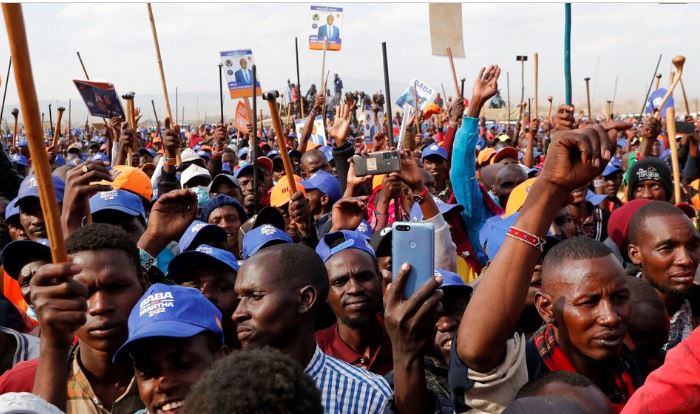
 Political rally /FILE
In Kenya’s political landscape, party politics often resemble a rickety matatu swerving wildlywithout a steering wheel – plagued by infighting, fragile alliances and a near-total absence ofideological consistency.
As the country inches closer to the 2027 general election, political formations across the boardare embroiled in internal power struggles, raising a fundamental question: Do Kenyan politicalparties thrive on ideals, or are they merely vehicles for personal ambition?
ODM: Sifuna shakes the Orange tree
The Orange Democratic Movement, once a disciplined, mass-based party forged in thecrucible of opposition politics, is currently battling waves of internal turmoil. Secretary-generalEdwin Sifuna, emboldened by his rising influence in Nairobi and Western, increasingly is seen as rocking the boat within the Raila Odinga-led outfit.
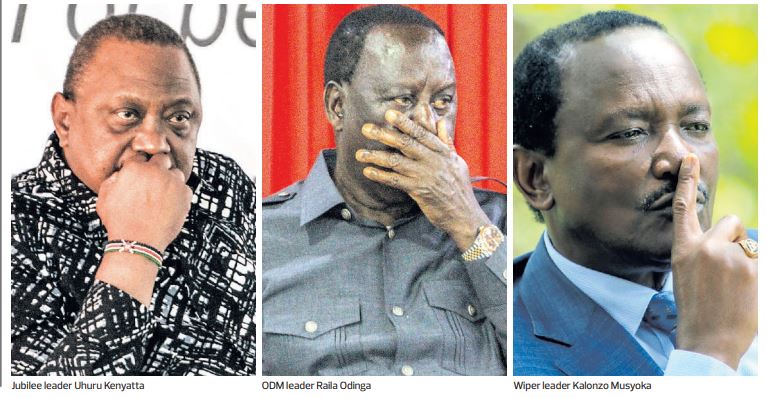
Positioning himself as a moderniser, Sifuna has advocated for structural reforms and youthinclusion. But critics accuse him of double-dealing – one foot in activism, the other in rawpolitical manoeuvring. Tensions escalated in May when Sifuna rejected the concept of a “broad-based government”, declaring that all government positions remain under the Kenya Kwanzaadministration led by President William Ruto.
“This thing called broad-based government, I don’t know where it exists. Personally, I don’trecognise any entity called broad-based. There is a government of Kenya Kwanza under theleadership of President Ruto.”
Senator Richard Onyonka defended Sifuna, saying his critique echoed public sentiment withinODM and beyond.
“What Sifuna is talking about resonates with ODM members and Kenyans. If the broad-basedgovernment can pick up from what Sifuna has been saying…”
However, ODM’s central committee, chaired by Raila, adopted a conciliatory positiontwo weeks ago. The party pledged support for the MoU with Kenya Kwanza and announced atechnical committee to advance its implementation – ironically, Sifuna was the one who readthe official resolution.
“The party supports the position of the party leader to work with the Kenya Kwanzaadministration… ODM will constitute a technical team to work with UDA counterparts,” Sifunaannounced.
Despite toeing the party line, the Nairobi senator later reignited tensions. Speaking in Sabaoti, Trans Nzoiacounty, he threatened to ditch ODM if it backed President Ruto’s 2027 re-election bid.
“Raila himself has said this is a democratic party and any member is free to speak their mind.Yet some thugs are saying I cannot hold views independent of the party just because I’msecretary general,” he said.
“I’ll read any party statement – even if it insults me – but the day the party decides to supportRuto in 2027, that one I won’t read.”
Insiders speculate that Sifuna may be positioning himself for a larger national role, possiblyaligning with the emerging Kenya Moja Alliance – a loose coalition including Wiper’s KalonzoMusyoka and impeached former Deputy President Rigathi Gachagua.
DAP-K: Natembeya waters the tent from within
Trans Nzoia Governor George Natembeya, once a provincial administrator, has become boththe face and the disruptor of the Democratic Action Party of Kenya. What began as avehicle for disaffected Western politicians is now struggling to contain his growingambitions.
Insiders say Natembeya is “peeing inside the tent” – challenging party leadership whileremaining within its ranks. His open criticism of DAP-K’s leadership has ruffled feathers. Andnow, the party finds itself at a crossroads: either forge a new independent path or risk beingpolitically absorbed.
On August 1, DAP-K was rocked by formal removal petitions filed against both party leaderEugene Wamalwa and Natembeya. The governor is accused of using party resources to prop up arival outfit – County Development-Kenya – while Eugene is accused of resistingreforms aimed at expanding DAP-K’s appeal beyond its Luhya stronghold.
DAP-K secretary-general Eseli Simiyu announced that the petitions had been referred to theparty’s internal disputes resolution committee.
“The petitions have been forwarded for urgent consideration,” he said. ‘No one is above partyprocesses.”
Meanwhile, Eugene urged calm. “Chama si ya mtu binafsi (The party does not belong to one person). Let’s follow due process and be guided byreason, not ambition.”
Natembeya, who skipped the meeting, countered in a statement, “DAP-K must evolve beyondtribal politics. That’s not betrayal; it’s leadership.”
He further accused Eugene of treating the party as a personal vehicle. In response, Eugene subtly warned Natembeya and Mumias East MP Peter Salasya againstorchestrating a hostile takeover.
The party’s central committee plans a special National Executive Committee (NEC) meeting later this month to chart its future.
As Raila is now working with Ruto and Musalia Mudavadi, having folded ANC into UDA,Wamalwa’s DAP-K is trying to fill the leadership vacuum in Western. Whether itsurvives its internal tremors is another matter.
UDA: Cracks in the Hustler mansion
In the ruling United Democratic Alliance, the post-2022 unity that propelled PresidentRuto to power is fraying. Prominent figures such as Kakamega Senator Bonny Khalwale, NyaliMP Mohamed Ali and Kiharu MP Ndindi Nyoro have launched low-key rebellions, questioningRuto’s policies and party favouritism.
Khalwale, a founding member and Senate Majority Whip, has clashed with UDA leadership,accusing them of meddling in Western politics and favouring insiders.
He recentlycriticised Farouk Kibet, Ruto’s powerful aide, for supposedly interfering in the by-election in Malava, Kakamega, slated for September 9.
“Farouk Kibet has no business interfering in Malava’s affairs. His sudden interest is not aboutour welfare; it’s about managing discontent over unfulfilled promises,” Khalwale said.
He also slammed Deputy President Kithure Kindiki, who is UDA’s deputy party leader.
“If you’ve failed to control former DP Rigathi Gachagua in your region, don’t think you’ll cometo Kakamega and decide who gets elected. I am your senior.”
He declared his bid for Kakamega governor in 2027, challenging UDA’s status quo.Meanwhile, Gachagua is said to be quietly consolidating power in MtKenya ahead of UDA’s grassroots elections, signalling potential realignments within the party.
Jubilee: Ghost of Uhuru’s past
Former President Uhuru Kenyatta’s grip on Jubilee remains tenuous. Years of factional wars andlegal battles have reduced the party to a shadow of its former self.
After regaining leadership inJuly, Uhuru chaired a NEC meeting this week, signalling a possibleattempt at revival. Deputy organising secretary Pauline Njoroge said the NEC meeting marked“a significant step in reaffirming the party’s ideals and internal unity”.
Uhuru also announced a special national delegates conference scheduled for lateAugust at Nairobi’s Jockey Club, aimed at reviewing party policies and strategic direction.Whether Jubilee can regain relevance remains uncertain.
His hold on the party remains tenuous at best. Since hisretirement, it has become a battleground for legitimacy, with rival factions pulling indifferent directions.
The party’s relevance in national politics is also increasingly being questioned, andrecent court battles over its leadership have further damaged its public image.
While Uhuru has attempted to maintain a statesmanlike presence, his limited politicalengagement has left a vacuum – one that new players are scrambling to fill, often driven moreby a desire to reclaim regional clout than by ideology or national policy.
Kanu and Wiper: Lost and rebranded
Kanu, the once-dominant independence party, has become largely symbolic under GideonMoi. Observers say that barring a political miracle, it will likely fade into oblivion. Gideon hasremained obscured since Ruto rode to power in 2022, with the Baringo Senate by-election posing a litmus test for him on August 17.
“If he recaptures the seat, then Moi will be a key political player ahead of the 2027 generalelection,” Alexander Nyamboga says.
“The former senator has a fighting chance, not by aligning with UDA, but by going flat out withKanu and attempting to ride on the national wave against the ruling alliance.”
Meanwhile, Kalonzo Musyoka’s Wiper Democratic Movement has rebranded itself as the WiperDemocratic Front, seeking to align itself with Gen Z’s appetite for change.
Critics dismiss the move as yet another round of cosmetic rebranding in a circus of personalitypolitics, not policy.
But Machakos Deputy Governor Francis Mwangangi disagrees, affirming the significance ofWiper’s radical rebranding ahead of the 2027 polls.
“WDF is a game changer. We’re positioning the party at the frontline in the fight againstimpunity, corruption, bad governance, and entrenched tribalism,” Mwangangi says.
“The best way to counter the regime is by modernising our political warfare and revolutionisingour armoury to match the test of time and that is what the new WDF offers.”
Despite more than a decade of constitutional reforms, Kenyan politics remains largelypersonality-driven. Parties rarely publish policy platforms or hold internal ideological debates.Manifestos are election season brochures, quickly forgotten. Internal democracy is chaotic,staged, or nonexistent.
Loyalty to Raila, Ruto, Kalonzo, or Uhuru still trumps any policy consistency. New partiesemerge from personal falling-out and coalitions are shaped more by arithmetic than sharedvision.
With just under two years to the next general election, the political chessboard is in flux.ODM must reconcile generational tensions or risk splintering. UDA faces internal divisions asthe Gachagua factor looms large.
Jubilee seeks revival, Wiper is rebranding, and DAP-K teeters on fragmentation.
“If current trends persist, 2027 could see a realignment driven more by personal brands thanparty manifestos,” political analyst Prof Gitile Naituli says.






