

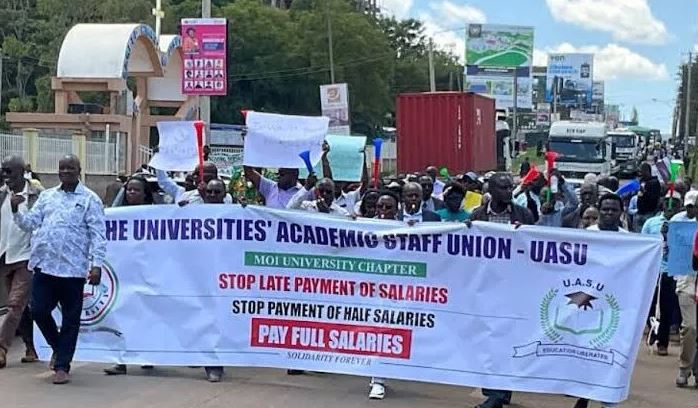
 Lecturers during a protest /FILE
On August 5, delegates of the University Academic Staff Union gathered at the Nakuru Athletics Club for an expected constitutional referendum.
The union, which represents academic staff across Kenya’s public universities, sought to adopt a new governing charter to replace the 2014 constitution – a document many felt was outdated, legally ambiguous and no longer fit for purpose.
The referendum results were swift but initially inconclusive: 270 votes in favour, 178 against and one spoiled ballot. According to widespread interpretation at the time, the proposal had failed—lacking the two-thirds supermajority presumed necessary for adoption. But in the days that followed, that verdict unravelled.
Legal scrutiny, guided by the Labour Relations Act, Uasu’s registered constitution, and precedents in trade union jurisprudence revealed a critical misreading: only a simple majority was required.
With that clarification, the vote stood—and the 2025 Uasu constitution was deemed lawfully adopted and duly registered by the Registrar of Trade Unions. What started, as a perceived failure of reform had, in legal terms, quietly become a resounding success.
Yet this outcome, legally sound as it may be, has left the union at a crossroads. For while Uasu now has a new constitution, it must contend with a deeper crisis: the erosion of trust, the fragility of institutional legitimacy, and the dangers of misinformation in constitution making.
There was broad consensus, at least among reformists, that the 2014 constitution had significant shortcomings. It lacked robust provisions on internal accountability, contained vague terms of office and did not adequately address chapter representation or procedural clarity in leadership transitions.
The proposed 2025 constitution sought to cure these institutional weaknesses by aligning union governance with evolving labour law, introducing clear term limits, decentralising authority and embedding financial transparency.
The “Yes” campaign, fronted by national secretary-general Dr Constantine Wasonga and national chairperson Grace Nyongesa, argued that reform was both timely and necessary. The “No” camp, headlined partly by former national officials eyeing the 2026 elections and the union’s “young Turks”, cited concerns over potential power entrenchment, diminished chapter autonomy and procedural opacity.
The legal clarification that only a simple majority was needed, redefined the referendum outcome. The Labour Relations Act (Section 18) stipulates that amendments to union constitutions must comply with the union's internal rules and be ratified through a properly convened vote. In Uasu’s case, the registered constitution did not expressly require a two-thirds majority for constitutional overhaul, only for specific amendments. In the absence of such a threshold, the simple majority prevailed.
But the larger question is not only what the law allows – it is also what democracy demands. Many delegates cast their votes under the impression that a two-thirds threshold applied.
The manner in which the draft was disseminated and the absence of structured civic education left room for misinformation, fear and factionalism. Legality, in this case, has not guaranteed legitimacy, and therein lies the deeper concern.
The referendum exposed the twin frailties that haunt both our unions and our politics: the weaponisation of process and the personalisation of power.
Instead of being a sober constitutional moment, the vote became a proxy war between incumbents and hopefuls, each accusing the other of hidden motives. WhatsApp groups became theatres of speculation. Misleading claims, from supposed term extensions to fiscal centralisation, spread faster than clarifications could be issued.
And when the referendum “failed”, only to be later declared legally successful, the credibility of the entire exercise came into question. What was missing was a shared understanding of the rules of engagement, a foundational requirement for any democratic exercise.
Uasu’s new constitution is now the law of the union. Its implementation is both necessary and urgent. But the leadership must not confuse legality with endorsement. The deeper challenge lies in healing the rift, restoring trust and rebuilding democratic culture within the union. That requires humility, not triumphalism.
The national leadership must now lead an inclusive process to make operational the new charter, taking into account the concerns raised by dissenting chapters, including fears of exclusion, procedural manipulation, and elite dominance. Failure to do so risks litigation, boycotts, or long-term institutional paralysis.
This moment offers lessons not just for Uasu, but also for Kenya’s broader democratic journey. Constitution making, whether at national or institutional levels, cannot be reduced to a numbers game. The law is only as strong as the consent that underpins it. Misinformation, if left unchecked, corrodes the public’s ability to deliberate in good faith. When constitutional reform becomes a vehicle for personal ambition – rather than collective renewal – it loses both its soul and its staying power.
Uasu now stands at a pivotal juncture. The legal battle may be over, but the democratic reckoning has just begun. The union has an opportunity, and a responsibility, to lead by example, to show that reform is not just about changing documents but about changing cultures. This is a chance to transform unionism from a battlefield of ambition into a forum of collective purpose.
Let the 2025 constitution be more than a legal artifact. Let it be the beginning of a renewed democratic ethic—one rooted not only in law, but also in trust, transparency, and truth.






