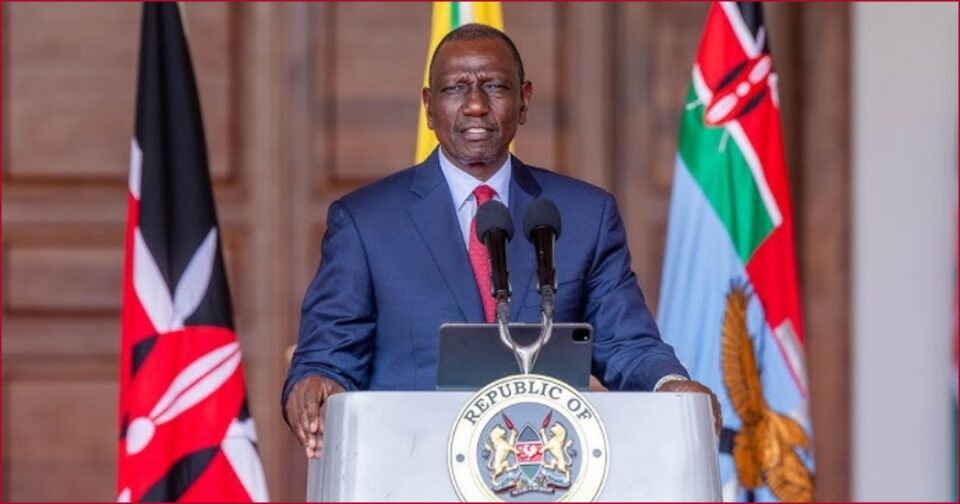
President William Ruto has dismissed concerns over a potential review of Kenya’s Major Non-NATO Ally status by the United States.
The President framed the diplomatic tensions as exaggerated and maintained that newly secured trade concessions from China were a strategic win for the economy.
At a roundtable with private business executives, Ruto dismissed sensationalised headlines about strained US relations and insisted Kenya’s partnership with Washington remained robust and intact.
"Forget about the headlines; they serve other purposes, for other reasons,” Ruto said, downplaying the significance of a proposed US congressional review of Kenya’s MNNA designation.
“Our engagement with the United States is a strong one, and we will progress as a continent using AGOA or bilaterally through agreements under negotiation.”
His remarks came amid growing scrutiny from US lawmakers, led by Senator Jim Risch, who has pushed for an assessment of Kenya’s MNNA status.
The senator, who chairs the US Senate Foreign Relations Committee, cited concerns over Nairobi’s human rights record, ties to Sudan’s Rapid Support Forces (RSF) and deepened links with China.
A confident Ruto, apparently bolstered by a recent breakthrough with China, hailed the trade deals as a transformative moment for Kenya’s agricultural exports.
“We have concluded high-level conversations with China. They’ve agreed to a reciprocal arrangement, removing all tariffs on our tea, coffee, avocados and other products. This is a major breakthrough,” he declared.
The President said the deals have addressed a longstanding trade imbalance. Kenya imports Sh600 billion worth of Chinese goods annually but exports only five per cent of that value in return.
“When I sat with [Chinese] President Xi Jinping, I told them this imbalance is unsustainable. Opening their markets to our farmers is the right thing to do,” Ruto said.
His unapologetic stance on China has drawn criticism from some US officials, who view it as a strategic alignment with Beijing.
In April this year, Ruto ruffled feathers by declaring at Peking University that Kenya and China were “co-architects of a new world order”.
Senator Risch later cited the remark as evidence of Nairobi’s “allegiance” to US adversaries.
Yet, Ruto dismissed these concerns, emphasising the country’s sovereign right to pursue multilateral trade partnerships.
“Some friends complain we trade too much with China. But I must act in Kenya’s best interest,” he said, noting ongoing negotiations with India, Turkey and Canada to diversify export markets.
Even so, Kenya is walking a diplomatic tightrope in balancing the security and trade dealings with the United States and China, respectively.
To state functionaries, the situation was being carefully managed in the face of the indications of the US's intent to review the non-NATO member status.
Nelson Koech, the chairperson of the National Assembly’s Defence and Foreign Relations Committee, underscored the value of the US alliance.
He said Kenya’s MNNA status—granted in June 2024—was rooted in its role as a counterterrorism partner, maritime security guarantor and regional mediator.
“This elevation of our bilateral ties [with the US] was no accident. The factors that made Kenya an MNNA haven’t changed,” Koech stated, urging Senator Risch to reconsider his proposed amendment to the National Defence Authorisation Act.
“Kenya continues to be a reliable US partner in advancing regional stability, security and prosperity. However, Kenya’s growing economic ties with China have not diminished our strong partnership with the US.”
“Nairobi has consistently maintained balanced and mutually beneficial relations with both powers. Any suggestion that warming China-Kenya relations threaten US interests is unfounded.”
He argued that the amendment doesn’t call for an automatic review of the country’s non-NATO member status “but rather an assessment to inform Congress’s deliberations”.
Foreign Affairs PS Korir Sing’Oei struck a conciliatory tone, pledging to address US concerns “comprehensively” while safeguarding the country’s sovereignty.
The congressional proposal demands scrutiny of Kenya’s use of US security aid, allegations of abductions and extrajudicial killings during anti-government protests.
It also seeks to review the country’s alleged ties to blacklisted rebel groups like Sudan’s Rapid Support Forces and terror groups like al Shabaab.
A report would be due within 180 days if the amendment passes, potentially reshaping bilateral relations between Washington and Nairobi.
The RSF issue has been thorny, especially after Kenya hosted RSF commander Mohamed Hamdan “Hemedti” in Nairobi, where the group announced plans for a parallel Sudanese government.
The announcement drew ire from Sudan’s transitional regime and US officials, who accused Kenya of enabling a sanctioned paramilitary force.
Congressional documents further suggested that officials may have helped RSF leaders launder money, a claim experts posit could undermine Nairobi’s credibility in mediating Sudan’s civil war.
Kenya, by virtue of its geographical location, is argued as of strategic value to the US in countering al Shabaab, securing the Indian Ocean and stabilising the Horn of Africa.
Ruto’s bet on China, meanwhile, offers immediate economic benefits, especially as Kenya services various bilateral debts to Beijing.
INSTANT ANALYSIS
For the leadership, Kenya remains confident that any objective evaluation will reaffirm the strength of our partnership. They hold that should such an assessment proceed, Kenya will engage constructively, confident that the process will ultimately deepen bilateral ties. The hope is that the legislative process will be guided by facts, not speculation.