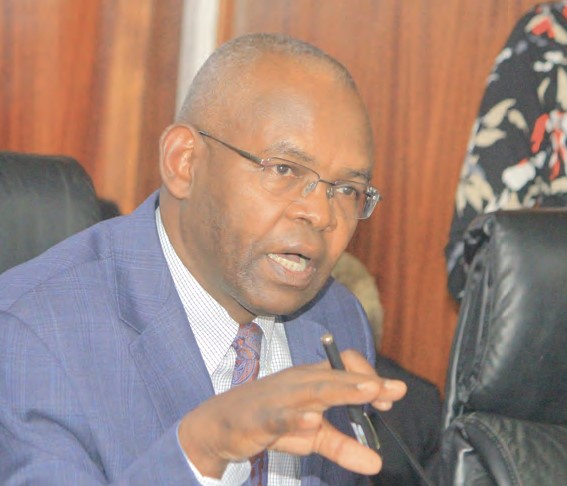
 Eugene Wamalwa and Thalia Psychotherapy COO, Mercy Mwende accompanied by staff at Westlands offices during a past engagement /JACKTONE LAWI
For many Kenyans, mental health and therapy are foreign things, let alone even an investment in the sector.
While fintech and agr-itech startups attract millions in venture capital, mental health initiatives struggle to secure even basic funding.
While Kenya’s digital economy booms—with startups raising over $638 million (Sh82.4 billion) in private equity in 2024—mental health ventures remain rare in VC portfolios.
A review of most healthcare venture funds reveals that most focus on fintech, telemedicine, and e-health, with only a handful backing mental health innovations.
However, for Denis Mwangi and Mercy Mwende, this was a big opportunity, too big to let go.
They opted to develop a health-tech startup - Thalia Psychotherapy, to transform how mental health services are delivered, using a digital platform to connect patients with qualified therapists and psychiatrists across the region.
What began in 2016 with just Sh100,000 in startup capital has grown into one of Africa’s fastest-expanding mental health networks, now boasting over 6,000 onboarded professionals.
“The main driver was that mental health is a big issue in Kenya with very high demand, yet pay for doctors is still low,” said founder Denis Mwangi, “We wanted to demystify and decentralise mental health support.”
Built initially as a self-funded project, Mwangi developed the platform himself after observing widespread mental health challenges and systemic gaps in the sector.
Thalia's model functions much like a ride-hailing app, with mental health professionals signing onto the platform and being matched with clients in need.
At the beginning, Mwangi says he developed the App and sought Mwende’s medical expertise as the first Therapist. Currently, the platform allows users to access services ranging from basic therapy to advanced psychiatric care—all through a digital interface.
“I developed the tech part of the app and we merged it with the mental health aspect,” added Mwangi.
The company is aiming to scale the number of professionals on the platform to 250,000 in the short to medium term.
In what Mwende says is a rare vote of global confidence for Africa’s emerging mental health sector, the Nairobi-based startup has secured funding from the Health Innovation Exchange (HiEx), with support from Reckitt Catalyst.
For the fast-growing startup, the investment signals a pivotal shift: mental health is no longer just a public good—it is an investable, scalable opportunity.
Mercy Mwende, now the chief operating officer at Thalia, says that with global investors gaining the confidence to invest in local mental health startups is a turning point in how they view mental health in Kenya and across the continent.
“This investment is more than just capital,” she says, “It is a global vote of confidence in the commercial future of mental health in Africa.”
The platform is currently riding on AI-powered mental health screening and revenue-sharing partnerships with more than 4,000 hospitals and clinics.
“To date, we have screened over 2.7 million people. We are not just treating mental health, we are rebuilding the infrastructure that delivers it,” Mwende told the Star.
While impact investors and donors have long backed mental health programmes, Mwende is making a direct pitch to Kenya’s institutional investors—particularly pension schemes and insurance providers—to see the sector differently.
“What is risky is not investing in mental health. What is risky is ignoring it,” she argues, “It leads to lower productivity, increased medical costs and stretched public health systems.”
Thalia’s approach, she says, mitigates those risks through recurring revenue contracts, long-term public-private partnerships and results-based financing models. These are the kinds of structures pension funds understand.
“This is not a gamble, it is infrastructure and infrastructure is where pension funds thrive.”
Mwende adds that Thalia is developing investment tools that allow pension schemes to back mental health now, while benefiting from reduced medical liabilities over time.
The HiEx deal comes after a string of high-profile recognitions for Thalia, including being named a “Startup to Watch” by Bloomberg and winning top honours at VivaTech 2024 in Paris.
Mwende says these milestones are accelerating growth and unlocking new partnerships across Africa.
“It is all reinforcing what we have always believed, mental health is the missing pillar in Africa’s health systems and Thalia is best positioned to build it.”
The company is currently expanding operations, deploying new digital tools and engaging with local and regional investors keen on combining stable financial returns with measurable social outcomes.
The startup has also expanded its reach beyond Kenya, setting up operations in Uganda, Nigeria, Namibia, Malawi and Côte d’Ivoire over the past three years.
As Kenya rolls out its universal health coverage and private insurers adapt to a shifting healthcare landscape, Mwende sees a window of opportunity for investors to act.
With HiEx’s backing, Mwende says Thalia is ready to partner with institutional investors ready to shape the future of healthcare in Kenya.
“Mental health is part of our national future. Investing in it is not just smart, it is essential,” she says.
However, Mwangi says the company faces persistent challenges, among them a lack of standardised pricing for mental health services across markets.
Without a unified framework, setting fees for services remains inconsistent, particularly as the company scales into new regions.
Despite these hurdles, he is confident that Thalia’s model is increasingly being viewed as a potential blueprint for accessible, scalable mental health solutions in Africa.
With growing user demand and investor interest, the startup is positioning itself as a key player in reshaping mental healthcare on the continent.