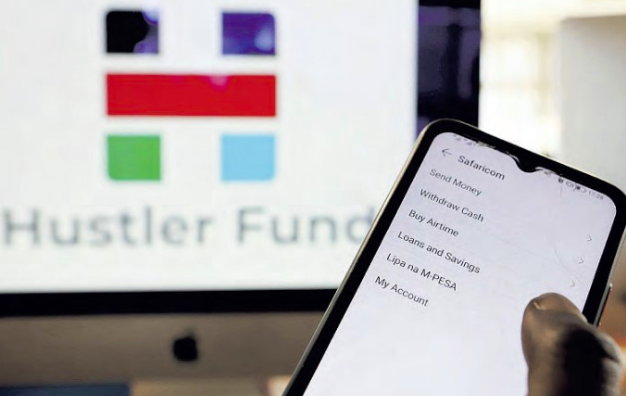
 A user accesses Hustler Fund through his Mobile Money Wallet./FILE
When the Hustler Fund launched in November 2022, it promised to be a game-changer for Kenya’s low-income earners. But interviews with beneficiaries reveal a mixed reality: tiny loan limits, casual repayment attitudes, and modest wins for only a few.
A private university student captured the irony starkly: “I found I was eligible to access Sh1,500, which, of course, I accessed and used to buy lunch. I paid it back later anyway.”
His candid admission reflects how many see the fund as too small to support business ventures and instead use it for day-to-day needs.
For Joyce Wanja, a shopkeeper, the story is similar. “Even though the Hustler Fund was intended to help businesses, it has provided little benefit to mine. The amount available is insufficient to purchase stock for my shop; I can only use it for emergencies,” she said after borrowing Sh500.
These frustrations are echoed widely in the Kenya Human Rights Commission (KHRC) report launched on August 4, 2025.
“We are being given Sh300 or Sh500 in the name of Hustler Fund, what business can you start with such an amount?” asked another borrower.
For some, the fear of defaulting is enough to stay away. “Only those with problems can take that money; I cannot, since I am struggling to get capital. I do not want to be arrested for defaulting on Sh400,” one respondent remarked.
Others openly admitted exploiting the fund’s lax enforcement. “I borrowed Sh500. What business can I use it for? I used it for alcohol, and I will not repay,” confessed one beneficiary. Another was blunt: “They are telling us to take the loan. I will take it, but not repay. What will they do to me?”
Fear of city crackdowns also keeps informal traders away. A Nairobi vendor explained: “I cannot take the Hustler Fund because, as a vendor, City Council can come and confiscate my goods, and I will not be able to repay. Therefore, it is risky to take the loan as this business does not have a permanent structure.”
Yet amidst the frustrations, a few positive stories emerge.
A sausage vendor who secured Sh1,000 credited the fund with helping him start his business: “At that time, it was very difficult for me to access affordable credit. So, when they unveiled the fund, I decided to give it a try… it truly helped me.”
For boda boda operators, the fund offers practical benefits. “With the Hustler Fund, most operators can service their motorbikes and purchase small spare parts, and after two weeks, they can repay this loan,” said a Nairobi boda boda chairman, noting that group registration under the Micro and Small Enterprises Authority (MSEA) helped increase access.
A vegetable seller in Kilimani used it to boost her trade incrementally. “The Hustler Fund has helped me increase my stock of pawpaw by Sh500. I sold them and made a profit of Sh500. With Sh1,000, I was able to restock more. I hope to start an M-Pesa business over time,” she said.
These interviews underscore a key challenge flagged by KHRC: most loans are used for personal expenses rather than enterprise growth, while structural issues—tiny loan limits, informal business risks, and repayment apathy erode the fund’s impact.
The report concludes that without revisiting its design, the Hustler Fund risks becoming “quick cash for consumption” rather than a tool for economic empowerment.
For many beneficiaries, their voices echo a simple plea: that a fund meant to uplift their businesses should match the realities of their lives.