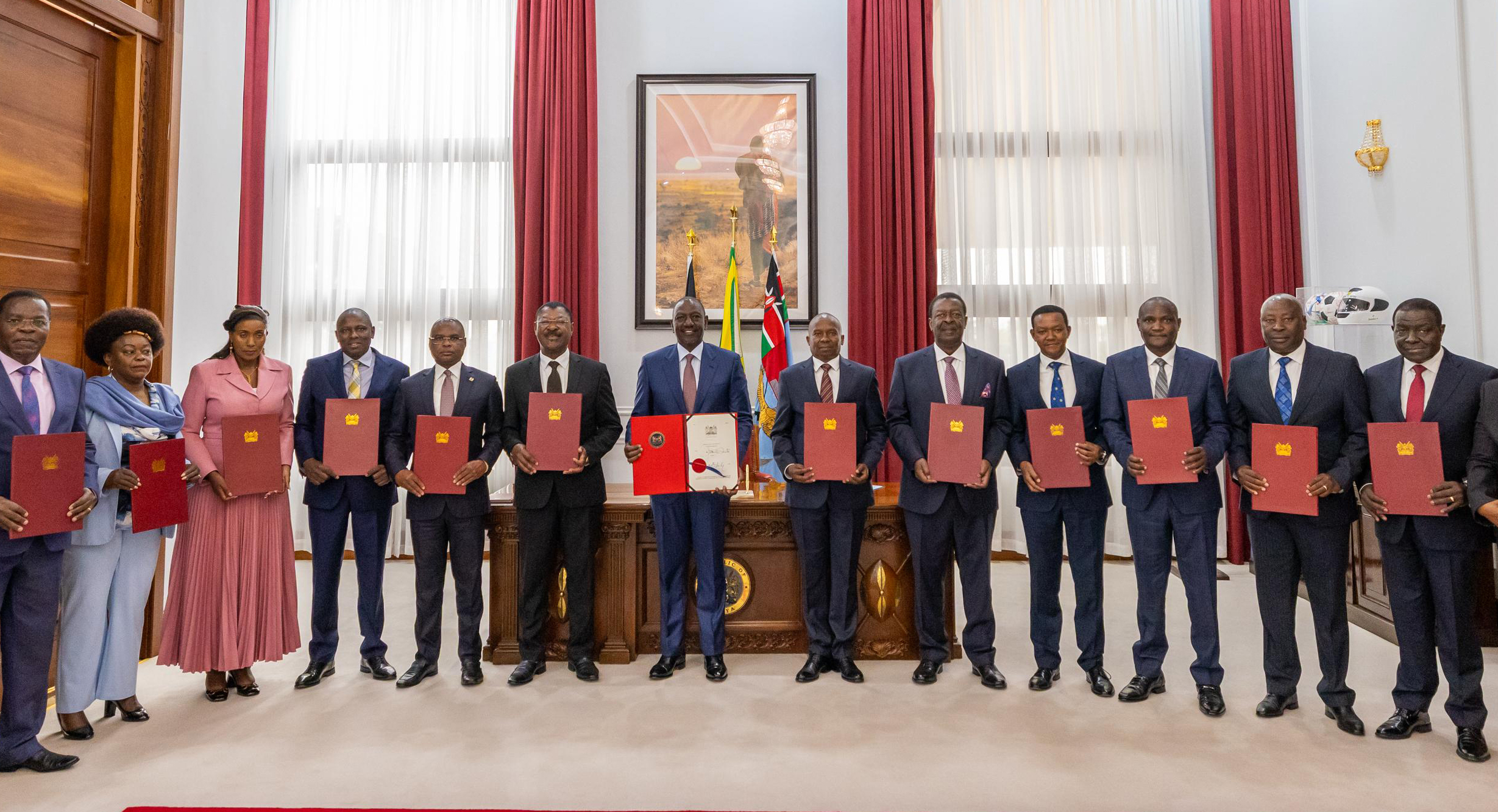
 President William Ruto, Deputy President Prof Kindiki Kithure, senior members of the Executive and MPs display copies of the assented Conflict of Interest Act and The Social Protection Act at State House, Nairobi, yesterday /SUE NYAMASEGE/PCS
President William Ruto struck a major blow to civil servants and public officials, signing into law a bill which bars them from conducting business with the government.
At a ceremony at State House, Nairobi, flanked by anti-corruption officials and lawmakers, Ruto declared an end to the era of civil servants awarding themselves tenders while serving in government.
“We have stepped up the fight against corruption by passing this law that now gives power to the Ethics and Anti-Corruption Commission to take charge of all matters of corruption,” he said.
EACC would thus have exclusive authority on matters of corruption, and has its enforcement capabilities strengthened in the new legislation.
The commission would also now institute forfeiture proceedings against public officers, without having to rely on the Assets Recovery Agency.
The new law also strengthens regulations of gifts, with civil servants now required to not only declare gifts they receive personally but also those accepted by family members or relatives, and other third parties.
Government agencies would, going forward, be required to maintain gift registers covering all recipients, not just public officers.
Public officers have also been barred from holding an interest in entities doing business with any government agency, not just those under their purview.
In the new law, MPs and MCAs are also barred from participating in debates where they have a conflict of interest.
The lawmakers would be subject to the same recusal requirements as other public officials, while civil servants would have to immediately declare any material change to their assets.
He said there was no room for civil and public servants to abuse the offices they hold, as well as the resources under their custody.
“This is a very consequential moment in Kenya. We are stepping up the use of resources and making it difficult for people to take advantage of the offices they occupy.”
President Ruto went on, “It is significant that Kenyans can participate in making sure they hold public officers to account in their exercise of the authority and power they have. This moment is significant.”
The law aims to ensure that no public servant competes with hustlers for government business, and for those employed to serve the people to be content with their salary.
The President said he was elated that the law was in place, saying the delays in passage of the law were caused by the very conflict of interest the law was addressing.
“We will now deal decisively with conflict of interest in every part of government,” President Ruto said.
The new law provides for a total ban on civil servants from meddling in government business.
As such, civil servants, state officers and their immediate families are prohibited from bidding for or supplying goods/services to the government.
Family is now defined in law to include spouses, dependent children, parents, and parents of a spouse, while relative covers anyone related to an officer by birth, marriage, or adoption.
It also provides for mandatory asset declaration by public officials, as well as their businesses and any conflicts will lead to automatic disqualification.
It also sets stiffer penalties with violators facing jail terms of up to 10 years, hefty fines and mandatory forfeiture of illegally acquired wealth.
Deputy President Kithure Kindiki said the coming into force of the Conflict of Interest Act, ‘strikes a phenomenal blow for the fight against corruption’.
“The new law not only closes the loopholes corrupt officials have been exploiting to steal money from public coffers, it also makes it much more difficult for them to use proxies to advance corruption,” the DP said.
He added, “The EACC now has the levers to advance the fight against graft, abuse of power and the manipulation of public trust for private gain.”
The law empowers the commission to investigate and prosecute those using relatives, friends, or shell companies to bypass the rules.
For years, corrupt civil servants have exploited loopholes to award themselves lucrative tenders, diverting funds meant for public projects into private pockets.
The new law aims to slam doors on these schemes, ensuring that public procurement benefits genuine businesses, not bureaucrats.
Conflict of interest has been cited in major tenders, especially in the infrastructure sector and in public-private partnership projects.
EACC has for years decried the lack of a strong legal framework to enforce conflict of interest laws, citing a clash of mandates with other agencies.
Both EACC chairperson David Oginde and CEO Abdi Mohamud were present during the assent of the law, which commences immediately.
MPs had attempted to water down the proposed law, forcing the President to send back the bill to the House for further amendments.
They sought to include provisions that would have exempted accused persons from stepping down and also given leeway for state officers to bag state tenders.