Parliament is set to review a controversial law exempting the estates of former presidents Jomo Kenyatta and Daniel Moi from inheritance tax, formally known as estate duty.
A petition before the National Assembly by public interest litigation advocate John Wangai challenges the constitutionality of Section 7(3) of the Estate Duty Act (Cap 483).
“Whenever any person dies, a tax known as estate duty shall, save as is hereinafter provided, be levied and paid on all property of which the deceased was at the time of his death competent to dispose,” the law reads.
The law also applies to property in which the deceased had an interest, property that was held for use or enjoyment, and proceeds of any policy of assurance on the life of the deceased.
The law grants immunity to the estates of the two former presidents from taxation upon death.
“This section shall not apply to His Excellency Mzee Jomo Kenyatta, nor to His Excellency Daniel Toroitich arap Moi,” the Estate Duty Act, as revised in 2012, reads.
Inheritance tax is generally levied on the value of property passed on after death, and is levied on the total value of property held by an individual upon death.
It is considered a means to redistribute wealth, curb inequality and generate revenue for the government, and also argued to help unlock idle real estate by pushing insolvent property into the market.
The petitioner contends the exemption violates Article 27 of the Constitution, which guarantees equality and non-discrimination, and undermines the principles of fair taxation.
The issue gained prominence at the height of protests mounted by Azimio top guns in 2023, where the government claimed that ‘tax cheats’ were funding opposition rallies.
At that time, President William Ruto said some people who were in power used state instruments to avoid paying taxes, something he said would not happen on his watch.
“This country is not the animal farm where some are more equal than others. We are going to have a society where every citizen carries [his or her] fair share of our burden to raise taxes,” he said.
This was the same day that Wangai and his compatriots, John Maina, and Muhia Kagwe presented the petition to Parliament.
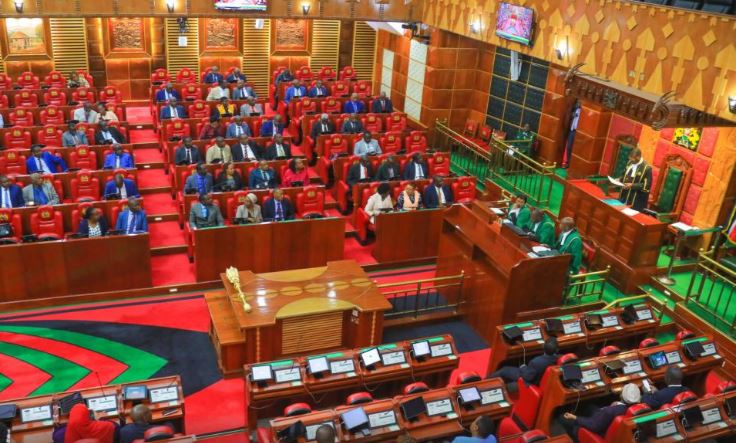
Several members of the Petitions Committee on Tuesday expressed the need to review the law.
They argued that it could be among colonial-era laws, which need to be “aligned with current democratic values and principles of accountability”.
“Are you aware that the estate duty was abolished through an Act of number 10 of 1982?” asked the committee chairperson Janet Sitienei (Turbo MP).
But Wangai held that he was aware of the same and brought to Parliament’s attention that the law was still in force.
“Yes, I am aware of the same, but our petition was premised based in the revised edition of CAP 483,” the lead petitioner said.
In his submission, he argued the law creates an unequal tax privilege for two individuals, undermining the constitutional guarantee of equality.
“The law is conferring a unique and unjustifiable tax exemption based solely on the fact that the beneficiaries had a God-given opportunity to serve Kenyans as Kenya’s 1st and 2nd President, respectively.”
Wangai further argued that the constitution explicitly bars tax exemptions for state officers based on their former office.
“This exemption creates an elite tax class above the law and fails the test of objective and reasonable differentiation."
The petitioner further told MPs that the exemption “fosters impunity and elitism, eroding public trust in governance”.
“The state forfeits billions in potential estate duty revenue, harming public finance, Wangai said, calling on MPs to exercise their “moral, legal, and economic imperative” to repeal the section.
Dagoretti North MP Beatrice Elachi questioned why the legislation doesn’t apply to subsequent presidents—Mwai Kibaki and Uhuru Kenyatta.
She, however, pointed out that the legislation was among colonial laws and should not hold back the country.
“We have to appreciate that those were colonial laws and somehow, they protected the colonialists, and I think we have to appreciate that we have to clean it up,” Elachi said.
“We must treat all Kenyans equally, regardless of status or background,” the lawmaker added.
Makueni MP Suzanne Kiamba questioned the petitioners why they were keen on the law being amended or were acting at the behest of those paying the duty.
“Are you pursuing this for the fact that these two got exempted or because others are suffering from the same?” she asked.
During deliberations, MPs argued the exemption—introduced during Kenya’s post-independence era—was outdated and inconsistent with the 2010 Constitution.
Kitui West MP Edith Nyenze questioned why the law would be discriminatory and only exempt the two families and exclude future presidents.
“Is it only touching on the two families or future presidents?’ she asked.
The committee pledged to revisit the Estate Duty Act and the broader inheritance tax regime, promising to issue recommendations in line with the constitution and current economic realities.
The petition reflects growing public concern over wealth concentration in Kenya, where the richest one per cent reportedly control more than 90 per cent of the country’s total wealth.
Critics say tax exemptions for politically connected families worsen inequality. “The exemption violates, denies, infringes and threatens Article 27 on the right to non-discrimination and subverts the basic rationale behind the imposition of the tax,” the petition reads.