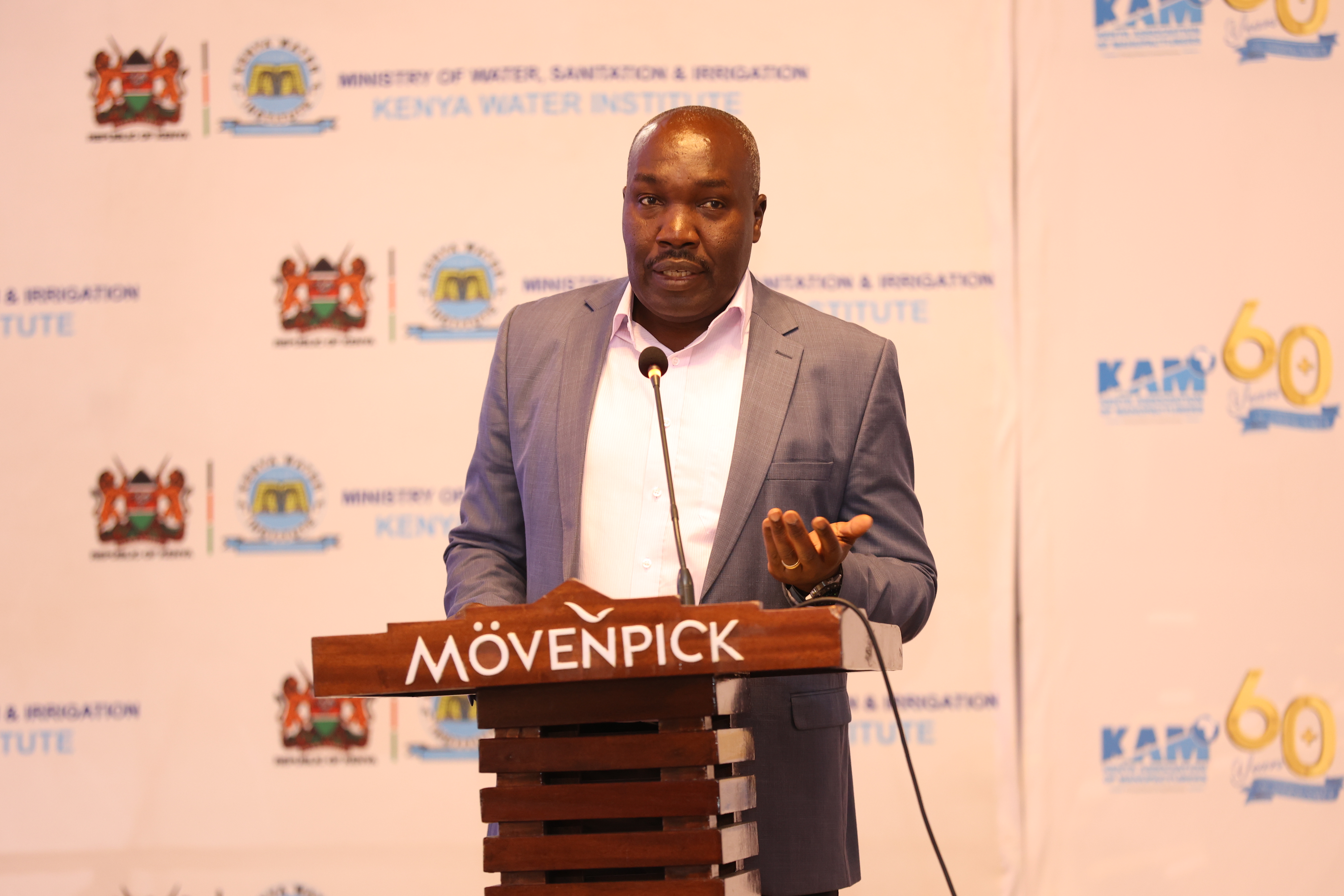
Principal Secretary in the State Department for Water and Sanitation, Julius Korir makes remarks during the launch of the report.
Kenya has made significant progress in integrating wastewater management into its broader climate action strategies, a study has found.
However, critical gaps in policy enforcement, infrastructure development and private sector engagement still hinder its full potential, the report noted.
The Industrial Wastewater Preparedness Study 2025 outlines both the strides made and the hurdles ahead in positioning wastewater management as a key climate solution.
It was launched by the Kenya Association of Manufacturers in partnership with the Confederation of Danish Industry and the Kenya Water Institute.
The 50-page report frames wastewater not as a burden but as a valuable resource in line with circular economy principles.
It highlights how sustainable wastewater practices can reduce greenhouse gas emissions and improve resource efficiency across industries.
“By implementing strategic interventions, Kenya can enhance industrial resilience, cut wastewater-related emissions and emerge as a regional leader in sustainable water management,” the report states.
With the goal of reducing GHG emissions by 32 per cent by 2030, the industrial sector is playing an increasingly central role in the country’s climate response.
The report shows that many industries have already taken bold steps, including recycling greywater, generating biogas from sludge and piloting zero-liquid discharge systems.
KAM chief executive Tobias Alando underscored the private sector’s proactive stance.
“Industry is not a passive observer in climate action, we are key actors. Some companies are reusing dye water, others are building on-site treatment plants," he said.
"But we still face barriers. We need a more enabling policy environment, improved access to green finance and capacity-building, especially for SMEs.”
The report recommends several key measures to scale up industrial wastewater action: stronger policy enforcement, increased infrastructure investment, support for public-private partnerships, adoption of circular economy models and the use of real-time data systems to drive accountability.
Water PS Julius Korir confirmed the government’s commitment to expanding sanitation access across the country.
“Access to water has improved from 68 per cent to more than 75 per cent by 2025,” he said.
“We’ve made progress in major towns like Nairobi, Mombasa and Kisumu, and are now focusing on emerging towns such as Mandera, Isiolo and Kiambu. Industries are both consumers and generators of water, and must be central to the solution.”
Kenya Water Institute CEO Dr Leiro Letangule emphasised wastewater’s untapped potential in climate adaptation.
“This report is a roadmap. It shows how wastewater can be transformed into a resource, creating both economic and environmental value," he said.
"Investing in climate-smart technologies is no longer optional — it’s essential.”
The report also calls for intensified collaboration between government, industry and development partners to overcome systemic weaknesses.
Strengthening regulatory frameworks, clarifying institutional roles and building enforcement capacity are seen as critical next steps.
Danish Industry East Africa TVET manager Millicent Kariuki stressed the need for implementation.
“Kenya has sound policies. What’s missing is a clear and actionable roadmap,” she said.
"If we’re serious about cutting emissions by 32 per cent, then we must also increase access to financing, technology and skills."
As the 2030 deadline approaches, the report argues that wastewater management is more than just an environmental concern; it’s a pathway to resilience, industrial competitiveness and long-term sustainability.
With coordinated partnerships, bold leadership and strong follow-through, Kenya has the potential to not only meet its climate goals but to set the standard for industrial wastewater management across the continent.