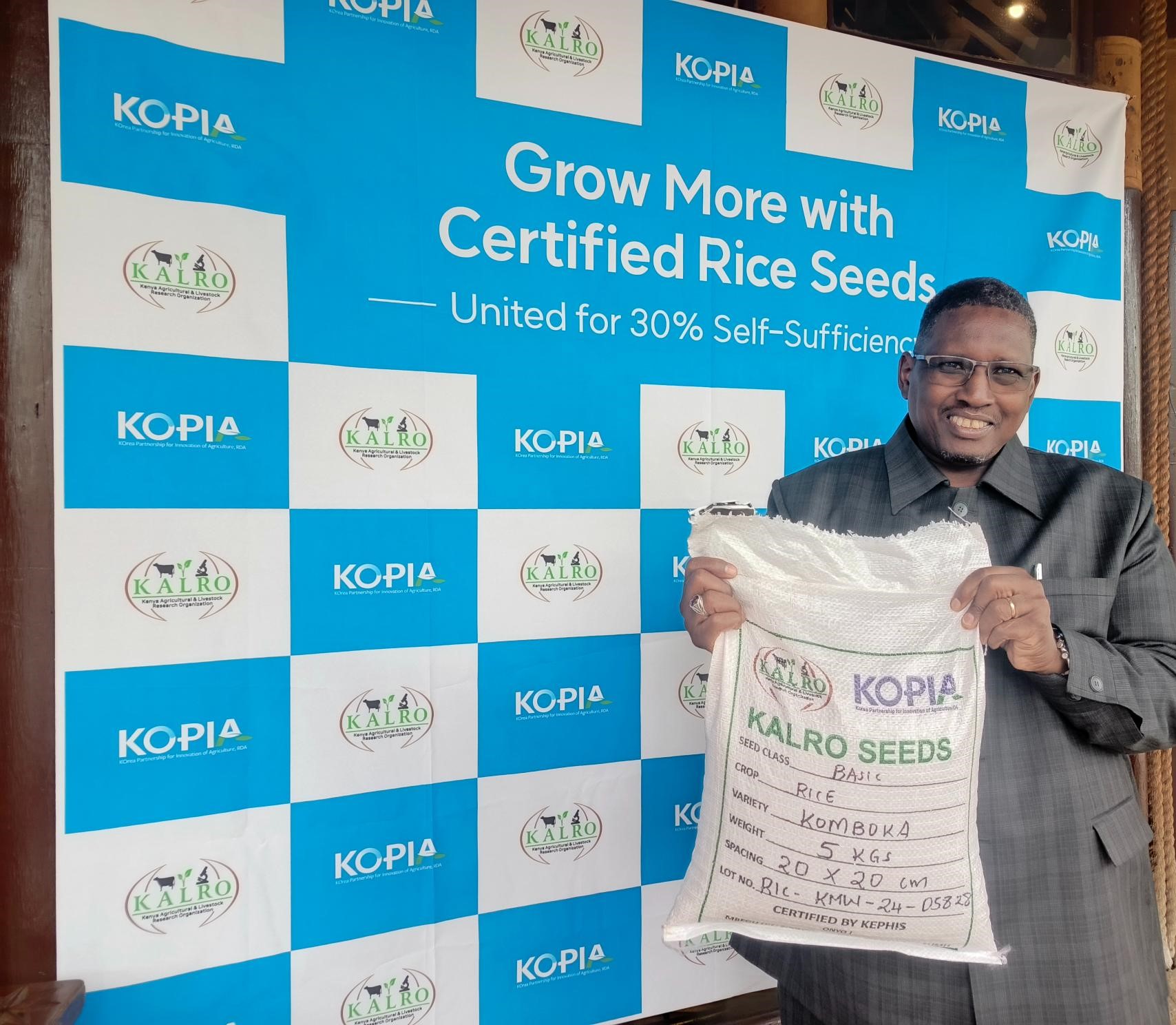
 Dr Eliud Kireger, Kalro director general, displays Komboka rice variety which farmers can access from different Mkulima shops across the country /AGATHA NGOTHO
Kenya’s famous appetite for ugali is slowly being challenged at the dinner table. Rice is becoming the go-to staple for many households, especially among the youth. According to scientists, this shift is driven by changing lifestyles, urbanisation and convenience.
Dr Ruth Musila, director at Kenya Agricultural and Livestock Research Organisation - Mwea centre, says rice consumption has more than doubled over the past decade.
But as demand soars, the country remains heavily reliant on imports due to low production.
“Rice is slowly overtaking ugali in many Kenyan households,” Musila said.
“This shift is largely driven by the youth who prefer rice due to its quick cooking time and versatility.”
For 28-year-old Beatrice Achieng’, rice offers a practical solution to her busy schedule.
“I get home from work between 7:30 and 8 pm, so I have little time to make dinner and prepare for bed. Some rice and stew are a quick fix for me,” she says.
“Besides, I’m watching my weight, so I prefer not to eat ugali before I go to bed.”
Musila notes that per capita (average consumed over a specified period) rice consumption in Kenya rose from 12kg in 2016 to 28kg in 2022.
“Rice is now the third most important staple after maize and wheat,” she said.
However, local production is not keeping pace.
“We currently import about 80 per cent of our rice to meet national demand. In 2024 alone, the import bill stood at Sh67.9 billion,” she noted.
“This over-reliance on imports exposes us to price volatility, forex pressure and food insecurity.”
Hilary Murimi, a rice farmer from Mwea, says he has witnessed the shift in demand firsthand. He began rice farming in 1996, inheriting land and knowledge from his parents.
“When I started, a kilo was selling at less than Sh50 but it has now gone up to Sh150. When you have rice in your home, that is gold,” he said.
“You can call merchants at night and they’ll send money on your phone and collect the rice the next day.”
Murimi said the rising demand has pushed farmers to adopt new technologies to boost production. He recalls the days of manual harvesting, which led to significant losses.
“We used to harvest manually and burn the rice straw. But with modern harvesters, we've reduced losses, saved time and even found value in the straw, either selling it or turning it into compost.”
Today, Murimi grows seed rice on four acres through a contract with a multipurpose cooperative. “When you grow seed, the earnings are about Sh10 more per kilo than regular rice,” he says.
According to Kalro, 32,988 hectares of irrigated and rain-fed lowland areas are currently under rice cultivation.
The government aims to increase this to 171,676 hectares by 2030, with over 540,000 hectares of potential land available.
“In 2022, irrigated farms averaged four tonnes per hectare,” says Musila.
“Our target is 7.5 tonnes. For rain-fed lowlands, we want to improve from 2 to 3.5 tonnes, and upland areas from 1.4 to 2.5 tonnes per hectare.”
Despite this potential, local production currently meets only 20 per cent of demand.
“Tanzania, for instance, is 90 per cent self-sufficient,” Musila noted.
“Our goal is to reach 30 per cent self-sufficiency in the coming years.”
Musila said there are a number of constraints including limited access to improved varieties, poor mechanisation, water shortages, pests and diseases and weak extension services.
“In particular, mechanisation is only common during harvesting. Manual transplanting is still the norm, which increases labour costs. We also lack trained technicians to repair machinery.”
She also cited the growing problem of snails in Mwea rice fields.
“Snails attack as soon as the seed germinates. Even when the plant reaches 15cm, they continue feeding on it,” Musila said.
“But cultural control methods have shown promise. We are training farmers to manage snails during early transplanting stages. This is safer and more effective than chemical options.”
Another major bottleneck is the seed system.
“In 2022, the demand for certified rice seed was 1,241 tonnes, but supply fell short,” Musila said. “By 2027, we aim to produce 6,000 tonnes, enough to grow about 1.3 million tonnes of paddy rice.”
Going forward, Kalro is working with partners like the Korea Partnership for Innovation of Agriculture (Kopia) to scale up seed production and mechanisation.
“With their support, we plan to increase domestic rice production from 150,000 to 1 million tonnes by 2030,” Musila said.
The K-Rice Belt project aims to modernise irrigation systems, train farmers and improve access to certified climate-smart varieties.
Musila stressed the need to strengthen cooperatives and involve the private sector more.
“Only a few rice cooperatives are well-structured. We need to replicate the model of those successful cooperatives across the country.”
With rising demand, better technologies and a push for seed system reform, Musila believes Kenya has a chance to reduce its dependence on imports.
“However, the road ahead requires sustained investment in mechanisation, seed systems, farmer training and infrastructure,” she concluded.
“Rice is no longer just an alternative. It’s becoming a central part of our food system and we must ensure we can grow what we consume.”