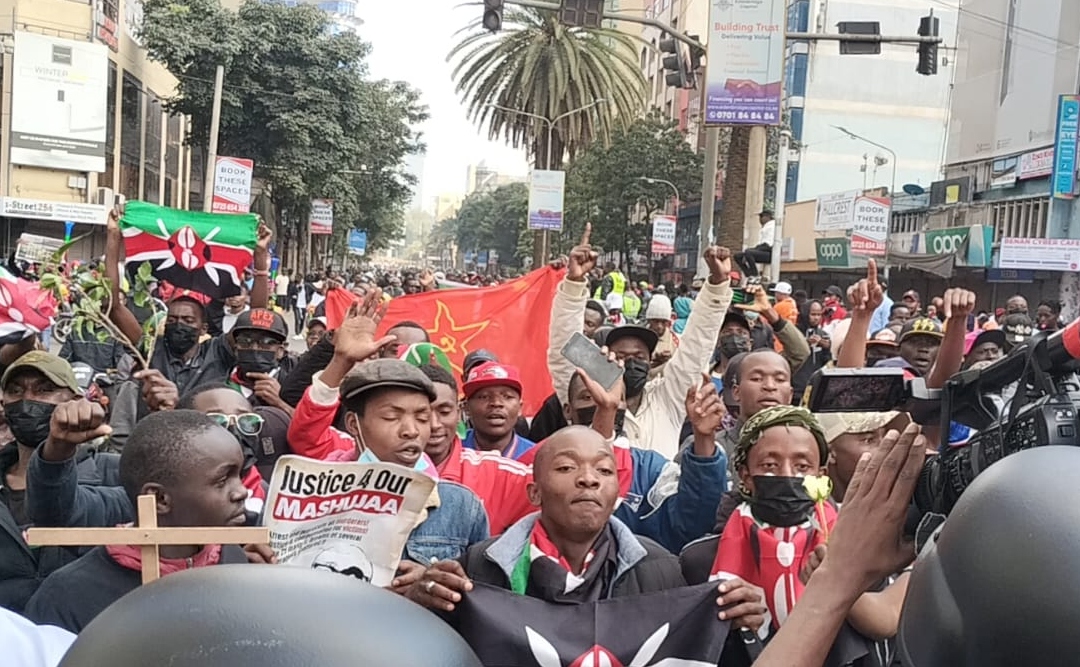
 Gen Z youth during the recent protests.
 In Kenya, the word terrorism evokes unforgettable tragedies—from the searing memories of Westgate in 2013 to DusitD2 in 2019.
But beyond the headlines, few Kenyans understand what exactly qualifies as terrorism in the eyes of the law.
Is every violent crime terrorism? Can highway bandits or political rioters face terrorism charges?
Under Kenya’s Prevention of Terrorism Act, 2012, the law draws clear, though sometimes, controversial lines.
The Prevention of Terrorism Act, 2012 (POTA), defines terrosim as an act or threat of action where the use or threat of violence causes or is likely to cause death, serious bodily injury to a person… or serious damage to property; and is intended to intimidate the public or to compel the government… or is intended to destabilise the religious, political, constitutional, economic or social institutions of a country.
The law further states that a person who carries out a terrorist act commits an offence and is liable, on conviction, to imprisonment for a term not exceeding 30 years and where a person carries out a terrorist act which results in the death of another person, such person is liable, on conviction, to imprisonment for life.
The same law issues a disclaimer: An act which disrupts any services and is committed in pursuance of a protest, demonstration or stoppage of work shall be deemed not to be a terrorist act… so long as the act is not intended to result in any harm referred above.
Yet, mid this year, a very different kind of case made national headlines: Youth-led anti-tax protests marking the first anniversary of Gen Z unrest were branded acts of terrorism, and tens of protesters hauled before court - including prominent activist Boniface Mwangi - and charged under terrorism laws.
To understand this seismic shift, this explainer examines how Kenya’s courts have defined terrorism—and whether the protesters fit that bill.
In January 2019, al Shabaab gunmen stormed the DusitD2 complex in Westlands.
Twenty-one civilians were killed, scores injured, and property left in ruin—acts that fall within the definition of terrorism as envisioned by the Prevention of Terrorism Act (POTA).
When the case reached the Kahawa Anti‑Terror Court, Lady Justice Diana Kavedza delivered a landmark verdict.
She sentenced Mohamed Abdi Ali and Hussein Abdille Ali to 30 years each.
In her ruling, she noted that although the convicts “may not have physically wielded the weapons that caused harm…, their facilitation directly enabled attackers who were heavily armed with guns, grenades, and suicide vests.”
She emphasised that this case represented “one of the most comprehensive counter‑terrorism investigations in Kenya’s history,” tracking financiers, logisticians, and facilitators—not just the attackers.
The human cost was brought to life in the courtroom as Joseph Spindler, whose son Jason died in the attack, told the court, “Jason…deserved a future, not a grave marked by the shrapnel from a terrorist’s suicide vest.”
This judicial clarity was made evident earlier in the Westgate trial, underscoring how Kenyan courts distinguish terrorism from other forms of crime.
The Court of Appeal affirmed the convictions of those accused, including individuals who never fired a bullet but facilitated logistics and harboured attackers.
In Abdi & another v Republic (2024), the court upheld convictions for conspiracy and facilitation of the attackers through logistical support.
The court insisted, however, that terrorism charges must be framed with precision, warning that vague indictments would collapse on appeal because accused persons are entitled to understand “fully the acts they are being charged with.”
The same high threshold applied in the 2014 Mpeketoni massacres in Lamu county and the 2015 Garissa University massacre—both attacks carried out by al Shabaab, involving mass civilian killings, ideological justification, and deliberate targeting of national institutions to sow widespread fear.
These cases exemplify what terrorism is in the Kenyan legal framework: deadly violence carried out by ideologically motivated actors acting in a coordinated, planned fashion to terrorise the public.
From the verdicts reached, POTA was built to tackle existential threats, not ordinary crime, however violent.
This distinction came under intense scrutiny in the wake of the June 25, 2025, Gen Z protests.
What began as a commemorative march for victims of past police violence quickly escalated.
Nairobi, Mombasa, Kisumu and other major towns saw police stations torched, government buildings vandalised, and security armouries raided, with stolen firearms and uniforms ending up in civilian hands.
The government later said 42 people died although human rights watchdog KNCHR put the death toll at 38.
Interior Cabinet Secretary Kipchumba Murkomen was quick to characterise the protests as “planned, deliberate, coordinated, funded, and politically instigated,” accusing the demonstrators of plotting to destabilise the country through fear and intimidation.
More than 30 protesters were swiftly arraigned in the Kahawa anti-terrorism courts on terrorism-related charges.
Among them was Boniface Mwangi, a long-time civil rights campaigner who was arrested after a dramatic police raid on July 19, 2025.
He was accused of facilitating terrorism and unlawful possession of teargas canisters and a single blank 7.62mm round.
The prosecution’s argument rested on the narrative that Mwangi, through his activism and influence, had inspired violent attacks against government institutions, thus satisfying the ideological element required under POTA.
In court, Mwangi remained defiant, calling the charges “a big shame,” and insisted there was no credible evidence linking him to any terror plot.
“They have no evidence. This is a big shame,” he told the court.
However, human rights defenders pushed back.
Amnesty International Kenya argued that the charges were “part of a broader attempt to weaponise anti-terrorism laws to suppress political dissent.”
They warned that this misuse of the law was undermining Kenya’s democratic institutions and eroding freedoms of expression and assembly.
Within two days, the DCI struck down the terrorism charges against Mwangi.
The Office of the Director of Public Prosecutions admitted in open court that the threshold required under POTA had not been met.
Prosecutors failed to demonstrate any connection between Mwangi and ideological violence or organised terror networks.
The court, citing precedent from Dusit and Westgate cases, observed that while Mwangi’s possession of prohibited items could raise other criminal charges, there was no basis to prosecute him as a terrorist.
The judge noted that POTA was intended for those who “intimidate the public through ideologically motivated violence,” not for individuals engaged in political activism or spontaneous protests.
Mwangi’s charges were downgraded to unlawful possession of ammunition without a valid firearm certificate and possession of two unused teargas canisters without lawful authority - lesser offences carrying standard criminal penalties.
He was released on a bond of Sh1 million and his lawyers demanded that his case be transferred to Milimani Law Courts from the Kahawa anti-terrorism court since the charges against him were no longer on terrorism.
Meanwhile, the cases against other Gen Z protesters continue.
State prosecutors maintain that the level of destruction, targeting of police infrastructure, theft of arms, and the spread of violence across multiple counties reflect a coordinated operation against public order, qualifying as terrorism.
Opponents argue the violence, while regrettable, was unorganised civil unrest fuelled by youthful anger—not premeditated terror acts backed by ideology.
These terrorism charges come with heavy consequences. Convictions can result in up to 30 years in prison.
Bail is denied except under special circumstances, and suspects are detained by the Anti-Terrorism Police Unit (ATPU), not regular police, under stricter custodial conditions.
Their cases are heard in special courts that bypass many of the procedural protections of normal criminal trials, reflecting the gravity attached to national security offences.
Legal experts, including former Chief Justice David Maraga, have warned that such actions risk shrinking Kenya’s civic space.
Maraga, who was in court in solidarity with the accused, cautioned that criminalising public dissent under POTA amounts to “punishing protest, not preventing terrorism,” calling it a distortion of justice.
Echoing these fears, Senior Counsel and Wiper Party leader Kalonzo Musyoka described the use of anti-terror laws against protesters as “abuse of anti-terror laws to punish protest, dissent, and even mourning.”
Siaya Governor James Orengo called the charges “ridiculous,” arguing that “protected speech and political action should never be criminalised”
Kalonzo went further, accusing authorities of “weaponisation of our Judiciary” by imposing “punitive bail terms” designed to frustrate and intimidate those exercising their democratic rights.
Former Law Society of Kenya president Eric Theuri added his voice to the criticism, specifically pointing to the flawed processes used to justify arrests.
“I looked at the affidavit that was used to obtain a search warrant at Boniface Mwangi’s office and I almost felt like crying in shame because it disclosed nothing,” Theuri said.
“You look at it and wonder how a court exercising its mind can allow that kind of illegality because it’s obviously not warranted.”
Overall, terrorism under Kenyan law is not about violence alone—it’s about intent, ideology, coordination, and fear.
DusitD2, Westgate, Mpeketoni, and Garissa are tragic reminders of why the law exists: to protect society from systematic campaigns of terror driven by extremist ideology.
But the Gen Z protests and Mwangi’s case test the boundaries of this definition.
As the cases against the protesters proceed, the courts must now decide whether their actions were deliberate acts of terror designed to coerce the state, or impulsive outbursts of popular dissent fuelled by economic desperation and political disillusionment.
The decisions in these cases will shape the future of political freedoms in Kenya, determining whether the law will continue to shield citizens from terror, or be stretched to stifle protest and dissent.