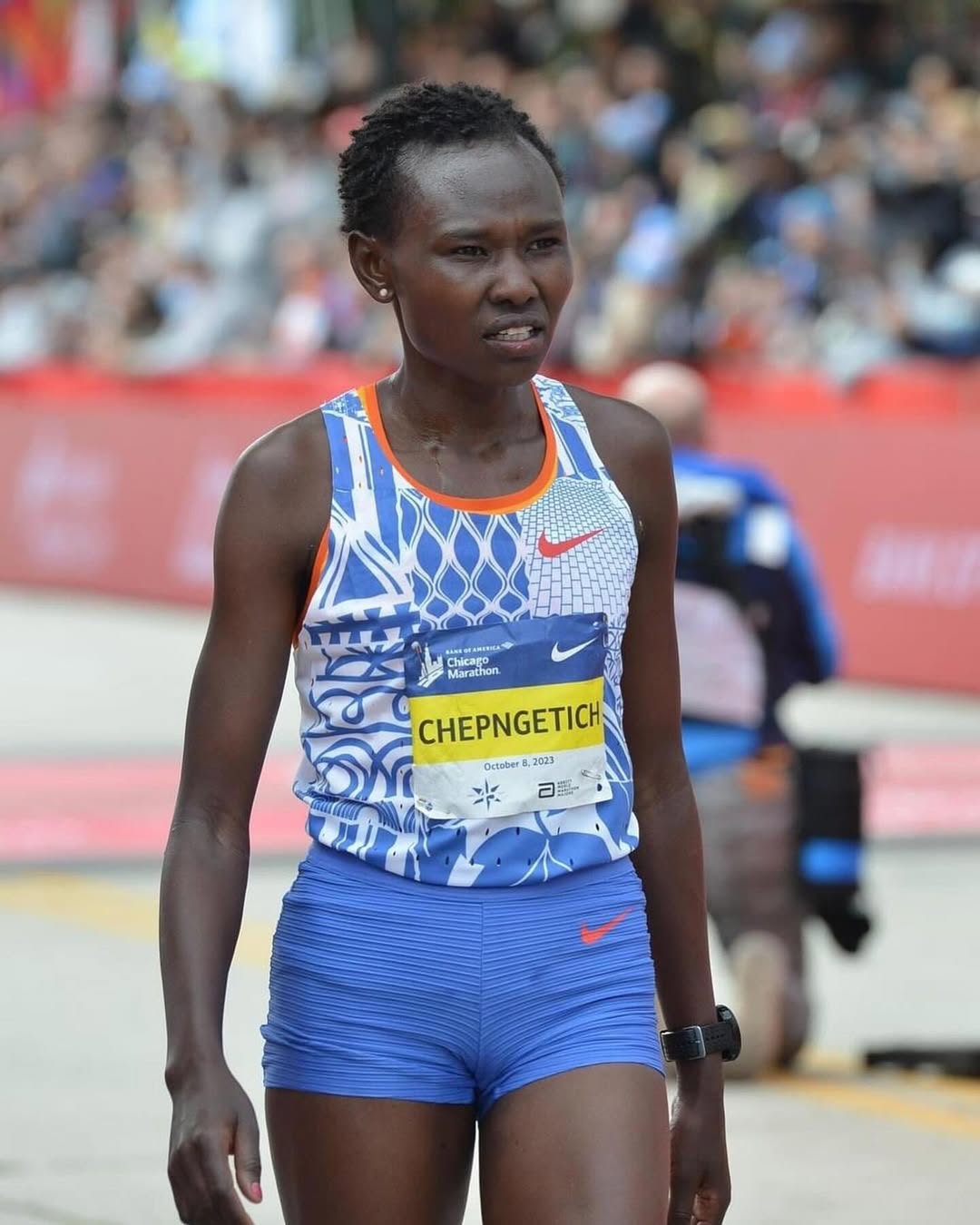
 Women's marathon world record holder Ruth Chepng'etich./FILE
Ruth Chepng’etich may have opted for a voluntary provisional suspension, but the world half-marathon record holder still retains the right to challenge the process before the Athletics Integrity Unit (AIU), and possibly the Court of Arbitration for Sport (CAS).
Chepng’etich was provisionally suspended on Thursday after testing positive for Hydrochlorothiazide (HCTZ), a diuretic listed under class S5 (Diuretics and Masking Agents) on the World Anti-Doping Agency (WADA) Prohibited List.
The banned substance, flagged in a March 14 sample, is outlawed at all times in sport due to its potential to mask other prohibited substances.
A specified substance has a standard sanction of two (2) years’ ineligibility (subject to possible reduction or increase in accordance with WADA Code provisions).
The AIU insists it follows strict due process before suspending any athlete.
Chepng’etich was first issued with a formal notice of charge on April 3, but was not immediately sidelined.
Instead, she voluntarily accepted a provisional suspension on April 19 pending the AIU’s investigations.
In its statement, the AIU noted that a statement of charge was issued to Chepng'etich on April 3.
It further added that she was not suspended at the time of notification but she opted for a voluntary suspension on April 19 as the AIU conducted its investigation.
"A Notice of Charge has been issued against Chepng'etich regarding the detection of the prohibited substance."
"Chepng'etich was not provisionally suspended by the AIU at the time of notification; however, on 19 April, she opted for a voluntary provisional suspension while the AIU’s investigation was ongoing."
As per AIU protocol, the organisation made the case public after its preliminary findings.
The investigation continues with evidence gathering and a thorough review of the alleged violation.
Chepng’etich now holds the right to request a hearing before the independent World Athletics disciplinary tribunal, which will determine her fate based on the evidence presented.
She has to submit a written plea to the AIU, either contesting the provisional suspension or presenting grounds why it should be lifted, a right protected under Rule 7 of the AIU’s anti-doping rules.
"Where a Provisional Suspension has been imposed, the Athlete or other Person may make a written submission to the Integrity Unit showing cause why the Provisional Suspension should be lifted (or, where it has not yet been imposed, should not be imposed)," the rules of AIU state.
The athlete must, however, establish that the anti-doping violation has no reasonable prospect of being upheld or that other facts exist that make it clearly unfair.
Should she choose not to request a hearing, she may accept the violation and enter into a negotiated sanction with the AIU, a route several athletes have taken in the past to reduce potential bans.
If an athlete does not want a hearing, they may accept the violation and agree on sanctions with the AIU.
Ultimately, if the matter proceeds to a hearing, the independent tribunal will deliver a verdict. A guilty finding would see sanctions imposed; if cleared, Chepng’etich would have her suspension lifted.
Should the AIU make a ruling that she deems unfair, Chepng'etich may file an appeal with the CAS.
Once the process is exhausted, the final decision is enforced, whether it means upholding the ban, reducing it, or clearing the athlete.