When
the 2010 constitution was promulgated on August 27, 2010, for many, it seemed
the dawn of a new Kenya and an opportunity to reorganise and reset the
country to reflectthetruenatureofa
republic.
Therewasexpectation,excitementandhope thatthe new constitutional order signalled the commencement of a journey towards fixing the country’s real structural failures and entrenching equity, inclusion, responsible use of public resources and, most importantly, real sovereignty for the people.
But almost 15 years later, Kenya has not just stagnated but in many ways, it has backslidden to a darker place where unchecked power operates with the same impunity as in the pre- 2010 era and Kenyans are not just disillusioned, they are angry at the failure of the promise of reengineering the nation to animate the aspirations captured in the new constitution; and they are right to be.
AttheheartofthisfailureisParliament,theveryinstitutionentrustedwithrepresenting the people, which has now become thesingle biggestobstacle to realising the promise of the 2010 constitution. It hasnot merely fallen shortbut has actively betrayed the public trust and sabotaged the emergence of the true republic.
Parliament has been given immense power to legislate for the benefit of the people, to check the executive, to safeguard the public purse as its custodians and, above all, to ensure the constitution is brought to life. Instead, it has turned into a betrayal machine, undermining everything the constitution stands for and betraying the aspirations of the people.
It happened rather quickly, almost two years post promulgation, in December 2012. The three arms of government acting in concert, Parliament and the Executive, supported by a majority advisory opinion of the Supreme Court, stalled on enacting laws required to implement key parts of the constitution, specifically dealing with inclusion; Articles 81(b), (c), and 100 were left hanging.
These provisions are not just suggestions, but core guarantees to ensure women, marginalised groups and persons with disabilities have fairrepresentationandparticipationinleadershipandgovernance ascapturedinArticle 27(6) and (8) and within the timelines under the Fifth Schedule.
The thing is, if the political elite and those who exercise the sovereign’s delegated authority were able to exclude close to three-quarters of the population from meaningful representation and engagement as constitutionally envisaged, then everything else is fair game.
This was the first constitutional breach, and the public did not push back because, for many,itwasassumedthatitwasjusta “women’sissue”orsomethingabstract.Buthere is what gets overlooked: Parliament’s failure to implement inclusion laws opened the floodgatesandbecamethesignalthatconstitutionalobligationscouldbeignored when they are deemed politically inconvenient. That is how the slide began.
From there, it was freefall. Parliament abandoned its duty and responsibility as the guardianofthepublicpurse,asitdisregardedtheprincipleslaidoutinChapter12on Public Finance Management. It disregarded its responsibility in the management of public finances, resulting in Kenya beingsaddledwith unsustainable [andvery likely odious] debt, broken public service, crippled education, healthcare, struggling devolution and non-existent social protections, among other ills; all because the legislature failed to do its job.
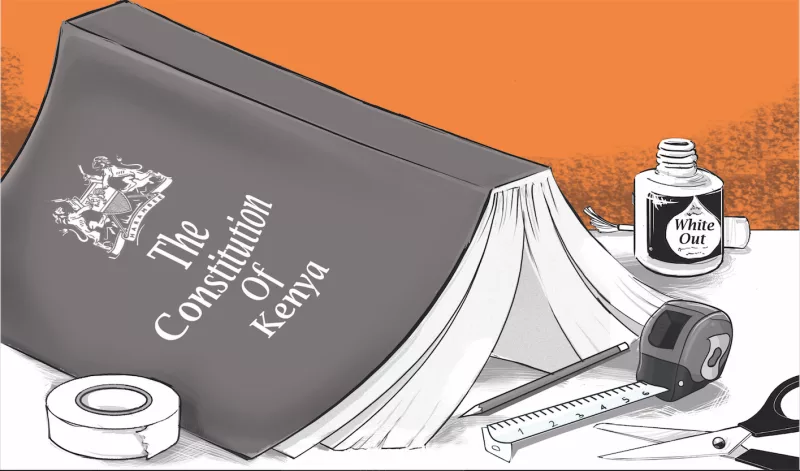
Through it all, Parliament, at the behest of the executive and on occasion for its own selfish ends, has repeatedly sought to chip away at the constitution by weakening the checks on power to evade public accountability.It has proposed all mannerof legislation,few toimplementtheconstitution butmoreto,amongotherthing,s amendit to escape accountability and consolidate power to themselves.
Kenya’s post-independence experience showed how dangerous unchecked power is, which is why the Committee of Experts deliberately made certain amendments subject toreferenda.Anychangethatfundamentallyaltersthecharacterofthe constitution and the roles of the arms of government mustgo back to the people.
Parliament knows this, but instead of upholding that principle, it has been trying, in various ways, to claw back at the safeguards meant to keep Kenya a republic in the true sense. While they have not succeeded in changing the supreme law, they have severely violated it in practice.
Parliament has failed to live up to its constitutional role as the body exercising the sovereign’s delegated authority. At a time when Kenyans are seeking a way out of the messthecountry andpeoplefindthemselvesin,thisisthetimetoremind ourselves that there is a remedy.
Article 261 exists precisely for a situation such as this. It is not a dead letterbutbothanaccountabilityandenforcementmechanism,providingthepeoplewith a way to impose serious political consequences on a Parliament and political elite that refuses to do its duty. Dissolution of Parliament is not symbolic, it is constitutional. It is the reset button meant to protect the republic when its institutions fail.
InSeptember2020,thethen ChiefJusticeDavidMaragaissuedaformal advisory recommending Parliament’s dissolution under Article 261. Not as a political stunt but becauseParliament’sfailuretoenactthelawsrequiredunderArticles81(b),(c) and100, as read with Article 27(6) and (8) had met the legal threshold for that extreme but necessarystep.JusticeMativo’sjudgmentinPetition371of2016madethatobligation crystalclear,andParliamentignoredit. Theirderelictionmetthelegalthresholdforthat extreme step.
That advisory has never been acted on. Parliament remains in contempt, not just of the people,butofmultiplecourtorders,includingtheSupremeCourt’s2012advisory.It continues to ignore the people, the courts and the constitution.
Meanwhile, the country is struggling under the weight of Parliament’s failure, which is not theoretical anymore. It is visible in every exclusion, oppression, collapsing public service,anunpredictableburdensometaxregimenandadebtcrisis.Parliament’sfailure lies at the heart of it all because they have proven, over and over, they are the weakest link and itis time to use the mechanism the Constitution givesus to holditaccountable.
ChiefJusticeMarthaKoomehasadutynow.Shemustreaffirmthe2020dissolution advisory. Kenyans must demand it of her.
This is not about emotion but about responsibility. Dissolving Parliament is how the sovereign,We the People,remindtherepresentativeswhoisreallyincharge.Itisthe clearest political cost possible for sustained dereliction of duty.
Parliamenthascrossedeveryredline.Kenyanscannotaffordtoletitkeepgoing. Wemustnotletthemkeepgoing.DissolveParliamentnow.For We the People,for the constitution and for the republic.
Daisy is a governance, development and women's rights specialist