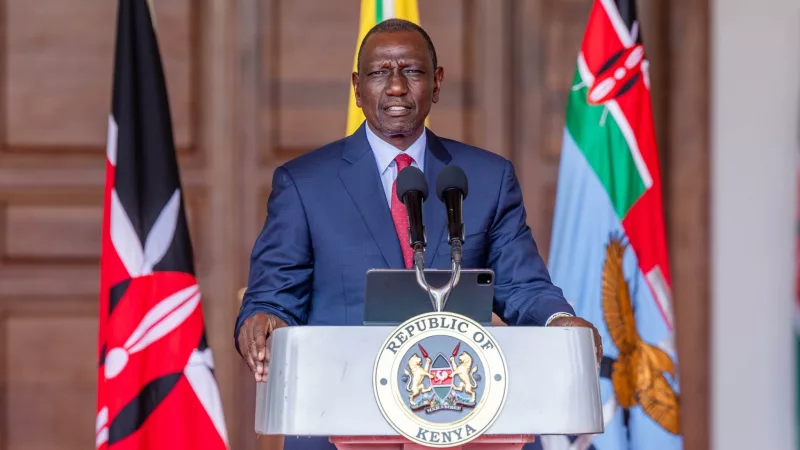
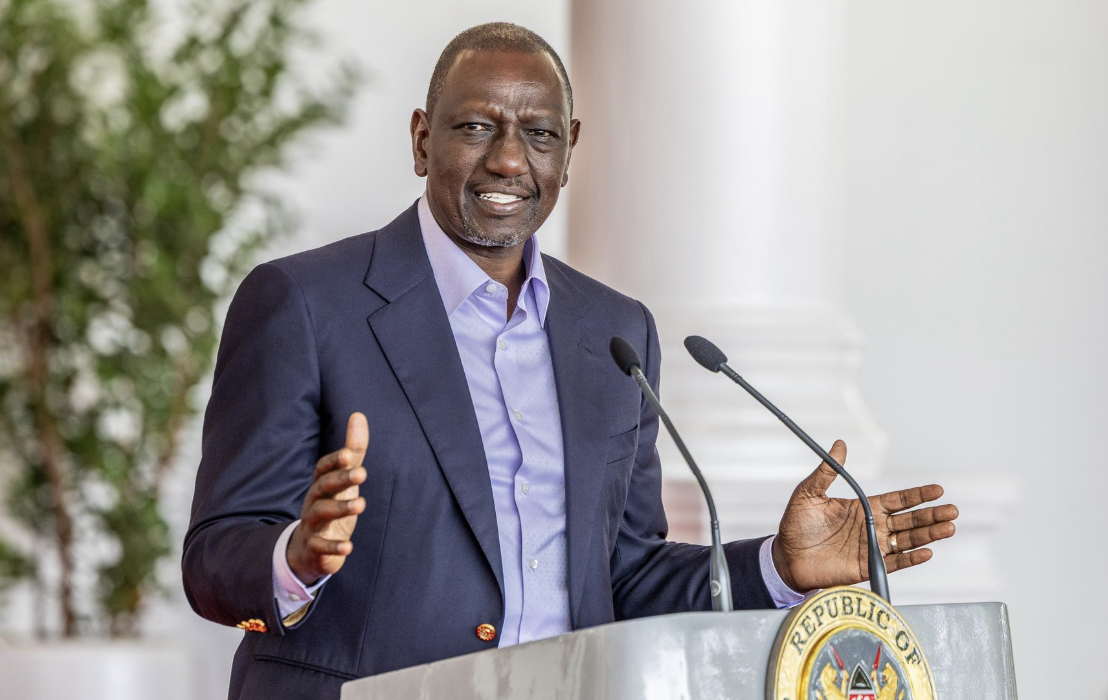
 President William Ruto on July 15, 2025. /PCS
President William Ruto’s recent directive that individuals found looting or destroying property during protests should be shot in the leg sparked sharp reactions across the country.
Speaking on July 9 during a tour of the police housing project in Kilimani, Nairobi, Ruto said in the interest of national peace, those involved in looting and destruction of property should not be spared.
Instead, they should be shot in the leg to destabilise them before being taken to court.
“Mtu ambaye anaenda kuchoma biashara ya mwingine, mtu kama huyo apigwe risasi miguu aende hospitali akienda kortini. Wasimuue lakini wapige hii miguu ivunjike ndio aende hospitali akienda kortini,” he said.
(Someone who goes to burn another person’s business—such a person should be shot in the legs and taken to hospital and then to court. Don’t kill them, but shoot their legs so they break, and then take them to hospital and to court).
Ruto’s remarks ignited widespread debate.
Opposition leader and longtime foe-turned-ally Raila Odinga swiftly responded, warning against the temptation to hand police illegitimate and deadly powers, even in cases where citizens are suspected of breaking the law.
Raila stressed the need to uphold the rule of law and due process at all times.
“We are all better served as a country when we stick to the principle that everyone is innocent until proven guilty; determination that can only be made by a competent court of law,” Raila said in a statement on July 11.
“Let's prioritise arrests and arraignment in courts over killing, maiming or brutalising of suspects.”
Many Kenyans on social media also expressed concern, interpreting Ruto’s remarks as a green light for police to use extrajudicial force.
AI-generated memes quickly went viral, depicting crowds of people on crutches and wheelchairs, mocking the President’s directive in a satirical fashion.
However, what may have escaped attention—including that of the President himself—is a lesser-known legal consequence: individuals shot and disabled by police could end up qualifying for tax relief under existing laws.
According to the Persons with Disabilities Act, 2003 and The Persons with Disabilities (Income Tax Deductions and Exemptions) Order, 2010, persons who become disabled are entitled to certain tax exemptions.
Specifically, those with a recognised disability can apply for exemption from income tax and other levies on earnings up to Sh150,000 per month or Sh1.8 million annually.
To qualify, the law requires a disability assessment report from a government-gazetted hospital detailing the nature of the disability.
The individual must also register with the National Council for Persons with Disabilities (NCPWD) and undergo vetting by a committee comprising representatives from NCPWD, the Ministry of Health, and the Kenya Revenue Authority (KRA).
“Upon recommendation of the application by the joint panel, the application is submitted to KRA through the iTax system by NCPWD, on behalf of the applicant,” the law states.
If the KRA Commissioner is satisfied with the application’s accuracy and completeness, a tax exemption certificate valid for five years is issued.
Additionally, disabled persons are eligible for tax exemptions on motor vehicle imports.
According to the Kenya Disabled Persons Car Import Tax Exemption Requirements, applicants must provide a tax compliance certificate, tax exemption certificate, and a medical certificate from a registered doctor.
They must also show a letter of recommendation from NCPWD after vetting, alongside proof of payment for the vehicle.
In essence, the President’s tough talk could trigger a zero-sum effect—where efforts to punish offenders through force may ultimately result in the government forfeiting tax revenue from individuals rendered disabled during protests.