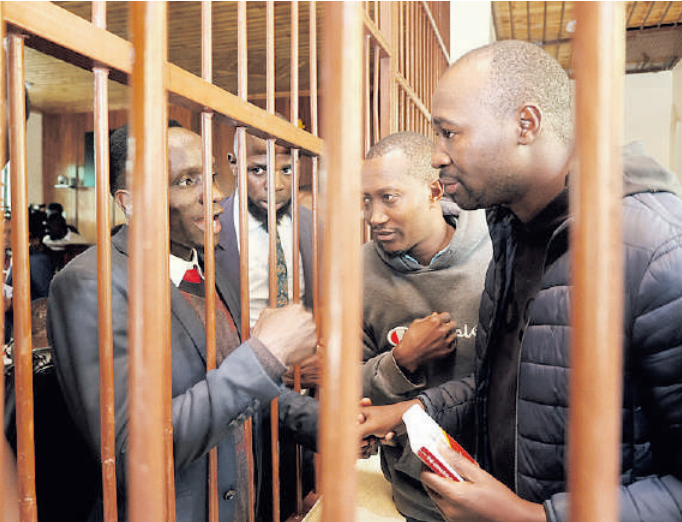
Two Democratic Congress Party officials who are allies of former Deputy President Rigathi Gachagua yesterday fought off terror charges levelled against them by the state over last week’s protests.
Peter Kinyanjui and Wanjiku Thiga argued the case is politically motivated and legally defective.
The duo was arraigned before the Kahawa law courts to face terrorism-related charges linked to the June 25 Gen Z protests.
“On June 25, 2025, between 1200 hours and 2300 hours in Kikuyu area within Kiambu county, you and others not before court, committed a terrorist act which resulted in serious damage to Government offices and buildings,” the charge sheet read.
Their lawyers, led by Wiper Party leader Kalonzo Musyoka, faulted the charges, telling the court the two youth leaders do not belong to any terrorist group.
This comes as more individuals believed to be protesters were arraigned over similar incidents linked to the demonstrations that were marred by violence.
Kalonzo warned that such charges risked rousing an already politically charged population.
“The penalty for terrorism is no less than 30 years. These young people do not belong to any terrorist group. Charging them under such a serious offence serves as a prospect of inflaming Kenyans,” he argued.
He further condemned the incidents witnessed in Kiambu and Ruiru courts, where the two DCP youth officials had been freed on bond only to be rearrested shortly after.
Kalonzo particularly criticised the nature of the rearrest of Kinyanjui, also known as Kawanjiru, saying it was executed in a manner that undermined judicial authority.
He noted that Kawanjiru had been granted bail by a competent court, yet was rearrested by anti-terror officers shortly after leaving the courtroom.
Kalonzo was referring to an event where a group of armed officers outside the court demanded that the main entrance be opened.
Once inside, the officers rushed into the courtroom and grabbed Kawanjiru, prompting screams and resistance from relatives and supporters.
A scuffle broke out, forcing officers stationed outside to fire several shots into the air to disperse the crowd and secure the arrest.
The officers then bundled Kawanjiru into a waiting van and sped off.
“Use of firearms in a court environment is excessive, unjustified and an affront to the authority and dignity of the judiciary. Courts are sacred places with constitutional adjudication,” Kalonzo stated.
He urged the court to distinguish between illegal militias and unarmed demonstrators.
“Illegal militias seen in protests are the groups Kenyans wish to be brought to the court of justice,” he said.
His sentiments were echoed by defence lawyers, among them Ndegwa Njiru and Kibe Mungai, who told the court that the charges are defective and an abuse of legal process.
They argued that they lacked both constitutional and evidentiary backing.
The defence said that the respondents were rearrested by officers from the Anti-Terrorism Police Unit and brought to the Kahawa law courts under unclear circumstances.
They likened the nature of the arrest to an abduction, arguing that it violated both court orders and constitutional safeguards.
“Once a person has been admitted to bail, the bare minimum is that they must sleep in their own bed for a night, not in a cell. What happened here is contempt of court,” the lawyers argued.
The prosecution team, however, defended the decision, saying the destruction targeted key government institutions, including a chief’s office, a court and subcounty administration offices, among others. They cited the need to protect public safety and property.
“The charge sheet demonstrates that the evidentiary and public interest tests were met. The right to prosecute is being exercised with humility,” they said.
They also denied claims of abducting the duo, adding that they were lawfully arrested and brought to court within the constitutional time limits.
“This was not an abduction, as has been alleged. It was a lawful arrest carried out under provisions of the law,” the prosecution said.
The state insisted that the charges, including terrorism, were properly brought and that any complaints about excessive force or procedural violations should be addressed during trial.
“If those allegations are serious, let them file a sworn affidavit. We cannot proceed on the basis of hearsay. There’s no greater force than necessary that should be used, but if there were, it is a matter for trial,” the state submitted.
“What we’re dealing with now is whether the accused should take plea.”
Magistrate Gideon Kiage said he would deliver a ruling on the objections raised on Thursday.
“Arguments have been made by counsels of both sides and due to the importance and gravity of the issues raised, I will preserve a ruling on these matters until July 10,” Kiage said.