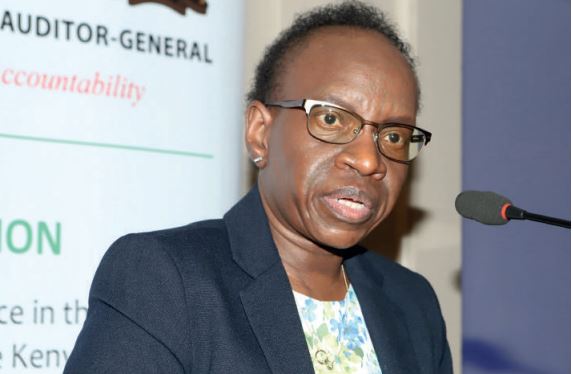
Parliament is being systematically ignored by institutions it oversees in the Executive, a new report by Auditor General Nancy Gathungu has said.
In a disturbing reality, it is emerging that government agencies continue to disregard audit recommendations with near impunity.
Despite clear legal mandates and repeated directives, the entities are feared to be creating a culture of financial mismanagement that costs taxpayers billions.
Gathungu's findings show only 21 per cent of parliamentary audit recommendations have been fully implemented, with half completely ignored.
This low compliance rate persists despite the Public Audit Act (2015) and Public Finance Management Act (2012) explicitly requiring government entities to act on parliamentary directives.
The pattern of defiance spans multiple administrations and suggests deep-rooted systemic failures in the country’s governance structure.
“The state of affairs is of major concern as this review was done almost one year after the report was adopted by the National Assembly,” Gathungu said.
Save for a few recommendations of a legislative and policy nature, the recommendations were to be implemented within three months after February 28, 2024.
“Implementation of audit recommendations can also lead to savings of public resources,” she noted, citing the recovery of Sh275 million in the period.
She decried the failure to submit a report on actions taken, as required to report back, creates a gap in the accountability process.
“The action reported to have been undertaken had no relationship with the recommendation as directed by the National Assembly in some cases,” she said.
The National Treasury emerges as a particular concern, failing in its fundamental role as custodian of public funds.
Shockingly, the audit shows it has not reviewed unutilised loans worth billions nor renegotiated costly commitment fees.
Despite clear orders to expedite Exchequer releases and prevent wasteful expenditures like avoidable interest payments on delayed disbursements, no corrective measures have been documented.
Perhaps most troubling is the Treasury's failure to clear pending bills, despite specific instructions to prioritise them in new budgets.
The Auditor General also highlights the Treasury's unexplained failure to recover Sh438,000 from a former Kenya National Bureau of Statistics director, raising questions about accountability for even relatively small amounts.
The Health ministry's performance is no better, with Mathari National Teaching and Referral Hospital's long-promised relocation remaining in limbo.
As per the review, officials offered vague excuses about funding constraints while failing to produce evidence of budget requests.
Similarly, 235 housing units at the facility continue to exist in administrative limbo, unregistered in official asset books despite explicit parliamentary orders.
State corporations have also demonstrated a bold disregard for oversight as directed by the Public Investments Committee.
Gathungu’s review shows the Kenya Ports Authority continues paying unlawful allowances, in direct violation of the Salaries and Remuneration Commission guidelines.
It also failed to recover Sh19.4 million in supervision costs from a contractor as ordered.
KPA has also been called out for not enforcing the vacation of the Lamu Port land by the compensated Project Affected Persons.
Other institutions show similar patterns of non-compliance, like the Kenya Railways Corporation, which has made no progress recovering deposits trapped in the collapsed Chase Bank.
Kenya Wildlife Service is yet to recover Sh6 million owed for land taken for SGR construction.
The National Housing Corporation has taken no meaningful action on the protracted Mavoko land court case.
Gathungu has also cited the Tourism Fund for failing to recover Sh9.5 million from the defunct African Safari Club despite directives by MPs.
The Auditor General's report suggests this systemic disregard stems from weak enforcement mechanisms.
While Parliament can issue recommendations, it lacks tools to compel compliance.
Gathungu proposes concrete solutions, including making audit implementation a key performance indicator for accounting officers.
She has also rooted for establishing legal consequences for non-compliance and creating a centralised system to track multi-agency recommendations.
The Executive should consider including the implementation of audit recommendations as a key performance target for accounting officers.
“This will motivate the management of state entities to implement the recommendations,” the Auditor General said.
Parliament should consider reviewing sanctions on failure to implement audit recommendations, including anchoring them in law.
This will act as a deterrent and ensure that recommendations are implemented, the Auditor General stated in the report.
“The head of the Civil Service should develop a mechanism for coordinating the implementation of audit recommendations requiring a multi-agency approach,” Gathungu said.
The implications of not implementing audit reports extend beyond financial losses, the review shows.
This persistent defiance undermines the entire governance framework, eroding public trust in institutions, said Chris Owala, director of the Community Initiative Action Group, a rights lobby.
“When parliamentary oversight becomes merely performative, it creates an environment where mismanagement flourishes,” he told the Star on the revelations.
In what suggests some agencies view compliance as optional rather than mandatory, the report red-flags the recurring nature of many audit queries – appearing year after year with no resolution.
Experts say Parliament must strengthen its enforcement powers, possibly through amendments to existing laws.
“The Executive needs to treat parliamentary directives with the seriousness they deserve rather than as optional suggestions,” Philip Gichana of Mzalendo Trust said.
For MPs, accounting officers must be held personally liable for non-compliance through mechanisms like mandatory surcharges or disqualification from public office.
“Parliament must now exercise its constitutional authority to compel compliance, whether through budget sanctions, personal accountability measures, or other enforcement mechanisms,” Butere MP Tindi Mwale, chairman of the Public Accounts Committee, said.
He said the alternative – that is, continued erosion of oversight – would represent a fundamental failure of Kenya's democratic institutions.
As the Auditor General's findings make clear, audit recommendations cannot remain optional if the President William Ruto administration hopes to curb waste and corruption.
Instant Analysis
The Executive's persistent defiance of parliamentary oversight represents not just a financial issue, but a direct challenge to constitutional governance itself. How Parliament responds will determine whether the country’s oversight institutions retain any meaningful authority or become mere rubber stamps for continued mismanagement.