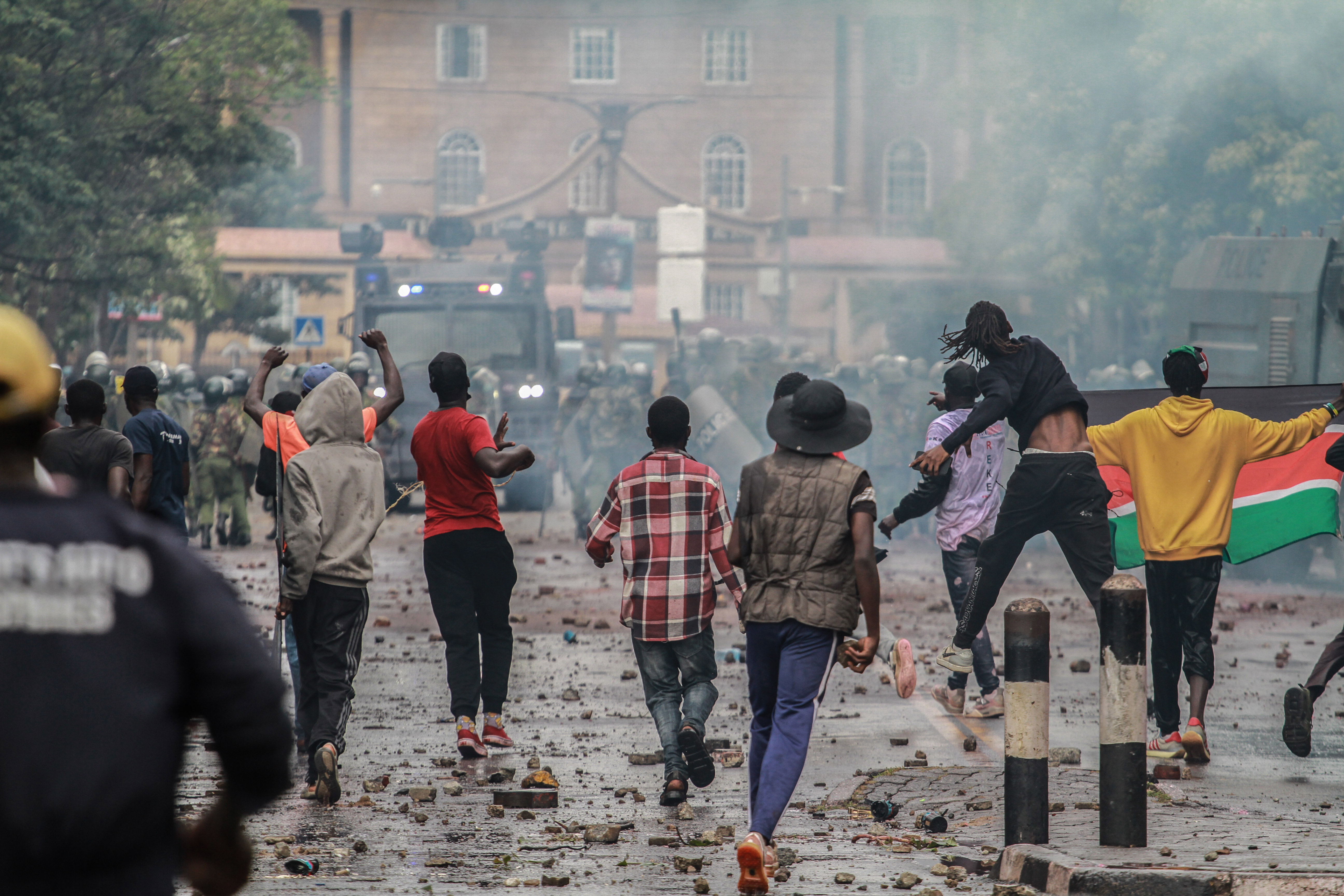
A new survey by US-based research firm GeoPoll suggests Kenya’s anti-government protests are unlikely to end unless there is a complete overhaul of the country’s top political leadership.
According to the poll, which was centred on youth aged 25-35, 42 per cent of them cited leadership change, when asked what must change for the protests to stop.
This was followed by calls for youth empowerment and employment at 13 per cent and tackling corruption at 12 per cent.
Other demands are economic reform and an end to abductions and killings tied at 11 per cent, public inclusion in decision making at six per cent, public reform and accountability at three per cent and resignation of leaders, and justice and rule of law tied at one per cent.
According to the Federation of Kenya Employers, the youth account for over 35 per cent of the Kenyan population and experience the highest unemployment rate. Over a million young people enter into the labour market annually without any skill set or defined profession, FKE says.
The perceptions on the June 2025 Gen Z protests report reflects a strong desire among citizens for transformative political and governance reforms as a means to restore public trust and stability,” the study says.
Political dissatisfaction emerged as they key problem pushing the youth to the streets. In a departure from last year's demos that were centred on the economy, concerns have now evolved into political dissatisfaction and disillusionment.
“In 2024, the Finance Bill, economic hardship and misgovernance dominated the conversation, with citizens expressing outrage over inflated living costs, unaccountable leadership and lack of job opportunities," report says.
“In contrast, the 2025 survey says political dissatisfaction has surpassed economic concerns as the primary reason for protest (31 per cent), while the cost of living has decreased to 22 per cent and corruption to just nine per cent,” the report says.
Notably, however, more than half of the respondents at 57 per cent believe that nothing has changed between last year and now.
Many youth expressed widespread perception of stagnation in governance, accountability and socio-economic conditions, despite the significant national and international attention the 2024 protests received.
“The results indicate that for most Kenyans, the promises of reform and open dialogue made after last year’s demonstrations have not led to any real improvements. This deep sense of disillusionment may be fueling ongoing civic unrest and the persistent demand for systemic change,” the study said.
The study indicated that frustrations have evolved from specific grievances to broader disillusionment with the political system. The situation has entrenched mistrust in governance and a rising demand for structural change.
The findings show very little public trust in the government to address the concerns raised during the protests .
As much as 63 per cent of respondents said they have minimal confidence, with 38 per cent saying they trust the government “very little” and 26 per cent said “not at all”.
Similar to last year, the top three concerns among Kenyans have remained largely consistent, with unemployment (89 per cent), corruption (84 per cent), and the cost of living (82 per cent) continuing to dominate public anxiety.
But even as the youth continue going to the streets with the anticipated Saba Saba demos, opinion is divided over the impact of protests towards effecting change.
About 34 per cent of respondents believed the protests would result in some minor changes, while 25 per cent felt that no changes would occur, underscoring skepticism about the government’s willingness to respond meaningfully.
“Only 11 per cent felt that their concerns are being acknowledged, while 18 per cent were unsure. In addition, the vast majority of respondents, 79 per cent believe the government is not addressing the needs of the youth. Only eight per cent felt that youth concerns are being taken into account, while 12 per cent were unsure,” the study said.
The survey was conducted via the GeoPoll mobile application on June 26 with a sample size of 915 randomly selected.
With a balanced representation of males (57 per cent) and females (43 per cent).
A majority held college degrees (67 per cent), while 49 per cent were unemployed and 18 per cent owned small businesses. Respondents were predominantly from urban (70 per cent) and rural (30 per cent).
Only 24 per cent expressed a moderate level of trust by selecting “somewhat,” while just 14 per cent reported having “very much” trust.