
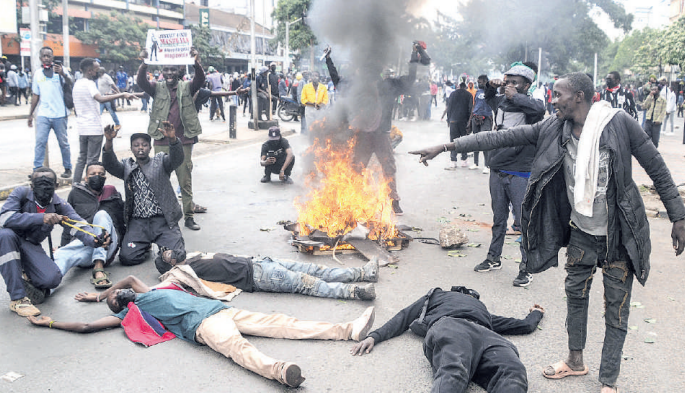
The William Ruto administration appears to be grappling with repeated missteps and challenges in crisis management. At the height of the Gen Z protests on Wednesday, June 25, marking the first anniversary of last year’s demonstrations, the government switched off free-to-air media signals after several media houses declined to comply with a directive to halt live coverage of the events.
As the administration faced its most severe political test since taking office, observers expected it to pursue dialogue and partnerships instead of straining relations with a key democratic institution: the media. Yet, many young protesters seemed largely unaffected by the blackout, turning instead to platforms like TikTok, Instagram, and X (formerly Twitter) to coordinate and share updates. Their parents, who rely more heavily on television, were likely the ones most impacted by the shutdown.
In the aftermath of violent clashes reported in at least 25 counties, Interior Cabinet Secretary Kipchumba Murkomen toured affected regions with senior security officials to assess the situation. His unscripted remarks, interpreted by some as condoning the use of force, drew public criticism even before discussions about the media blackout had subsided.
Further controversy arose as statements by certain officials and allies of the ruling coalition appeared to link the protests and ensuing unrest to Rigathi Gachagua, the former Deputy President and a prominent political figure in the Mt Kenya region.
While Gachagua is seen as a divisive figure in national politics, attributing the organisation of widespread youth-led protests across counties such as Kisii, Kakamega, Mombasa, and Ukambani to him appears speculative and lacks clear evidence. His political influence has often been described as regionally and ethnically focused, raising doubts about his ability to inspire a broad-based, nationwide movement.
Nevertheless, the narrative arguably benefits Gachagua by portraying him as a significant opposition force with a youthful, countrywide following. His occasional public challenges to President Ruto, including taunts suggesting his arrest could trigger mass demonstrations, carry political risks and underscore tensions within the political landscape.
Claims that his rhetoric amounts to incitement or threatens national security require careful legal scrutiny to ensure any state response respects constitutional rights and avoids perceptions of political persecution.
Crucially, framing the protests as a tribal rebellion or an orchestrated power grab risks obscuring the core issues driving this wave of dissent. The current demonstrators represent a different demographic: young, educated, tech-savvy, and urban. Notably, young women are taking up prominent roles in the movement, a departure from previous demonstrations.
This context casts doubt on allegations of an organised coup plot. It also raises questions about the preparedness and effectiveness of security agencies, considering the scale and spontaneity of the protests. If such a conspiracy were truly as extensive as some allege, it would call into question the efficacy of national intelligence services.
For now, the Gen Z movement identifies itself as leaderless and unaffiliated with any political party. This lack of formal structure challenges conventional state responses, such as arresting leaders or banning organisations.
The administration would do well to engage meaningfully with these young citizens. Genuine dialogue and responsive governance could help de-escalate tensions and demonstrate a commitment to listening to Kenya’s youth.
Before the June 25 protests, social media platforms were filled with young people posting mock eulogies and epitaphs for themselves, a darkly humorous but poignant reflection of their awareness of the risks they faced. Beneath the humour lies a sobering reality: this generation is willing to risk their lives to demand change.
Protesters have signalled plans to return to the streets on Monday, July 7, to mark Saba Saba Day, a date symbolic of Kenya’s fight for multiparty democracy. Meanwhile, some government officials have suggested tightening restrictions on demonstrations. Such measures, however, risk being seen as repressive and could further inflame tensions, particularly against a loosely organised yet determined movement.
History shows there are limits to the use of force against unarmed civilians. While crackdowns might temporarily suppress protests, they do not address the grievances fuelling them.
The administration’s credibility is under strain. Public frustration has been heightened by reports of corruption, perceived impunity, and controversial government spending. Recent headlines, including plans for a luxury hotel within Ngong Forest and nearly Sh1 billion allocated for State House renovations, have amplified resentment among citizens struggling with high taxes, mounting debt, and economic stagnation.
To regain public trust, the government must pursue visible reforms: tackling corruption, cutting wasteful spending, and introducing bold policies to secure the future of Kenya’s youth. Without such action, it risks deepening alienation and triggering further unrest.
Even broad political alliances may not shield the administration if the youth-led movement continues to grow.
The signs are clear: Kenya’s young generation is increasingly impatient with unresponsive leadership and is willing to demand accountability in ways never seen before.
The writer is a political commentator