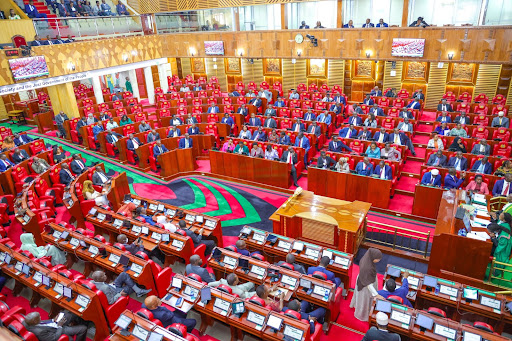
The National Assembly’s Public Petitions Committee has directed the IEBC to expedite the delimitation of electoral units upon its reconstitution.
“The committee recommends that upon reconstitution, the commission should commence the delimitation process expeditiously with a view to concluding the process in compliance with Article 89 (4),” it said in a report to the National Assembly yesterday.
This clause mandates the IEBC to conduct boundary reviews every eight to 12 years.
The last one was conducted in 2012, with the next one due by March last year.
The process stalled, however, due to the absence of commissioners.
The commission has been non-functional since January 2023, when its commissioners’ terms expired.
In June, President William Ruto appointed a new chairperson, Erastus Ethekon, and six commissioners, but they are yet to take office.
Their swearing in was blocked by a High Court order on a case citing procedural flaws in the selection, including alleged lack of diversity and public participation.
The committee’s directive comes barely two years to the 2027 General Election.
The committee’s recommendations follow a petition filed by the Centre for Accountability, Reform and Democracy.
The petition highlighted the IEBC’s failure to meet the constitutional deadline of March 2024 for reviewing constituency and ward boundaries.
The petition warned that delays risked undermining fair representation, entrenching resource disparities and triggering legal challenges ahead of the polls.
While the move is aimed at addressing long-standing electoral disputes and ensuring constitutional compliance, the path forward remains riddled with uncertainty.
Even so, chairperson Ernest Kagesi, MP for Vihiga, emphasised the urgency of the matter.
IEBC’s dysfunction has left Kenya in an uncharted territory, he said.
Article 89 (4) requires the IEBC to conclude the boundary delimitation at least 12 months before a general election, setting the stage for a race against time should MPs adopt the committee report in plenary.
The committee said the framework for the delimitation process has been articulated in changes made to the IEBC Act in July 2024.
Additionally, the IEBC must submit its Boundaries Review Operations Plan to Parliament within three months of resuming office.
MPs raised concerns that the operations plan, a phased roadmap for delimitation, is yet to be made public, raising concerns about transparency in the process.
IEBC chief executive Marjan Hussein has warned that failing to conduct the review would render the 2027 elections unconstitutional.
He cited outdated boundaries as disproportionately favouring densely populated regions, where some constituencies now exceed the national quota.
The Attorney General also emphasised that the failure to conduct boundary delimitation would likely result in legal challenges.
In an advisory, the AG warned that a lack of review would compromise the right to fair representation, political stability, social cohesion and electoral integrity.
The Supreme Court is poised to rule on whether the delimitation can proceed past the set deadline of 12 years since the last review.
IEBC wants clarity on whether it can proceed with the review without commissioners and whether the review is possible after the March 2024 deadline.
It also wants the courts to determine whether the deadline can be extended, and if so, by whom, and under what circumstances.
“If the Court allows the Secretariat to proceed with delimitation, the process can continue,” IEBC told the petitions committee.
“However, a critical question remains about who has the authority to extend the deadlines.”
Marjan warned that failure to resolve these issues could jeopardise the 2027 elections, as delimitation must be completed at least 12 months before polling day.
The objective, the commission secretariat said, is to allow for voter registration and dispute resolution.
MPs, under the National Dialogue Committee process, are required to make a resolution to extend the deadline, in a move to cure the breach of the constitution.
Whereas the report, which was midwifed by the President William Ruto and Raila Odinga-led coalitions, has been approved, the resolution is yet to be made.
An extension would require an amendment to the constitution, which is pending under the Nadco process.
Constitutional lawyer Bobby Mkangi warns that any review now would face legal challenges. “The original deadline has lapsed,” he said.
As the crisis persists, some 27 constituencies, which were protected in the first review, risk dissolution.
The petitions committee said it had no powers to dictate how the IEBC should handle the electoral units, which include Lamu East and Samburu West.
Others are Lamu West, Mvita, Mwatate, Wundanyi, Voi, Bura, Galole, Isiolo South, Kilome, Laisamis, North Horr, Saku and Mbeere North.
The future of Ndaragwa, Tetu, Mukurweini, Othaya, Kangema, Mathioya, Samburu East, Marakwet East, Keiyo North, Mogotio, Vihiga and Budalangi is also at stake.
The petitioner asked MPs to deliberate and enact a mechanism to save the constituencies during the second review process.
The committee ruled that Parliament cannot interfere with the IEBC’s constitutional authority to review these boundaries, leaving their future to the commission’s discretion.
“Pursuant to Article 89 (2) of the constitution, the commission has the mandate of review of boundaries for constituencies,” MPs said.
“Therefore, Parliament cannot dictate over the process of review.”
Failure to act, the committee warns in the report, could plunge the next election into a crisis of legitimacy.
The petition’s architect, Tom Macharia, argued that preparatory work, such as harmonising administrative maps and inter-agency collaboration, could begin even before the IEBC’s reconstitution.
Political undertones loom over the process, with the IEBC facing a cash strain, which risks hampering the review altogether.
With the 2027 elections approaching, boundary reviews could alter electoral fortunes, especially in densely populated areas.
In the said areas, deviations from population quotas have historically favoured incumbents.
The petitioner subtly alludes to this, noting that violating Article 89(5), which demands near-equal constituency populations, risks “resource deprivation and entrenchment of poverty” in underrepresented regions.
The Public Petitions Committee has further recommended amending the National Government Coordination Act to standardise sub-location boundaries, addressing a key flaw in the 2012 process.
INSTANT ANALYSIS
The IEBC’s fate hinges on the courts. The High Court is set to rule on the validity of the new commissioners’ appointments. The Supreme Court’s advisory opinion on delimitation timelines could either save face or force the country into an election with outdated boundaries, a scenario IEBC has billed as “illegal”. For now, MPs want the clock set ticking, but the path to achieving the up-to-date boundaries remains fraught with logistical hurdles.