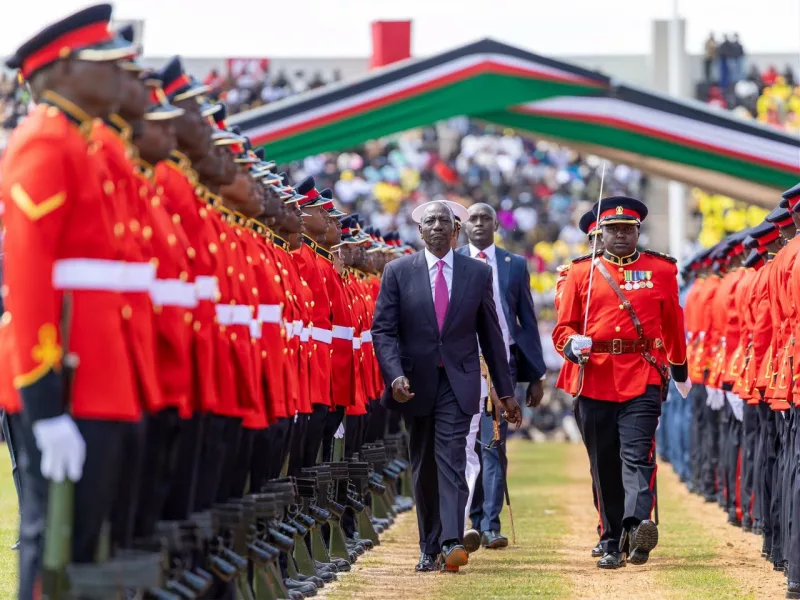
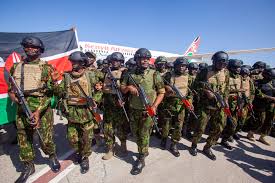
A section of Kenyan troops in Haiti/HANDOUT
The Kenya-led Multinational Security Support in Haiti is far from successful as violence has continued to escalate.
Human Rights Watch says in a new report that violence has continued to escalate, resulting in record displacement as gangs wreak havoc in the Caribbean country.
In a review of the mission one year since the first deployment, HRW says violence has intensified in capital Port-au-Prince and beyond, leaving at least 2,680 people dead and 957 injured, according to UN figures.
Personnel deficit, shortage of equipment and funding are cited as major hindrances.
“Ongoing shortfalls in personnel, funding and equipment have severely limited the MSS’s ability to contain violence,” HRW says in the review.
It adds that violence has forced hundreds of thousands to flee their homes, pushing the number of internally displaced people to nearly 1.3 million, the highest ever recorded in Haiti, according to the International Organisation for Migration.
The Displacement Tracking Matrix report by the IOM noted that the 1.3 million displaced persons represent a 24 per cent increase since December 2024. They now account for approximately 11 per cent of Haiti’s population.
International human rights workers reported that the gangs are burning homes on the outskirts of targeted neighbourhoods to force residents—and, at times, the police—to flee.
UN officials say the tactics are aimed at forcibly depopulating areas so that the organised gangs expand their presence and take control of other areas.
Nathalye Cotrino, senior Americas researcher at HRW, said the gang violence force is forcing hundreds of Haitians to flee with nothing but the clothes on their backs to makeshift sites or other cities, where they remain at risk and have little to no access to food and water.
“UN member countries should immediately reinforce the MSS. The UN Security Council should end its inaction and transform the MSS into a full-fledged UN mission that has the personnel, resources, and mandate to effectively protect the Haitian people,” Cotrino said.
The HRW review further reported that since 2025, gangs have escalated attacks in previously safe areas, including Port-au-Prince, its metropolitan area, as well as in other municipalities.
“This violence—including clashes with self-defence brigades, often operating with the involvement of police officers, and confrontations with security forces—has forced more than 245,000 people to flee their homes, according to the IOM,” it said.
HRW has blamed the escalation on failure by the international community to meet pre-agreed commitments such as deployment of forces, funding and equipment.
For instance, it notes, while eight states promised to deploy forces to MSS, only five have honoured — Kenya, Guatemala, El Salvador, Jamaica and the Bahamas have deployed forces.
“Their combined deployment totals just 991 officers, well below the expected 2,500. The MSS still requires additional funding to sustain operations through December and establish the remaining 9 of the 12 planned operational bases critical for securing territory and consolidating its presence,” HRW said.
Out of the 991 officers deployed, Kenya accounts for 744.
HRW has called on the UN Security Council to ensure the mission receives the personnel and resources needed to fulfil its mandate. It added that the UNSC needs to agree on steps to transform the mission into a full-fledged UN operation capable of protecting human rights and preventing a further escalation of violence.
In October last year, President William Ruto called on the international community to honour their commitments to support the mission.
Ruto said there is an urgent need for personnel, logistics and financial resources to sustain and expand the security mission.
While MSS Force Commander Godfrey Otunge maintains there is “tangible progress”, he on Thursday cited funding, personnel, and logistics as among the challenges the mission is facing.
Speaking during the first anniversary, Otunge assured that the issues were being actively addressed.
Commander Otunge also announced plans to establish Forward Operating Bases in key areas of Port-au-Prince.
“These bases will serve as strategic hubs for intelligence gathering, rapid threat response, and the protection of critical infrastructure. He appealed for continued partner support and reaffirmed his commitment to a peaceful Haiti,” he said.