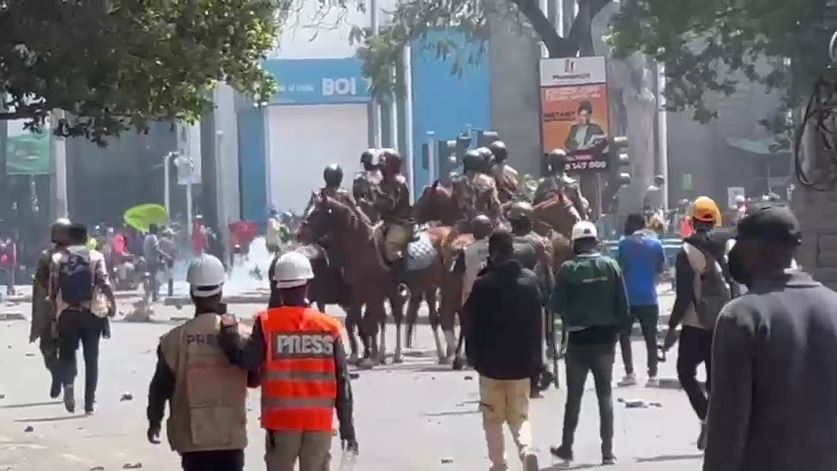
Police planned to allow protesters into Nairobi city but changed tune after it emerged some of them planned to hold a night vigil and make unknown demands.
Intelligence shared showed there was massive mobilisation from various parts of the city and its surrounding, and the plan was to either breach Parliament, City Hall or State House and later hold a sit-in overnight, while making the demands.
This prompted the police to block motorists from coming to the city. They also ring-fenced Parliament Building using razorwire.
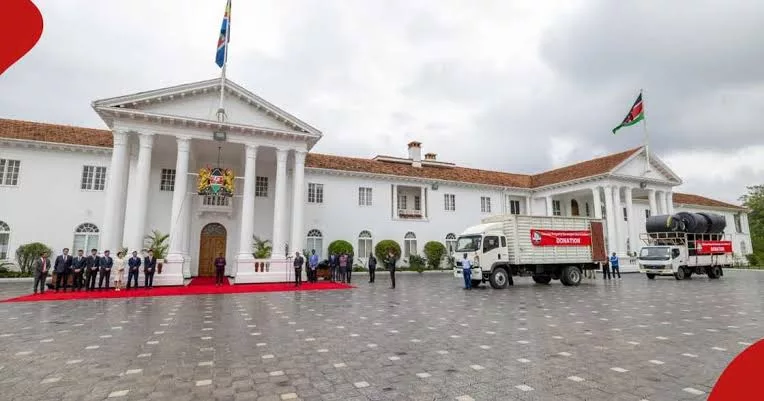
Roads around State House were also barricaded using razor wire.
More personnel were mobilised from towns surrounding Nairobi and brought in for the mission.
Intelligence, according to officials aware, showed there was massive mobilisation, and the intention was to cause maximum damage to marked property in the city.
Police had earlier said they would allow the protests to go on and even contemplated meeting the organisers and agreeing the routes to be used.
According to sources, those fronted as the organisers of the protests were unaware of the underlying plans.
The plans were to raid major government premises and stage sit-ins to last up to the following day.
Those planning the protests knew the police would be worn out by evening and hence were ready for the drama.
Police had also planned to release anti-riot teams in batches by withdrawing those tired and replacing them with new teams.
And contrary to the earlier plans, the city woke up to find major roads barricaded. Only select cars were allowed to pass through.
Boda boda riders came in handy, transporting some of those who planned the protests.
And by 10am, some parts of the city had started the protests.
Opposition leaders Kalonzo Musyoka and Eugene Wamalwa led a group to outside Parliament, where they laid flowers in rememberance of those killed in last year’s protests.
They later left the scene and drove towards Kenyatta Avenue and off to Karen.
In the meantime, crowds were forming in different parts of the city. Some tried to breach Central Police station. Others camped outside the National Archives and engaged police in running battles.
Teams of police moved on board five landcruisers, dispersing any crowd that tried to march to their intended destination.
Water cannons were deployed and managed to keep the mobs at bay.
Some of the protesters managed to reach City Hall and attacked askaris on duty, accusing them of working with goons to disrupt the planned protests.
The protests were called to commemorate the 2024 Finance Bill protests, in which more than 60 people were killed.Tension mounted in the city for the better part of Wednesday as police battled with what looked like hardened gangs.
Police were instructed not to use live bullets.
But come later in the day, some people were shot and killed in Ngara and Imara Daima in the chaos. Police said they were trying to loot.
One victim, a guard, was shot and killed by a stray bullet in Ngara.
Police said property of unknown value was destroyed in the city alone. There were scenes of looting in Thika, Nyeri and other major towns.
Many shop owners found their shops looted when they returned to work yesterday.
Officials said more than 10 people were killed and 400 injured in the protests.
The protests were called to commemorate the 2024 Finance Bill protests, in which more than 60 people were killed.
There were at least 61 suspected protesters arrested across the country.Further, there was infiltration of demonstrations by goons.This led to looting of property in many places.
The government banned live TV and radio coverage of the protests, but its decree was overturned by the High Court in Nairobi.
President William Ruto urged protesters not to threaten peace and stability, as some in the crowds tried to reach his official residence but were pushed back by police.
"Protests should not be to destroy peace in Kenya. We do not have another country to go to when things go wrong. It is our responsibility to keep our country safe," he said.
The President was speaking at a burial ceremony in the coastal county of Kilifi.
His absence from the State House, his official residence, was notable as young protesters threatened to storm it. They were stopped and dispersed outside State House Girls.
The protests were held in 24 counties and later turned chaotic. Properties were looted and others destroyed in the chaos.
Many roads were blocked for hours as groups flocked there to air their anger and frustration against the government.Ipoa said they deployed officers to the Kenya National Commission on Human Rights Situation Room to strengthen bilateral collaboration between the two institutions in monitoring interventions.
There was extensive damage to private and public property, Ipoa added, saying the monitoring team documented the use of excessive and varied force by police officers, including live ammunition, tear gas, water cannons, whips, and batons.
“Police officers concealed their identities contrary to the law. Interruption of free movement and normal public service operations including public transport, policing services and commercial activities,” Ipoa said in a statement.
Consequently, Ipoa has taken up preliminary enquiries into the various concern areas and will expedite investigations into cases where excessive force was documented during the public order management of the protests.
Separately, the Kenya National Commission on Human Rights recorded eight fatalities during the demonstrations.
KNCHR Vice Chairperson Dr Raymond Nyeris said the deaths resulted from six different counties: Machakos (two), Makueni (two), Nakuru (one), Kiambu (one), Uasin Gishu (one) and Nyandarua (one).
KNCHR also reported more than 400 casualties, including protesters, police officers and journalists.
Out of these, the majority have been treated and discharged, with 83 being referred for specialised treatment.