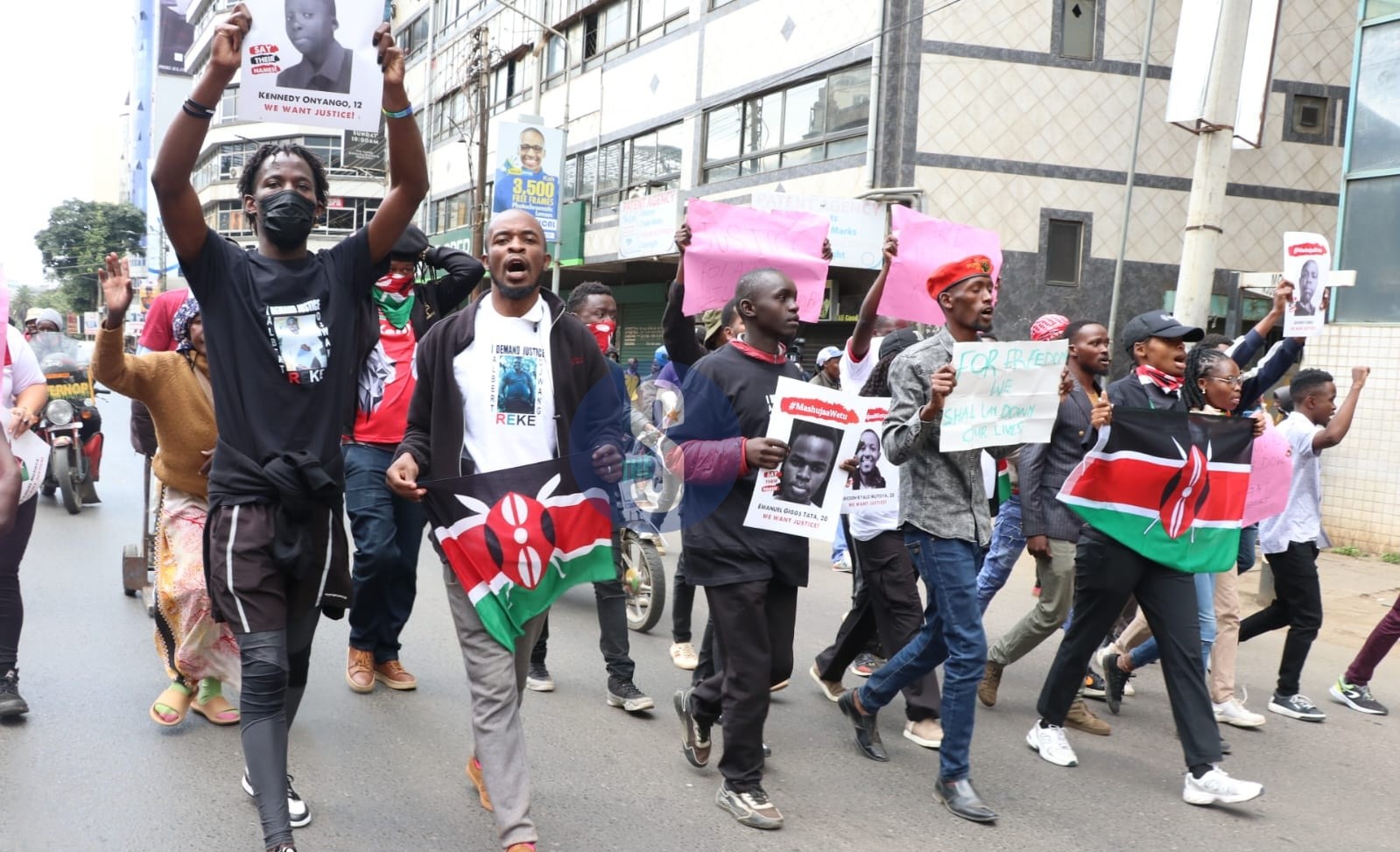
 Activists protesting over the death of the late Albert Ojwang as they head to Central Police station on June 17, 2025/LEAH MUKANGAI
As Kenya prepares to mark the first anniversary of the deadly June 25, 2024 anti-Finance Bill protests, the Office of the Attorney General has issued a timely reminder of the rights of arrested persons, underscoring constitutional protections at a time when police conduct is under intense public scrutiny.
The new guidelines, anchored in Article 49 of the Constitution of Kenya, come in the wake of a surge in reported cases of police brutality and arbitrary arrests.
Last year’s protests, which left dozens dead and many more injured, also saw hundreds detained—most of whom were later released without charge.
The move by the Attorney General’s office is seen as an effort to reinforce the rule of law and reassure Kenyans of their fundamental rights.
Key rights under article 49
According to the guidelines, every person arrested in Kenya is entitled to a set of non-negotiable rights.
“You have the right to be informed why you’re being arrested, in a language you understand,” the document states.
This provision is crucial in a country with diverse languages and communities, ensuring that no one is left in the dark about the reasons for their detention.
Arrested persons also have the right to “speak to a lawyer or a person of your choice,” and to “remain silent—you don’t have to say anything.”
These rights are designed to protect individuals from self-incrimination and to ensure access to legal counsel from the outset.
The guidelines further stipulate that detainees must “appear in court within 24 hours” and “apply for bail or bond.”
Importantly, the document highlights that individuals must “not be held longer than necessary without being charged” and must “be kept away from convicted criminals.”
The right to “be treated humanely and with dignity” is also emphasised, reflecting commitment to upholding human rights standards.
Limits on remand and the presumption of innocence
The Attorney General’s office makes it clear that “you cannot be remanded if the offence is only punishable by a fine or imprisonment for six months or less.”
This is a significant safeguard against unnecessary pre-trial detention for minor offences.
The guidelines remind Kenyans: “You are innocent until proven guilty. You are still protected by the Constitution even after arrest. The police must follow the law—and so must the courts.”
Justice delayed is justice denied
The document warns that “justice delayed is justice denied,” noting that “any delay in being brought to court violates your rights.”
This echoes concerns raised by human rights organisations, including Amnesty International, which has repeatedly called on Kenyan authorities to uphold due process and prevent prolonged detentions.
AG's advice to Kenyans
The guidelines encourage those arrested to always ask: “Why am I being arrested?”, “Can I speak to my lawyer?”, and “Am I being charged or released?”
These questions are intended to empower citizens to assert their rights and hold law enforcement accountable.
The release of the guidelines come as the Independent Policing Oversight Authority (Ipoa) continues to investigate allegations of excessive force and unlawful detentions.
According to Ipoa's 2024 mid-year report, complaints against police rose by 18 per cent compared to the previous year, with many cases linked to crowd control during demonstrations.
The most recent case that has captured local and international headlines is the June 8 death of blogger and teacher Albert Ojwang' who died in his cell at Nairobi's Central police station hours after he was picked up from his home in Homa Bay.
Police initially said he died by suicide but an autopsy report later indicated that he was assaulted and stangled.
He had been arrested on allegations of defaming Deputy Inspector General Eliud Lagat on social media.
The senior cop has since stepped aside to pave way for impartial investigations while three others were on June 23 arraigned to answer to murder charges alongside to civilians.
During protests on June 17 to condemn Ojwang's death and push for accountability, a face mask vendor was shot in the head by anti-riot police on Moi Avenue, Nairobi.
He remains in critical condition at the Kenyatta National Hospital (KNH).
The guidelines conclude with a powerful reminder: “The state shall ensure access to justice for all persons and, if any fee is required, it shall be reasonable and shall not impede access to justice.”
As Kenyans prepare to commemorate the events of June 25, the renewed focus on constitutional rights serves as both a warning to law enforcement and a reassurance to the public.
In a climate of heightened tension and calls for police reform, the Attorney General’s guidelines are a timely reaffirmation of the rule of law and the enduring promise of justice for all.