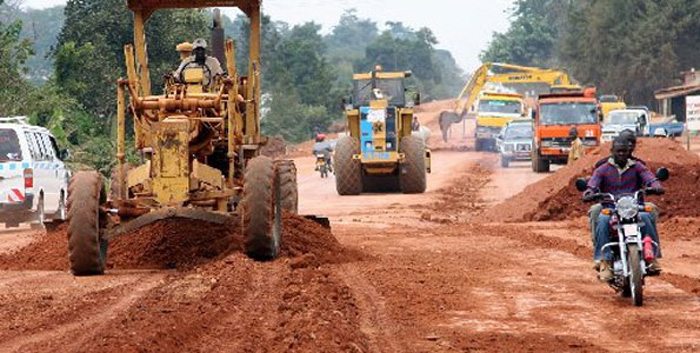
 An ongoing road construction/FILE
With stalled road projects and unpaid contractors threatening to cripple the country’s transport sector, the government is turning to a bold solution-securitisation.
Through this model, the Kenya Roads Board (KRB) is unlocking future fuel levy revenue to settle Sh175 billion in arrears, without burdening the national budge
The innovative funding model, he said, will reshape infrastructure funding while reducing additional pressure on taxpayers or the national budget.
Transport Cabinet Secretary Davis Chirchir thrown his weight behind the plan, terming it a significant step towards addressing the persistent backlog of pending bills in the sector.
“By monetising proceeds from the RMLF, the KRB aims to unlock billions in upfront funding,” he said.
This move, done through the creation of a Special Purpose Vehicle (SPV), has unlocked Sh175 billion upfront to settle verified contractor arrears and revive stalled road projects across the country.
Rather than taking on a traditional loan or waiting for funds to accumulate slowly over time, the institution bundles a portion of its expected cash flow and sells it to investors through a financial intermediary, typically called a Special Purpose Vehicle (SPV).
In simpler terms it is like borrowing against your salary for the next few years without borrowing a loan, but using that money to pay off urgent obligations or make new investments today, without increasing your debt load or changing your income.
KRB’s model: A first for Kenya’s infrastructure sector
KRB has become the first public infrastructure agency in Kenya to apply this model on a large scale.
Faced with over Sh175 billion pending bills to contractors and more than 580 road projects stalled across the country, KRB needed a financing solution.
This would clear the backlog, unlock stalled development as well as avoid putting more pressure on the exchequer or public debt. To do this, KRB securitised part of its income from the Road Maintenance Levy Fund (RMLF).
Specifically, it committed Sh7 out of every Sh25 per litre of fuel collected for the next ten years. This commitment was handed over to an SPV, which raised Sh175 billion upfront from private investors.
The investors will be repaid directly from the fuel levy, not from the government budget over a period of years. KRB bears no risk of revenue shortfalls; the SPV and investors assume that risk in exchange for a return on their investment.
What are the benefits of this approach?
No additional public debt
Unlike traditional loans, securitisation does not appear on the national balance sheet. It’s treated as a private commercial transaction.
This is important for Kenya, which has limited headroom for additional borrowing under current debt sustainability limits.
Immediate liquidity
KRB gets the entire Sh175 billion now, allowing it to pay contractors who have been waiting for years, resume road projects that were paused and stimulate jobs in the construction sector.
Efficient use of predictable revenue
The Road Maintenance Levy is collected consistently through fuel sales.
That predictability makes it ideal for securitisation, since investors can reasonably forecast future income streams.
No increase in fuel prices or new taxes
The existing fuel levy remains unchanged as this is not a new tax, but a smarter use of an existing one.
Risk is shifted to private sector
If fuel consumption drops or collection underperforms, investors, not the government, bear that risk.
What does this mean for Kenya’s wider public sector?
KRB’s securitisation could serve as a blueprint for other revenue-generating government agencies that face capital constraints but have steady, predictable income sources.
These include:
• Kenya Airports Authority (KAA) – through passenger service charges
• Kenya Ports Authority (KPA) – through cargo and docking fees
• Kenya Power or KenGen – through energy tariffs
• Water service boards – through bulk water sales
In each case, agencies could securitise part of their revenue streams to upgrade infrastructure, expand service delivery, clear pending bills and invest in new technologies.
As long as the revenue streams are predictable and the financial structures transparent, securitisation offers a way to break dependence on exchequer allocations or debt-heavy loans.
Challenges and considerations
While the benefits are clear, successful securitisation demands strict governance and transparency and clear legal frameworks to protect investors and the public.
It also demands careful project selection to ensure funds are used productively and capacity within agencies to manage complex financial transactions.
If done right, it can help unlock billions for development without distorting national finances.
However, if done poorly, it could create opacity or mismanagement risks.
The road ahead Kenya’s public sector is under pressure to do more with less.
With limited budget space and growing infrastructure demands, securitisation, if applied responsibly, offers a transformative pathway.
The KRB model proves that government institutions don’t always need more taxes or debt to solve funding problems.