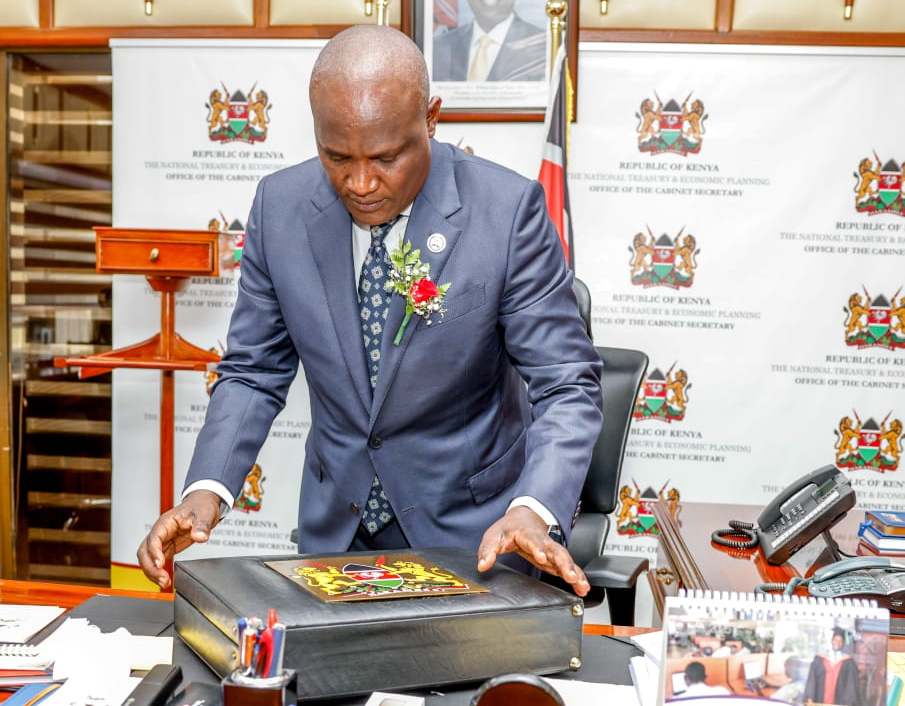
 Treasury Cabinet Secretary John Mbadi at his office before budget reading on June 12, 2025/COURTESY
The pronouncement of the 2025/26 budget statement on the national government's spending has now paved way for the next critical stage in the fiscal process.
Treasury Cabinet Secretary John Mbadi presented the Sh4.2 trillion budget Thursday, outlining tax measures while recommending the recurrent expenses expected to consume Sh1.79 trillion and Sh707.8 for development.
According to recommendations by the Budget and Appropriations Committee, Sh1.34 trillion has been earmarked for Consolidated Fund Services (CFS), out of which Sh1.1 trillion will be spent on interest payment on the country’s public debt.
Budget reading marks the climax of months of work of refining fiscal frameworks to adjusting revenue projections.
From barazas to one-on-one engagements, sector hearings to citizen forums, Mbadi admitted that last year’s public protests over the Finance Bill reflected a more engaged and alert citizenry. In response, he said, Treasury had take a more inclusive approach this year.
“We had to change how we do things. Kenyans demanded openness and transparency in the budget-making process.
This year, we have held public barazas and stakeholder meetings to explain the budget and the Finance Bill,” he said.
The formulation and preparation of the budget involves development and submission of key documents for approval by Cabinet and Parliament.
The process is guided by the budget calendar which stipulates timelines for a number of key activities to be undertaken in order to finalise the budget and submit it for approval by April 30, of each financial year.
The budget calendar is usually contained in the Treasury circular issued in accordance to Section 36 of the Public Finance Management Act, 2012.
It provides guidelines on the processes and procedures for preparing the subsequent Financial year and the Medium-Term Budget.
For Treasury to begin releasing the funds to individual ministries, government departments, and key other organs, a Finance Bill outlining revenue measures has to be approved by Parliament.
This is done by June 30, which is usually the end of the financial year.
The Treasury will then begin disbursing funds based on approved budgets and cash flow projections.
This marks the start of actual implementation of policies, projects, and programs outlined in the budget.
Budget making process
The budget-making process in Kenya is a systematic and organised procedure guided by the 2010 Constitution and the Public Finance Management Act of 2012.
This process involves multiple stakeholders such as the Executive, Parliament, and the public.
The budget preparation process is initiated by the National Treasury Cabinet Secretary.
This first stage commences on August 30. The CS issues a circular advising all government agencies on how to prepare the budget for the next financial year.
By September 30, the National Treasury submits the budget review and outlook paper (Brop) to the cabinet for approval. Brop shows the actual expenditure in the previous financial year and projections for the final year.
The Brop is then tabled in the parliament by October 21 and is to be made public not later than November 5.
The Treasury then takes the budget policy through public participation before seeking cabinet approval in January.
Public participation serves as a catalyst for transparency, accountability and good governance.
In January also, the Commissioner on Revenue allocations submits its recommendation for how much should be distributed to each level of government (National and County ).
These recommendations inform the division of revenue and county allocation of Bills tabled annually by parliament by February 15.
The Treasury CS then tables the budget policy statement and debt management strategy in parliament by February 15.
The national budget estimates will then be tabled by April 30 in the National Assembly.
The finance bill which set out the revenue-raising measures will also be tabled before parliament by April 30.
The National Assembly then starts a public hearing on the budget estimates in May.
After the public hearings, the Treasury CS then presents the budget statement in parliament highlighting the revenue-raising measures in the Finance Bill.
This is usually in mid-June.This year the budget is read on June 12.