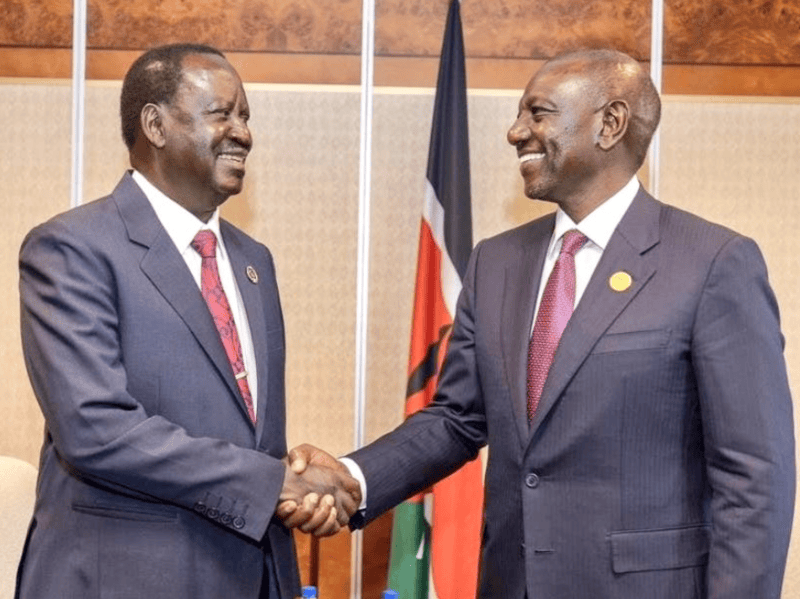
The political deal between President William Ruto and ODM leader Raila Odinga is under intense strain as a series of political blunders and a resurgence of extrajudicial killings threaten the truce.
The painstaking rapprochement, inked in March this year, is now teetering on the edge of collapse, with the recent death of social media influencer Albert Ojwang’ shifting focus to the political détente.
In the deal, Ruto and Raila agreed, among other things, to stop abductions, end corruption, compensate rights victims and stop the plunder of public resources.
The two political leaders also agreed to protect devolution, invest in young people, end opulence, audit the national debt, ensure inclusivity in budgetary allocations and fully implement the National Dialogue Committee report.
The agreement that promised to steer the country towards political stability and institutional reforms is now running into strong headwinds.
A section of ODM lawmakers have accused Ruto’s administration of missteps and breaching the MoU.
It is these missteps that the opposition camp now says are putting Raila in an awkward position for aligning with an unpopular regime.
There are growing concerns in the ODM camp that the opposition risks inheriting the baggage of Ruto’s Kenya Kwanza regime.
Raila, whose post-election engagement with Ruto helped calm months of unrest in 2023 and 2024, has remained publicly restrained in his criticism. But insiders say he is under growing pressure from his base to reconsider the deal.
A senior ODM party official told the Star that indeed the outfit is worried by the blatant violation of the Ruto-Raila understanding.
“The breaches are huge concerns to us, we have tried to raise the same on many occasions but there are quarters feeling we need to give the deal benefit of doubt,” the official who spoke to the Star off record said.
ODM deputy party leader and Vihiga Senator, Godfrey Osotsi was, however, blunt on the floor of the House on Tuesday.
“We signed an MoU with UDA and agreed that we are not going to have abductions and killings like this one,” Osotsi said.
“If we do not get proper answers from the UDA government, we will consider this as a breach of the MoU we have with UDA.”
However, governance expert Javas Bigambo argued that limiting the ten-point agenda to Raila and Ruto is to miss the point, as the issues will remain concerns even post the united government.
“The MoU between UDA, ODM was just a convenient bridge to enable the broad-based government,” Bigambo said.
Even more alarming are the fresh reports of extrajudicial killings and enforced disappearances, particularly targeting activists and suspected anti-government youths.
A recent glaring breach is the resurgence of abductions, torture and extrajudicial killings – candidly exposed by the manner Ojwang’ was picked up from Homa Bay and driven to his death in police custody in Nairobi, 350 kilometres away.
The resurgence of this long-standing scourge has sparked public outrage and drawn condemnation from both local and international observers.
Senators Oburu Oginga (Bondo) and Osotsi triggered debate on the deal, threatening a walkout over the breach of the ten-point deal.
Osotsi, in a rare attack at the broad-based arrangement, termed Ojwang’s case a breaking point in the political truce between the two parties.
“We are beginning to see the return of intolerance in this country. This cannot be allowed. It is unacceptable. We must stand firm against the return of the state-sponsored brutality.”
Homa Bay Town MP Opondo Kaluma, while avoiding to draw a link between the breaches and the political deal, cited the recent killing of Ojwang, arguing that it should be seen as a misstep by the police department.
“The Police constitution is very clear on how policing should be done, adhere to the constitution. Police officers are going overboard and the blame is taken to other offices,” Kaluma said.
Oburu wondered why the Deputy Inspector General Eliud Lagat was still in office despite being mentioned in the controversial death of Ojwang’.
“I have seen incidents where people are putting the President in a cell and they have never been arrested. Is this police officer bigger than the President? Why can't he be arrested and interrogated? If we don’t tackle this case to the end, Kenyans won't believe us,” Oburu noted.
The Ruto-Raila agreement on the anti-graft fight is also seen as another area poisoning the already fragile deal.
In recent months, Ruto and several allies have resumed large-scale 'harambees' – monies whose sources have been questioned by anti-government forces.
The generosity, running into millions in donations despite his last year’s directive outlawing the act, has been ongoing, ignoring murmurs even from the ODM side.
Machakos Deputy Governor Francis Mwangangi told the Star that in the absence of full disclosure of the sources of the donations, the monies are suspect.
“One question Kenyans must be told is where these huge donations are coming from. It is easy to conclude that they are proceeds from graft in the absence of a convincing explanation,” Mwangangi said.
In the heat of the Gen Z revolt, Ruto ordered that no state officer should be allowed to participate in fundraising activities.
“In this regard, it is notified that His Excellency the President directed that no state officer and public servant shall participate in public collections (harambee) henceforth,” head of Public Service Felix Koskei said in a memo dated July 7, 2024.
Instant Analysis:
The constant breach of the Ruto-Raila deal is now feared to put the working arrangement between the two leaders on the balance. Murmurs within the ODM party suggest that the opposition may end up carrying the baggage of Ruto's administration.